 Fairhaven Siding
 Every siding estimate we write for a home in Fairhaven ends up a little different, and homeowners often want to know why. Two houses of similar size on the same street can land tens of thousands of dollars apart once we account for what's underneath the old siding, how the house is shaped, and what material is going back on. This guide walks through the real cost drivers so you can read your own estimate with a clearer eye — and know which questions to ask before you sign a contract.
Why Fairhaven Costs Don't Match National Averages
National siding cost calculators are built around dry-climate assumptions and don't hold up well here. Fairhaven sits on Bellingham Bay, and that means salt air, driving rain off the water, and a long moss season that can run eight or nine months out of the year. Houses here need a siding system engineered for sustained moisture exposure, not just a material that looks good on a spec sheet. That requirement shapes almost every line item on a Whatcom County siding estimate, from the underlayment to the fasteners.
Older homes in the historic Fairhaven neighborhood and the surrounding hillside streets also tend to have quirks — original 1890s-era framing, additions built at different times, or trim details that a generic estimate simply doesn't price in. A contractor who hasn't worked this specific stretch of coastline will often underbid the moisture-management work and then hit you with change orders once the old siding comes off.
The Big Three Cost Drivers
1. Square Footage and House Shape
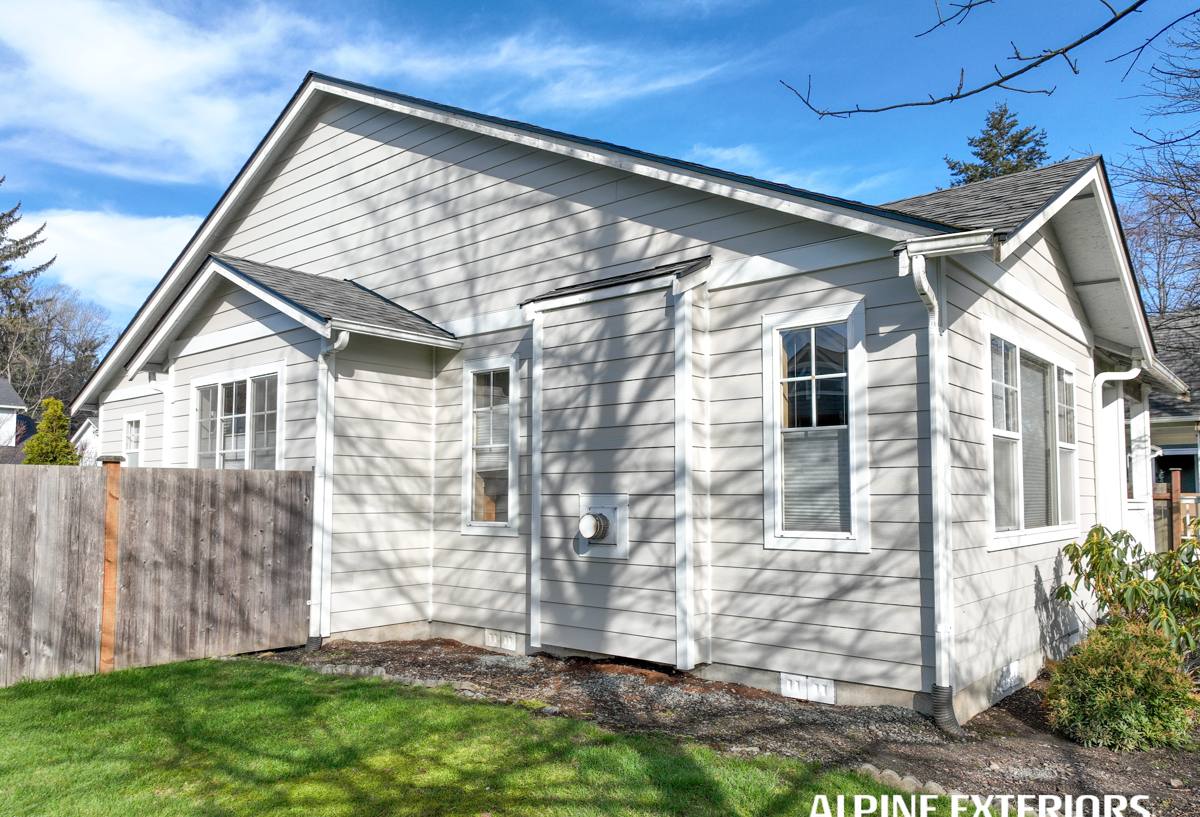
This is the obvious one, but shape matters more than raw square footage. A simple rectangular ranch is cheaper to side than a Craftsman with dormers, bump-outs, and a wraparound porch, even at the same total square footage. Every inside corner, outside corner, window trim run, and gable end adds labor hours that a flat per-square-foot number won't capture.
2. What's Underneath the Old Siding
You can't know this until the old siding is off, which is why a wide "not-to-exceed" range is normal on the first estimate. Common findings in this area include water-damaged sheathing near window and door openings, missing or failed house wrap, rot at the bottom plate, and inadequate flashing at roof-to-wall transitions. Each of these needs to be repaired before new siding goes up — skipping that step just seals moisture problems behind a fresh face.
3. Material Choice
This is where homeowners have the most control over the final number, and it's worth understanding the trade-offs rather than just chasing the lowest bid.
| Material | Typical Lifespan Here | Moisture Behavior in a Coastal Climate | Maintenance Burden |
|---|---|---|---|
| Vinyl | 15-25 years, shorter with UV and salt exposure | Can warp, crack, or blow off in wind-driven storms; doesn't manage trapped moisture well | Low, but limited repair options when panels fade or crack |
| Primed spruce / cedar | Highly variable; often 10-15 years before major repaint or repair | Absorbs moisture readily; prone to rot, cupping, and paint failure in a long moss season | High — repainting and caulk maintenance every few years |
| LP SmartSide (engineered wood) | 20-30 years with diligent upkeep | Better than raw wood, but still an engineered wood product — edge sealing and caulking have to be kept up or moisture gets in | Moderate — inspection and caulk touch-ups matter more here than in drier climates |
| James Hardie fiber cement | 30-50+ years, factory finish included | Non-combustible, dimensionally stable, engineered HZ product lines built for wet regional climates | Low — factory ColorPlus finish holds color without a repaint cycle |
We install James Hardie exclusively, and that's a deliberate decision, not a default. We've seen too many jobs in this area where a homeowner chose a cheaper material, saved money up front, and then paid for repainting, caulk repair, or panel replacement within a decade — sometimes sooner, depending on sun and rain exposure. Hardie's HZ5 product line is specifically engineered for climates like ours, and the factory-applied ColorPlus finish is backed by a longer, stronger warranty than field-applied paint can offer. We'll walk through why we don't install vinyl, LP SmartSide, or cedar on our other pages — here, the short version is that fiber cement's stability and moisture resistance make it the material that actually performs over the decades homeowners expect from a siding investment.
Labor and Crew Costs
Labor is typically the largest single line item on a siding job, often more than the material itself. It covers tear-off and disposal of the old siding, repair of any damaged sheathing found underneath, installation of a compliant weather-resistant barrier, precise cutting and fastening of the new siding to manufacturer specification, and finish work around windows, doors, and trim. Fiber cement in particular is unforgiving of shortcuts — improper fastener spacing, wrong nail type, or insufficient clearance at grade can void the manufacturer's warranty and lead to early failure. That's a big part of why installer experience with the specific product matters as much as the product itself.
Site and Access Factors
A few things specific to Fairhaven and the surrounding hillside affect labor time and, therefore, price:
- Steep lots and terraced yards common on the hill above Fairhaven Historic District can slow scaffolding and material staging
- Multi-story homes require more scaffolding or lift rental than single-story ranches
- Mature landscaping and tree cover, common throughout Whatcom County, may need temporary protection or trimming for crew access
- Older homes may have lead paint on the original siding, which requires EPA RRP-compliant containment and disposal procedures
- Proximity to the water can mean tighter weather windows for tear-off days, since exposed sheathing shouldn't sit uncovered during a rain system
What a Typical Estimate Breaks Down Into
Rather than one lump number, a well-built estimate should separate these components so you can see where your money goes:
- Tear-off and disposal of existing siding
- Sheathing repair allowance (an estimated range, finalized once old siding is off)
- Weather-resistant barrier and flashing at all penetrations and transitions
- Material cost for the siding itself, plus trim, corner boards, and accessories
- Installation labor, priced to manufacturer fastening and clearance specifications
- Paint or finish (unnecessary with factory-finished ColorPlus, a real cost difference over field-painted materials)
- Cleanup and disposal
If an estimate you're comparing skips the sheathing repair allowance entirely, ask why. It usually means either the contractor is assuming no damage will be found — a risky assumption on an older coastal home — or the cost will show up later as a surprise change order.
Questions to Ask Before You Sign
A little vetting up front saves a lot of frustration later. Before hiring anyone for a siding project in this area, ask:
- Are you licensed and insured in Washington, and can you provide proof?
- What's your experience specifically with fiber cement installation to manufacturer spec?
- How do you handle unexpected sheathing damage once old siding is removed — is there a documented change order process?
- What warranty applies to labor versus material, and who do I call if something fails five years from now?
- How do you protect the house and landscaping during tear-off, especially if rain moves in mid-project?
- Can you provide references from other jobs in this specific climate, not just general references?
Why Cutting Corners Costs More Here
In a drier inland climate, a lower-grade siding job might coast along for years before problems show up. On the Bellingham Bay waterfront, moisture finds weaknesses fast. Gaps in house wrap, under-caulked seams, or a material that wasn't built for sustained wet exposure tend to show their limits within a handful of wet seasons, not decades. That's the practical reason we standardized on one material system rather than offering a menu of options at different price points — we'd rather tell a homeowner honestly what a budget-tier install will cost them in five years than sell something we don't believe will hold up on this coastline.
Financing and Timing Considerations
Siding replacement is a major expense, and most homeowners don't pay cash outright. Many contractors offer financing partnerships, and it's worth asking about terms and whether there's a cost difference for financed versus cash jobs. Timing also affects price indirectly: scheduling work outside the peak summer season can sometimes mean more flexible scheduling and less competition for crew time, though Fairhaven's wet season does narrow the practical installation window compared to drier parts of the state.
Getting an Accurate Number for Your Home
The only way to get a real number — not a ballpark from a square-footage calculator — is a walk-through that accounts for your home's shape, current siding condition, and access. If you'd like a straightforward, no-pressure estimate for your Fairhaven home, use the form below and we'll take a look and walk you through exactly what drives your number.