 Fairhaven Siding
 Why This Page Exists
Cedar siding shows up on a lot of Fairhaven homes, and it's easy to see the appeal. It's a real wood product with a warm, natural look that fits the Pacific Northwest aesthetic, and it has a long history in this region. We get asked about it regularly, and we think homeowners deserve a straight answer instead of a sales pitch. This page is that answer: what cedar does well, what it actually costs to keep looking good on a home a few blocks from Bellingham Bay, and why we made the decision not to install it.
We're not here to tell you cedar is a bad product. In the right application, with an owner committed to a maintenance schedule, it can perform for decades. Our position is narrower: given the climate Fairhaven and the rest of Whatcom County actually deliver, and given what we've seen happen to cedar siding that doesn't get maintained on schedule, we don't think it's the right standard to put our name behind. Here's the reasoning.
What Cedar Siding Gets Right
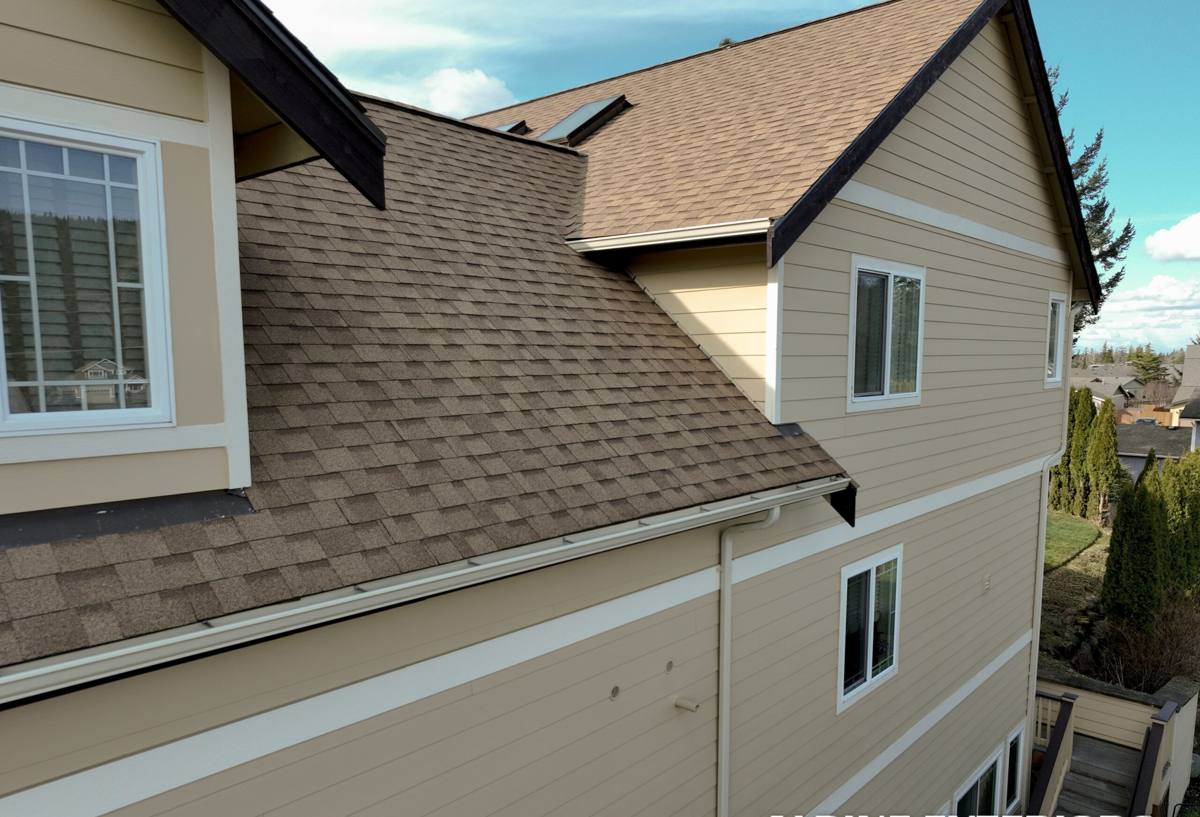
Credit where it's due. Cedar has natural oils that give it some inherent resistance to decay and insects, which is more than you can say for most softwoods. It takes stain and paint well, it's lightweight and easy to work with, and a freshly finished cedar exterior is genuinely beautiful. It's also a renewable material, and many homeowners like the idea of a wood exterior for that reason alone.
Cedar can also be repaired board by board in a way that some manufactured products can't, and there's a segment of homeowners — particularly on architecturally distinct or historic homes — who want the specific look that only real wood provides. We're not arguing against any of that. We're arguing about what it takes to keep it looking that way here, specifically.
The Climate Problem: Salt Air, Driving Rain, and Moss
Salt Air
Fairhaven sits right on Bellingham Bay, and homes close to the water take on salt-laden air more or less constantly. Salt is hygroscopic — it pulls moisture out of the air and holds it against whatever surface it lands on. On a painted or stained wood surface, that means the finish is fighting a low-grade moisture battle nonstop, not just during storms. Finishes break down faster near the water than they do a few miles inland, and cedar sided homes in Fairhaven proper typically need refinishing attention sooner than the same siding would need in, say, Ferndale.
Driving Rain
Whatcom County doesn't just get a lot of rain — a good share of it comes in sideways off Georgia Strait weather systems, driven by wind. Wood siding depends entirely on its finish to shed water; once that finish is compromised anywhere — a hairline crack, a nail pop, a scuffed corner — driving rain will find it and push moisture behind the board. Wood that's wetted repeatedly without adequate drying time between storms is exactly what sets up rot, and our wet season here runs long.
Moss Season
Whatcom County's moss season isn't a few weeks — it's most of the fall through spring. Moss and algae need shade, moisture, and organic material to establish, and cedar checks all three boxes, especially on north-facing walls and anywhere trees keep siding from drying out fully between rains. Once moss gets a foothold, it holds moisture directly against the wood surface around the clock, which accelerates finish failure and, eventually, decay underneath.
What the Maintenance Schedule Actually Looks Like
This is the part that doesn't always get spelled out up front. Cedar siding is not a "finish it once and forget it" product anywhere in Western Washington, and it's less so on a coastal lot in Fairhaven. A realistic maintenance rhythm looks like this:
- Annual visual inspection of the full exterior, checking for cracked or peeling finish, nail pops, and moss or algae growth, especially on shaded and north-facing walls
- Washing (soft wash, not high pressure) to remove moss, mildew, and salt residue before it embeds in the finish
- Re-staining or repainting on a cycle that's typically shorter near the water than manufacturers' general guidance suggests — many owners find they're touching up sooner than the "5-7 years" often quoted for inland applications
- Caulking and sealing checks at butt joints, corners, and trim intersections, since these are the first places driving rain gets behind the board
- Prompt replacement of any board showing soft spots, checking, or insect damage before the problem spreads to neighboring boards
- Keeping vegetation and irrigation spray back from the siding to reduce the constant moisture load that feeds moss
None of that is exotic work, but it's real, recurring cost and recurring attention — and it only pays off if it actually happens on schedule, year after year. That's where we see the gap between how cedar is marketed and how it performs in practice.
What Happens When Maintenance Slips
Life gets in the way. Owners move, priorities shift, a year gets skipped, then two. We understand why maintenance schedules slip — it's not a character flaw, it's just what happens with a product that demands ongoing attention on a fixed clock. The trouble is that cedar doesn't fail gracefully when that clock gets ignored. A finish that's overdue for renewal stops shedding water, moss keeps a section damp for months at a stretch, and the wood underneath starts to soften in ways that aren't visible from the ground. By the time damage is obvious — dark staining, soft boards, a musty smell near an exterior wall — the fix is usually board replacement, not just a fresh coat of stain.
We've been called out to Fairhaven homes where cedar siding looked fine from the street but had significant hidden rot at butt joints and lower courses, exactly where driving rain and splash-back moisture concentrate. That's not a defect in the wood — it's what happens to any organic material when a maintenance-dependent finish system falls behind in a wet, salt-exposed climate.
Cost Over Time: Cedar vs. Fiber Cement
| Factor | Cedar Siding | James Hardie Fiber Cement |
|---|---|---|
| Finish renewal | Stain/paint typically every 3-7 years, often sooner near the water | ColorPlus factory finish backed by its own warranty; field painting not required for decades |
| Moss/algae exposure | Organic material feeds growth; requires active washing and monitoring | Inorganic material doesn't feed moss growth the way wood does |
| Moisture behavior | Absorbs and releases moisture; prone to swelling, cupping, checking | Engineered for Pacific Northwest moisture cycling (HZ5 product line) |
| Fire exposure | Combustible | Non-combustible core material |
| Insect/rot risk | Natural oils help but don't eliminate risk over decades | Not a food or moisture source for wood-destroying insects |
| Warranty structure | Varies by finish product; wood itself typically unwarrantied | Manufacturer-backed limited warranty on both product and finish, transferable |
The sticker price on raw cedar material can look competitive, sometimes even lower than fiber cement, depending on the grade. What changes the picture is the 20-30 year cost of ownership: refinishing labor, board replacement, and the risk of moisture damage that isn't caught until it's already expensive to fix.
Where Cedar Still Makes Sense
We're not going to pretend there's no legitimate case for wood. Cedar can be the right call for accent applications — gable ends, entry features, small architectural details — where the exposure is limited and the maintenance burden is proportionate to the area involved. It's also a reasonable choice for owners who genuinely want to do the upkeep and value the material for what it is. Our decision not to install it as a full-house siding system is about matching our installation standard to what we can stand behind on a whole building envelope, not a blanket judgment on wood as a material.
Why We Standardized on James Hardie
After years of doing exterior work in this climate, we made a deliberate call: full-house siding installations use James Hardie fiber cement, and that's it. It's engineered specifically for Pacific Northwest moisture cycling through the HZ5 product line, it's non-combustible, and the ColorPlus factory finish means the color coat is baked on and warranted by the manufacturer rather than dependent on a field-applied stain holding up against salt air and driving rain. It also carries a strong transferable warranty, which matters to buyers if you ever sell the home.
None of that makes Hardie maintenance-free — it still needs periodic washing and caulk checks like any siding system — but it removes the finish-renewal treadmill that cedar puts an owner on, and it doesn't give moss the organic material it needs to take hold the way wood does. For a coastal Fairhaven property dealing with salt air, sideways rain, and a long moss season, that's the trade-off we're comfortable standing behind.
If you're weighing cedar against fiber cement for your home, or you're dealing with cedar siding that's already showing its age, we're happy to take a look and talk through what we're actually seeing — no pressure, no obligation. A free estimate is a good way to get a straight answer about your specific siding before you commit to a repaint, a repair, or a full replacement.