 Fairhaven Siding
 Columbia's Spot Between the Bay and the Trees
The Columbia neighborhood sits close enough to Bellingham Bay to catch salt-laden air off the water, while many of its lots still carry mature Douglas fir, cedar, and bigleaf maple cover left over from the area's timber history. That combination is exactly what makes exterior materials work harder here than in a typical inland Washington neighborhood. Homes get a steady mix of marine moisture and deep shade, sometimes on the same wall, depending on which direction it faces and how close the tree line sits. We've worked on enough homes throughout Fairhaven and the surrounding Whatcom County area to know that a siding choice that performs fine in Spokane or Yakima can struggle here within a decade.
None of this is exotic weather. It's simply persistent. Whatcom County doesn't get the dramatic freeze-thaw cycles of the Cascades or the hard summer heat of Eastern Washington — what it gets instead is months of damp, mild conditions that never really let a wall dry out completely. That slow, grinding exposure is the real test for any siding product, and it's the reason we standardized on one material rather than offering a menu of options that don't all hold up the same way.
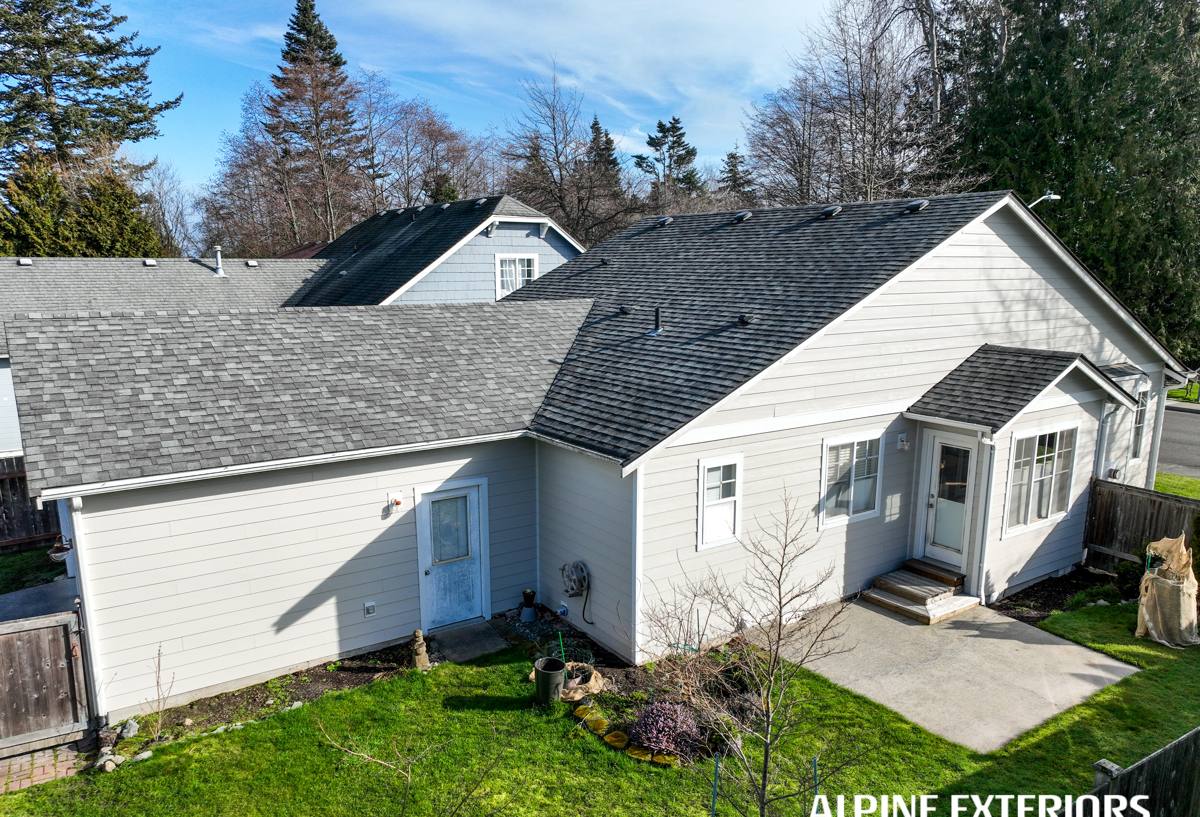
What Salt Air Actually Does to a Home's Exterior
Proximity to Bellingham Bay means airborne salt finds its way onto siding, trim, fasteners, and flashing, especially on west- and south-facing elevations that catch prevailing wind off the water. Salt is corrosive to unprotected metal fasteners and hardware, and it accelerates the breakdown of coatings that aren't formulated to resist it. On painted wood siding, this often shows up as chalking, early peeling, and soft spots where paint has failed and moisture has gotten underneath.
Why Factory Finish Matters Here
A factory-applied finish, baked on and cured under controlled conditions, holds up to salt exposure far better than a field-applied paint job, which is one of the reasons ColorPlus finishes on James Hardie products are worth paying attention to in a coastal-influenced neighborhood like Columbia. It's not a marketing detail — it's a direct answer to the specific problem the location creates.
Driving Rain and Moisture Management
Whatcom County doesn't just get rain — it gets rain pushed sideways by wind coming off the Strait of Georgia and the bay, which drives water into laps, seams, and penetrations that a calmer climate would never test. Siding systems need correct lap spacing, proper flashing at windows and doors, and a drainage plane behind the cladding that lets any water that does get past the surface find its way back out rather than sitting against the wall sheathing.
Where Problems Usually Start
In our experience, most siding failures in this kind of climate don't start with the siding material itself — they start at the details: a window head flashing installed backward, a butt joint left uncaulked, a J-channel packed too tight to drain. That's an installation issue as much as a product issue, which is why we treat correct installation as inseparable from product quality.
The Long Moss Season
Shaded lots with tree cover hold moisture longer after a rain, and that extended dampness is what moss, algae, and mildew need to take hold on a north-facing wall or anywhere sun doesn't reach for much of the day. Whatcom County's moss season effectively runs from fall through spring — several months where a wall can stay damp for days at a time. Wood-based siding products are the most vulnerable here because moss and mildew feed on organic material and hold moisture against the surface, which is exactly the condition that leads to rot underneath.
Fiber cement doesn't give moss the organic material it needs to establish itself the way wood or wood-composite products do, which is a real advantage on the shadier lots common throughout Columbia and the rest of Fairhaven.
Why We Install Only James Hardie Fiber Cement
We made a deliberate decision to install one siding system — James Hardie fiber cement — rather than offer vinyl, LP SmartSide, Cemplank, Allura, primed spruce, or cedar as parallel options. That's not because those products have no merit; it's because, given what we've seen this climate do to exterior walls over time, we don't think they hold up as well here as fiber cement does, and we don't want to sell a homeowner something we wouldn't be comfortable standing behind ten or fifteen years out.
Vinyl
Vinyl is affordable and low-maintenance in the sense that it doesn't need painting, but it can warp or become brittle with temperature swings, and it doesn't offer the same impact resistance or dimensional stability as fiber cement. In a marine environment, seams and panel edges are also a common entry point for wind-driven moisture.
Wood Products (Cedar, Primed Spruce)
Real wood siding has genuine curb appeal, but it requires ongoing maintenance — repainting, caulking, and monitoring for rot — that only gets more demanding in a climate with a long moss season and driving rain. Left unmaintained even briefly, wood siding in a shaded, damp lot can develop rot faster than in most other parts of the state.
Other Fiber Cement Brands (Cemplank, Allura)
These are legitimate fiber cement competitors to Hardie, and the base material category performs reasonably well in wet climates. Our decision to standardize on Hardie specifically comes down to the strength of its ColorPlus factory finish program, its climate-engineered HZ product lines (built with regional moisture and temperature profiles in mind), and the depth of its transferable warranty — factors that matter more the longer a homeowner plans to own the house.
How James Hardie Fiber Cement Performs Here
| Factor | James Hardie Fiber Cement | Vinyl | Cedar / Primed Wood |
|---|---|---|---|
| Salt air resistance | Strong with ColorPlus factory finish | Moderate; seams vulnerable to wind-driven salt spray | Weak; finish breaks down faster near the bay |
| Moisture/moss resistance | Non-organic surface, doesn't feed growth | Resists moisture but can trap it behind panels | Organic material; prone to moss and rot in shade |
| Maintenance | Occasional wash; repaint only if requested | Low, but panels can crack or fade over time | Regular repainting and caulk inspection |
| Fire resistance | Non-combustible | Combustible | Combustible |
| Typical warranty | Long-term, transferable | Varies by manufacturer | Limited to finish, not material |
How We Approach a Siding Project in Columbia and Fairhaven
Every project starts with a walk-around that looks specifically at the conditions this neighborhood creates: which elevations face the bay and take the worst of the wind-driven rain, which walls sit in tree shade long enough to stay damp, and where existing siding, trim, or flashing already shows early signs of moisture damage. That assessment shapes the flashing and drainage plan before a single board goes up.
Installation Details We Don't Skip
- Correct panel and lap spacing per manufacturer specification, not shortcuts to save time
- Properly lapped house wrap and flashing at every window, door, and penetration
- Corrosion-resistant fasteners appropriate for coastal exposure
- Caulking only where specified — over-caulking can trap moisture instead of shedding it
- Field-cut edges primed or sealed to protect against moisture intrusion
We also factor in local permitting and inspection requirements that apply within Whatcom County and the City of Bellingham, so the project doesn't stall on paperwork after the crew is already scheduled.
Beyond Siding: Roofing, Windows, and Decks
Siding doesn't work in isolation. A roof that's shedding water improperly, windows with failing flashing, or a deck ledger board that's trapping moisture against the house all undermine even a well-installed siding job. We handle roofing, window replacement, and deck construction alongside siding specifically so these systems get coordinated rather than treated as separate projects with separate assumptions about how water moves around the house.
Why That Coordination Matters in This Climate
In a driving-rain, long-moss-season environment, the places where two systems meet — roof to wall, window to siding, deck to house — are where most real-world moisture problems start. Having one crew responsible for the whole envelope means those transitions get planned together instead of guessed at after the fact.
What to Ask Before Hiring a Siding Contractor
- Are they licensed and insured to work in Washington State, and can they provide proof?
- Do they install to the manufacturer's written specifications, including fastener type and flashing details?
- Will they explain their moisture management plan for your specific lot, not just a generic answer?
- Do they offer a warranty that covers both material and workmanship, and is it transferable?
- Have they worked on homes in similar conditions — shaded lots, bay-facing exposure — nearby?
What Affects the Cost of a Project Like This
Cost on any siding project is driven by square footage, the amount of trim and detail work involved, how much existing material needs removal, and whether repairs to sheathing or framing turn up once old siding comes off. Homes with more window and door openings require more flashing and detail labor per square foot than a simpler wall plane. We give homeowners a real, project-specific number after a site visit rather than a rough estimate over the phone, because guessing on a coastal, tree-shaded lot like the ones common in Columbia tends to be wrong in one direction or the other.
If you're weighing options for your home in Columbia or elsewhere in Fairhaven, we're happy to walk the property, look at what your specific exposure and shade conditions are doing to your current siding, and put together a free, no-pressure estimate.