 Fairhaven Siding
 Siding Built for Sunnyland's Corner of Whatcom County
Sunnyland sits close enough to Bellingham Bay that the marine layer is a daily fact of life, not an occasional visitor. Homes here deal with a specific combination of stressors: salt-laced air drifting off the water, long stretches of driving rain that comes in sideways more often than straight down, and a moss season that can run from October through May in a wet year. None of that is unique to one street or one block in the neighborhood — it's the baseline for exterior materials anywhere in this part of Fairhaven. We've built our siding, roofing, window, and deck work around that baseline rather than around a national average climate that doesn't apply here.
When we talk about a "local crew," we mean something practical: people who install siding on Whatcom County homes week after week, who know how a north-facing wall in Sunnyland holds moisture longer than a south-facing one three blocks away, and who don't need a climate lesson before they can give you a straight answer about what your house needs.
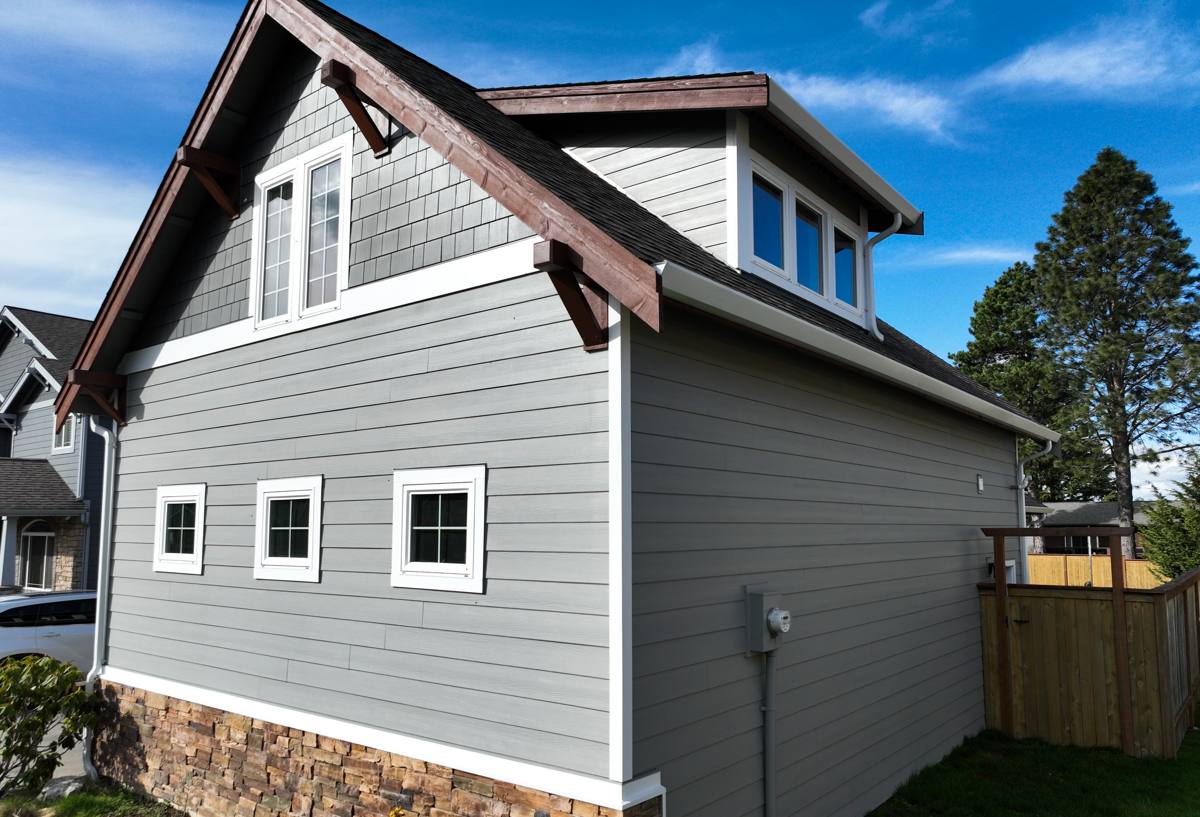
What Salt Air and Driving Rain Actually Do to Siding
Salt Air
Proximity to Bellingham Bay means airborne salt is a constant, low-level exposure. It's not the heavy salt spray you'd get on an oceanfront bluff, but it's persistent, and persistent exposure adds up over the 20-30 year window a siding product is supposed to last. Salt accelerates corrosion of exposed metal fasteners and trim, and it interacts with certain paint chemistries in ways that shorten repaint cycles. Materials and finishes that aren't engineered with coastal exposure in mind tend to show it first at fastener heads, seams, and any spot where the factory finish has been compromised during installation.
Driving Rain
Fairhaven's weather doesn't just deliver a lot of rain — it delivers a lot of wind-driven rain, which behaves differently than a straight vertical downpour. Wind-driven rain gets pushed up under laps, into seams, and around penetrations that would stay dry in a calmer climate. This is why lap spacing, flashing details, and caulking practices matter more here than they would in a drier, calmer region. A siding installation that's technically "to code" in a low-wind, low-rain market can still underperform in Sunnyland if those details aren't tightened up for local conditions.
Moss Season
A long, cool, wet season is exactly what moss and algae need to establish themselves on north- and shade-facing exterior surfaces. Beyond the cosmetic issue, moss holds moisture directly against the siding surface for extended periods, which is the kind of sustained dampness that wood-based and wood-derived products are most vulnerable to. It affects roofing too — moss growth on a roof surface is one of the more common maintenance issues we see on Fairhaven homes, siding and roof exposure often failing on the same timeline for the same reason.
Why We Install Only James Hardie Fiber Cement
We made a decision early on to install one siding system — James Hardie fiber cement — and to stop installing several others, including vinyl, LP SmartSide, and other fiber cement or engineered wood products. That wasn't a marketing choice. It came out of watching how different materials actually perform over years of exposure to exactly the conditions Sunnyland deals with.
- Non-combustible core: Fiber cement doesn't burn, which matters more each year as wildfire smoke and regional fire risk become a bigger part of Pacific Northwest summers.
- Moisture-stable material: Fiber cement doesn't swell, rot, or delaminate the way wood-based products can when they take on repeated moisture exposure — a direct answer to the driving-rain and moss-season problem.
- Factory-applied ColorPlus finish: The finish is baked on under controlled conditions before the boards ever reach the jobsite, which gives more consistent, longer-lasting color performance than field-applied paint, especially in a climate where repainting is disruptive to schedule around the rain.
- Climate-engineered HZ product lines: Hardie makes region-specific formulations for different climate zones, including versions engineered for the wetter conditions found along the Pacific Northwest coast.
- Transferable warranty: A strong, transferable warranty backs the product, which also supports resale value — a real consideration for a coastal-adjacent neighborhood where buyers increasingly ask about exterior material and maintenance history.
To be fair to the alternatives: vinyl is inexpensive and low-maintenance in mild climates, and engineered wood products can look good and install quickly. Where they fall short in our experience is specifically in the conditions Sunnyland has in abundance — sustained moisture, salt exposure, and long shoulder seasons where surfaces don't fully dry out between rain events. We'd rather install one product we trust completely in this climate than offer a menu of options with different risk profiles.
How a Siding Job Runs in Sunnyland
Assessment
We start by looking at the whole exterior envelope, not just the siding surface. That means checking for existing moisture damage, evaluating flashing and trim conditions, and looking at how the home is oriented relative to prevailing wind and rain direction. A wall that's taken 20 years of wind-driven rain needs a different look than a more sheltered elevation on the same house.
Prep and Moisture Barrier
Given how much of the region's siding failure traces back to water getting behind the cladding rather than through it, the water-resistive barrier and flashing details get real attention — not just a pass-through step on the way to hanging boards.
Installation
Fiber cement installation is less forgiving of shortcuts than some materials — proper fastening, lap spacing, and caulking are what determine whether the product performs to its rated lifespan. This is the stage where installer experience with fiber cement specifically, not general carpentry experience, makes the difference.
Finish and Trim
Trim details, especially around windows and roof lines, are where wind-driven rain finds its way in if they're not done correctly. We treat these as functional details first, cosmetic details second.
Siding, Roofing, Windows, and Decks Together
Most exterior problems in this climate don't respect the boundary between trades. A roof that's shedding moss onto a north wall, gutters that overflow onto siding below them, a window that's not flashed correctly and is feeding moisture into the wall cavity — these show up as siding problems even though the root cause is somewhere else. Because we handle siding, roofing, windows, and decks, we can look at a Sunnyland home as one system instead of diagnosing a siding issue in isolation from a roofing or window issue that's actually driving it.
Comparing Siding Options for This Climate
| Factor | James Hardie Fiber Cement | Vinyl | Engineered Wood (e.g. LP SmartSide) |
|---|---|---|---|
| Moisture resistance in driving rain | High — non-organic core, engineered HZ lines | Moderate — seams and panel joints can allow water intrusion | Moderate — engineered to resist moisture but wood-based |
| Performance in salt air | High — stable material, factory finish holds up | Can become brittle over time with UV and temperature swings | Coating performance varies with exposure |
| Combustibility | Non-combustible | Combustible (melts/burns) | Combustible |
| Repaint interval | Long — factory ColorPlus finish | Does not need repainting but can fade/chalk | Field-applied finishes typically need earlier attention |
| Typical lifespan (installed to spec) | 30+ years | 20-30 years, variable | 20-30 years, moisture-dependent |
Cost Factors Homeowners Should Know
Every Sunnyland home is different, so we won't quote a number without seeing the house, but the factors that move a siding estimate up or down are consistent:
- Square footage and home complexity: More corners, gables, and roof lines mean more cutting and trim work.
- Condition underneath the existing siding: Hidden moisture damage or rot found during tear-off adds scope that's impossible to price sight-unseen.
- Trim and detail level: Board-and-batten accents, varied reveal widths, and custom trim profiles all add labor time.
- Access and site conditions: Tight lots, mature landscaping, or multi-story sections affect staging and safety requirements.
- Product line and color: Hardie's various HZ and ColorPlus options carry different price points.
Signs a Sunnyland Home May Need Siding Attention
- Visible moss or algae growth on siding surfaces, especially on shaded or north-facing walls
- Bubbling, peeling, or chalking paint that keeps returning after repainting
- Soft spots or visible warping, especially near the ground line or under windows
- Staining or streaking that suggests water is tracking behind the siding rather than off of it
- Gaps opening up at seams, corners, or trim boards
- A noticeable jump in heating bills, which can point to a compromised exterior envelope
Why a Local Crew Matters Here
A crew that only occasionally works this close to the water can miss things that are obvious to people who do it constantly — how far salt exposure actually reaches inland from the bay, which elevations catch the worst of the wind-driven rain, how aggressively moss needs to be addressed before it becomes a moisture problem instead of just a cosmetic one. That local pattern-recognition is part of what a Fairhaven-based crew brings to a Sunnyland project that an out-of-area contractor generally doesn't.
If you're weighing a siding, roofing, window, or deck project on a Sunnyland home, we're happy to take a look and walk you through what we're seeing — no pressure, no obligation. Reach out for a free estimate using the form below.