 Fairhaven Siding
 South Hill and the Weather It Actually Deals With
South Hill sits above Bellingham Bay in the Fairhaven area of Whatcom County, and that elevation and bay exposure come with a real trade-off. The views are worth it, but the same wind that clears the air off the water also drives rain sideways into siding, soffits, and trim for months at a time. Add the salt content in that air and the deep shade many South Hill lots get from mature evergreens, and you've got a exterior climate that's harder on building materials than most homeowners realize until something starts failing.
We've worked on enough homes in this pocket of Whatcom County to know the pattern: it's rarely one big storm that causes damage. It's the slow, repeated cycle of wet-dry-wet, the salt film that never fully rinses off in a low-rain summer, and the moss and algae that get a running start every fall and don't let go until late spring. Siding, roofing, and trim that aren't built for that cycle show it early — usually in year five to ten, not year twenty.
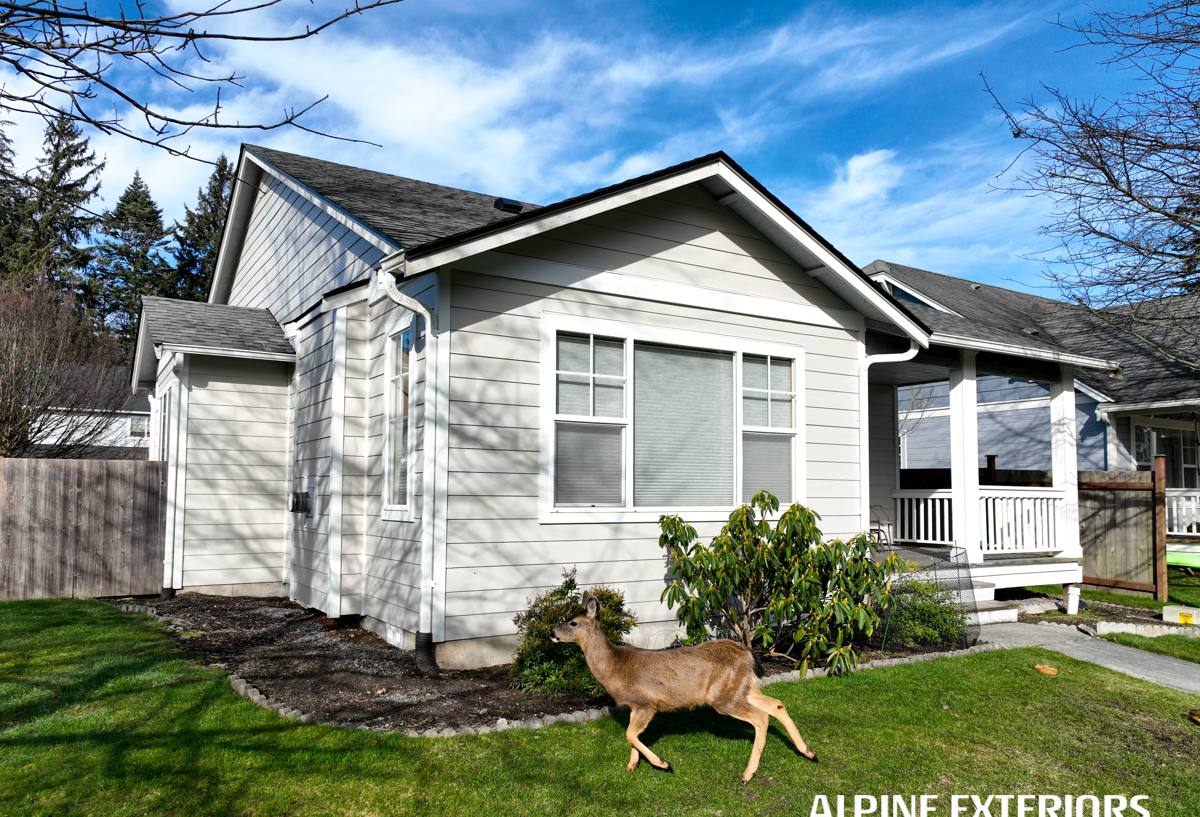
Why We Only Install James Hardie Fiber Cement Here
We're a James Hardie-exclusive contractor. We don't install vinyl, LP SmartSide, Cemplank, Allura, or bare cedar and primed spruce siding, and that's a deliberate call based on what actually holds up in this climate — not a sales pitch.
Moisture Behavior Is the Whole Game
Fiber cement doesn't swell, rot, or delaminate the way wood-based and engineered wood products can when they take on repeated moisture. In a marine climate with a long wet season, that matters more than almost any other spec on the product sheet. Hardie board is engineered specifically for wet Pacific Northwest conditions — it's literally formulated in climate-specific "HZ" versions for regions like ours.
ColorPlus Finish vs. Field-Applied Paint
Hardie's ColorPlus finish is baked on at the factory under controlled conditions, which gives it better adhesion and UV stability than paint applied on-site after installation. In a region where driving rain and salt air chew through cheaper finishes fast, that factory-cured finish is a big part of why Hardie siding still looks sharp a decade or more after installation, with touch-up rather than full repaint being the norm.
Non-Combustible
Fiber cement doesn't burn. That's a secondary benefit for most South Hill homeowners compared to the moisture story, but it's a real one, and it's part of why we don't hedge on the product we install.
What South Hill Homes Are Up Against, Material by Material
| Material | How It Handles Salt Air & Driving Rain | How It Handles Moss Season |
|---|---|---|
| Vinyl siding | Can warp, fade, and become brittle with UV and temperature cycling; seams are a moisture entry point | Moss and algae grow on the surface film; hard to clean without damaging the panel |
| LP SmartSide / engineered wood | Vulnerable at cut edges and seams if moisture gets behind the coating | Prone to surface growth if trapped moisture isn't allowed to dry out |
| Cedar / primed spruce | Absorbs moisture directly; needs ongoing sealing and maintenance to resist rot | Organic material is the most hospitable surface for moss and algae |
| James Hardie fiber cement | Cement-based core doesn't absorb and swell; factory finish resists salt and UV wear | Dense, inorganic surface is far less hospitable to growth; cleans without damaging the substrate |
Full Exterior Work for South Hill, Not Just Siding
Siding is our specialty, but a home's exterior is one connected system, and we handle the rest of it too: roofing, windows, and decks. Trying to fix one component while ignoring the others is how you end up doing the same repair twice.
Roofing
Moss on a roof isn't cosmetic — it holds moisture against shingles and shortens their life, and it's directly connected to the same shaded, damp conditions that stress siding. We look at roof condition as part of any siding conversation, because water that gets past a compromised roofline often shows up as siding or trim damage lower down the wall.
Windows
Window flashing and trim are one of the most common places we find hidden water intrusion on older South Hill homes. When we replace siding around existing windows, we check flashing details as a matter of course — a beautiful new siding job installed over bad window flashing just hides a problem instead of solving it.
Decks
Decks on hillside and view lots take a similar beating from rain and shade-driven moisture as siding does, just at a horizontal angle where water sits longer. We build and repair decks with the same eye toward drainage and material selection that we bring to the rest of the exterior.
What a South Hill Siding Project Actually Looks Like
- Walkthrough and assessment — we look at the whole exterior, not just the siding: roofline, window flashing, trim, and any existing moisture or moss damage.
- Sheathing and moisture check — once old siding comes off, we inspect what's underneath. This is often where hidden rot or past water intrusion shows up, and it needs to be addressed before new siding goes on, not covered up.
- Weather barrier and flashing detail — proper house wrap, window and door flashing, and rainscreen detailing where called for are what actually keep driving rain out, more than the siding material itself.
- Hardie installation to spec — correct fastener spacing, clearances, and joint treatment matter as much as the product. Manufacturer-spec installation is what the warranty is actually contingent on.
- Final walkthrough — we go over the finished work with the homeowner before calling the job done.
Cost Factors Worth Understanding Before You Get Quotes
Every South Hill home is different, and we don't publish blanket prices because the honest answer is "it depends" — but these are the factors that actually move the number:
| Factor | Why It Matters |
|---|---|
| Existing sheathing condition | Hidden rot found during tear-off adds repair scope that can't be priced sight-unseen |
| Home height and access | Multi-story and steep-lot homes, common on hillside sites, take more labor and equipment |
| Siding profile and trim complexity | Lap width, board-and-batten, and detailed trim packages all affect labor time |
| Window and door count | More openings mean more flashing detail work, which is where quality is won or lost |
| Full house wrap vs. partial replacement | Whole-house moisture barrier replacement adds cost but avoids gaps between old and new |
Signs Your Siding Is Telling You Something
- Dark streaking or a green film that comes back quickly after cleaning
- Soft or spongy spots when you press on siding near the bottom edges or corners
- Paint that's peeling or bubbling rather than just fading
- Visible gaps or separation at seams and trim joints
- A musty smell near exterior walls inside the home
- Warping, cupping, or panels that no longer sit flat against the wall
Any one of these on its own isn't necessarily an emergency, but they're worth a professional look before the next wet season, especially on a home with the kind of bay exposure common on South Hill.
Why a Local Crew Makes a Difference Here
Exterior work in Whatcom County isn't the same job as exterior work in a dry inland climate, and a crew that mostly works elsewhere doesn't always catch that. We install to the details that matter for this specific weather pattern — flashing at window heads, rainscreen gaps where they're called for, fastener placement that accounts for the wet-dry cycling this area gets — because we see the failures that come from skipping those details on other homes in this same weather zone. A local crew also means someone who can be back out to look at a callback or a warranty question without a long drive, and who has a reputation in the community to protect.
Maintenance That Actually Matters in a Marine Climate
Hardie siding is low-maintenance compared to wood or vinyl, but "low-maintenance" doesn't mean "zero-maintenance" in a climate like this. A yearly rinse to knock off salt film and early moss growth, keeping gutters clear so water isn't sheeting down the wall, and trimming back vegetation that keeps siding in constant shade all go a long way toward getting the full lifespan out of the product. None of that is difficult, but it's easy to skip until moss or staining has already taken hold.
If you're seeing any of the warning signs above, or you're just planning ahead for a home on South Hill or elsewhere in the Fairhaven and Bellingham area, we're happy to take a look and give you an honest, no-pressure estimate — no obligation, and no pressure to sign anything on the spot. Use the form below to get started.