 Fairhaven Siding
 Building a Custom Deck for South Hill's Climate and Terrain
South Hill sits on the rise just above Fairhaven and downtown Bellingham, and that elevation shapes almost every deck project we take on up here. Lots step up and down the hillside more than they do on flatter ground closer to the water, homes often have a view worth building toward, and mature tree cover shades a lot of yards for much of the day. At the same time, South Hill doesn't escape the coastal weather that defines exterior work across Whatcom County — salt-laden air off Bellingham Bay, rain that comes in sideways more often than straight down, and a moss season that runs longer here than most homeowners expect.
A custom deck built for South Hill has to answer both of those conditions at once: the climate that wears down fasteners and decking surfaces, and the terrain that changes how a deck gets framed, supported, and laid out in the first place. A design that would work fine on a flat lot in a drier part of the state often needs real adjustment here — different footing depths, different railing requirements, different drainage thinking. This page covers what that actually looks like: what the climate and the slope both demand, what a correctly built deck involves, and how our process works for a custom deck project on this part of the hill.
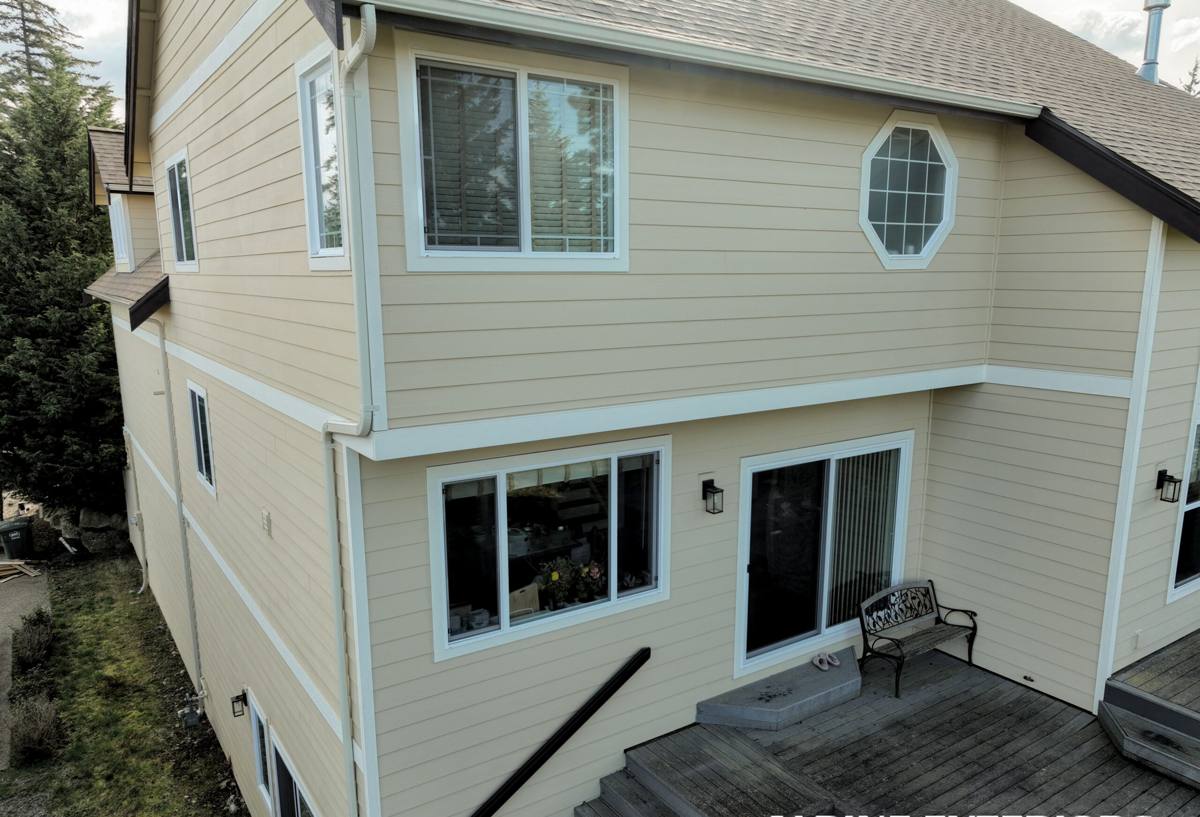
What This Climate Does to a Deck
Salt Air Off the Bay
Even set back and up from the shoreline, South Hill still sits close enough to Bellingham Bay that salt-carrying air reaches homes here on a regular basis, particularly on higher, more exposed lots. Salt accelerates corrosion in exposed metal — screws, brackets, post hardware, railing connectors — and corroded fasteners lose holding strength well before they look obviously bad. That matters more on a deck than almost any other exterior structure, since it's something people stand, walk, and lean on directly.
Driving Rain and Wind
Storms moving through Whatcom County rarely drop straight down; wind pushes rain sideways, driving it up under railings and into ledger connections that a calm-weather design wouldn't have to account for. On an elevated hillside lot, that wind exposure is often stronger than it would be on a sheltered, low-lying site, since there's less around the structure to break the wind up before it hits the deck. A deck surface and railing system built only for still, dry conditions tends to perform fine on a good day and trap moisture the moment wind gets involved — which around here is most days between fall and spring.
A Moss Season That Runs Most of the Year
Mild temperatures and near-constant moisture give moss and mildew a long growing season across this whole region, and South Hill's tree cover makes it worse in spots — shaded, north-facing decks under a mature canopy hold moisture longer than open, sun-exposed ones and give moss more time to take hold between dry stretches. Any decking material with even a little surface porosity gives it something to grip, and horizontal deck boards are usually the first place it shows up on a property, well before it's visible on a wall or roofline.
Building on South Hill's Sloped Lots
The hill itself is the other half of what makes a South Hill deck project different from one on flat ground. A sloped lot changes footing depth, post height, and often the whole layout of the deck, since a level surface has to be built out from ground that isn't level to begin with. That usually means taller support posts on the downhill side, engineered footings sized for the actual soil and grade rather than a standard depth, and sometimes a stepped or multi-level design that follows the terrain instead of fighting it.
Drainage works differently on a slope, too. Water doesn't just need to shed off the deck surface — it needs somewhere to go once it's off the structure, and on a hillside lot that means thinking about where runoff travels underneath and beyond the deck, not just how the boards themselves drain. Elevated decks built on a slope also carry different railing and guard requirements under the building code than a low, ground-level deck does, since fall height changes what's required. None of this is a reason to avoid building here — it just means the design work has to account for the actual grade of the lot rather than assuming it's flat.
| Factor | Ground-Level Deck | Elevated Hillside Deck |
|---|---|---|
| Footings | Standard depth, simpler layout | Engineered for grade and soil, often deeper on the downhill side |
| Railing & guards | May not be required depending on height | Required by code once fall height is met; sized for actual wind exposure |
| Drainage | Water sheds directly to grade below | Runoff must be directed past the structure and downhill neighbors' grade |
| Access & stairs | Single short run, if any | Often multi-flight stairs; landing and stringer design matter more |
Choosing the Right Decking Material for This Climate
Material choice carries more weight here than it would in a drier, more sheltered spot, because the performance gap between a well-suited product and a poorly-suited one shows up faster under sustained moisture and salt exposure. The three categories most South Hill homeowners weigh are pressure-treated or cedar wood, capped composite, and cellular PVC.
Wood
Pressure-treated lumber and cedar look great when new and remain a popular choice, but both need regular sealing or staining to hold up against sustained moisture, and both are more vulnerable to fastener corrosion over time in salt-influenced air. Left unmaintained even a season or two, wood is usually the first material on a South Hill deck to show moss, graying, and soft spots — especially in shaded, tree-covered yards.
Capped Composite
Capped composite boards have a plastic shell wrapped around a wood-fiber composite core, which resists moisture absorption, staining, and UV fade far better than uncapped composite or raw wood. In a moist, shaded, salt-influenced environment like much of South Hill, that cap layer is doing real work — it's the difference between a board that needs occasional washing and one that needs ongoing sealing to avoid soaking up moisture at the surface.
Cellular PVC
PVC decking contains no wood fiber at all, so it doesn't absorb moisture the way even capped composite can at cut edges or fastener holes. It typically costs more than composite and can flex more under heavy point loads, but for a shaded, moisture-heavy lot or a deck close to the water side of the hill, some homeowners find the added moisture resistance worth the extra cost.
| Material | Moisture & Salt Air | Moss Resistance | Upkeep |
|---|---|---|---|
| Cellular PVC | Excellent — no wood fiber to absorb moisture | Strong, smooth non-porous surface | Occasional washing |
| Capped composite | Strong — cap layer resists moisture and staining | Good on most product lines | Occasional washing |
| Uncapped composite | Moderate — some absorption at exposed fiber | Fair; more prone to buildup over time | Periodic cleaning |
| Cedar | Moderate — natural resistance, needs sealing | Fair when sealed and maintained | Regular oiling or sealing |
| Pressure-treated wood | Weak against sustained moisture over time | Poor without regular treatment | Regular sealing or staining |
What a Correctly Built Deck Involves Here
The decking surface gets most of the attention when homeowners picture a custom deck, but on a South Hill lot, the framing, footings, and fastener choices underneath are what actually determine how long it lasts and how safely it holds up on sloped ground. A build done right for this area includes:
- Footings and post sizing engineered for the actual slope and soil conditions on site, not a standard flat-lot depth applied by default
- Stainless steel or coastal-grade corrosion-resistant fasteners throughout, not standard hardware that starts corroding in salt-influenced air within a few seasons
- Hidden fastener systems on the deck surface where the product supports them, reducing exposed metal and giving a cleaner walking surface
- Correct board gapping for drainage and material movement, so wind-driven rain and standing moisture can actually clear between boards
- Proper ledger board flashing where the deck ties into the house, one of the most common points where moisture gets into a poorly built deck
- Railing height and guard spacing sized to code for the actual fall height, which changes on an elevated hillside deck
- Stair stringer and landing design suited to multi-flight runs where the grade requires them, not a single short run assumed by default
- Grading and drainage routing beneath and beyond the structure so runoff doesn't pool against footings or travel onto a downhill neighbor's property
Skip any one of those and the deck usually still looks fine the first year. The problems tend to show up a few winters later — a soft joist, a loosening railing post, or fastener corrosion staining the boards around it.
How Our Process Works
We start with a site visit to look at what's actually there: the slope and soil on the specific lot, drainage patterns during wet weather, tree cover and shade through the day, and how exposed the site is to wind and salt air off the bay. From there we talk through decking material options that fit the budget and how the space will actually get used, along with the layout choices the slope itself points toward — a single level, a stepped design, or a multi-level deck that follows the grade.
Permitting on South Hill and elsewhere in Bellingham generally involves setback, structural, and — on sloped lots — grading and drainage review, and we handle that as part of the job rather than leaving it for the homeowner to sort out. Once permitted, the build follows the sequence above: footings and framing first, sized and fastened for the site's actual grade and exposure, then the decking surface, railing, and any stairs. We finish with a walkthrough covering exactly what the material you chose needs going forward, which for most modern decking is minimal but not nothing.
What Your Deck Still Needs From You
Even a well-built deck in the right material needs some routine attention in this climate to reach its full lifespan. A short list worth keeping in mind:
- Rinse or wash the deck surface periodically to clear salt residue, pollen, and organic buildup before it works into the surface or cap layer
- Keep gaps between boards clear of leaves and debris — under a tree canopy, this needs more frequent attention than on an open, sunny lot
- Check railing posts and hardware once a year for early corrosion or loosening, especially heading into the wet season
- Watch for standing water or erosion around footings after heavy rain, particularly on the downhill side of an elevated deck
- Trim back overhanging branches that hold moisture against the deck surface or block airflow and sun across shaded sections
- Address any soft framing, loose stair stringers, or shifting posts right away — on a hillside structure, that's a safety issue, not just a cosmetic one
Why It Matters That We Already Work South Hill
A crew that mostly builds on flat, sheltered lots can still frame a deck competently, but a South Hill project brings variables that don't come up as often elsewhere in the area — footing and post engineering for sloped ground, railing and guard requirements tied to actual fall height, drainage that has to account for a downhill run rather than a flat yard, and moss pressure that runs longer under this area's tree cover than it does in more open parts of the county. Working this hillside regularly means we're not solving those problems for the first time on your project. We've seen which decking materials and fastener grades actually hold up to South Hill's combination of salt air, driving rain, shade, and slope, and which structural details are worth the extra time rather than an unnecessary upsell.
That familiarity also shows up in the smaller judgment calls — how to lay out a stepped deck on a particular grade, where a downhill footing needs extra depth versus where standard sizing is fine, and being straightforward with homeowners about what their specific lot actually requires.
Get a Straight Answer About Your Deck
Whether you're replacing an aging deck, building new on a sloped lot, or want an honest read on what a custom deck would take on your South Hill property, we're glad to walk the site with you and lay out the options plainly. Reach out below for a free, no-pressure estimate.