 Fairhaven Siding
 South Hill's Siding Problem Isn't Cosmetic — It's Moisture
Homes on South Hill sit up on the hillside above Fairhaven, exposed to weather rolling in off Bellingham Bay and the Strait of Georgia. That exposure means three things happening at once, year-round: salt-laden air working on fasteners and finishes, driving rain hitting siding at an angle instead of falling straight down, and a moss season that runs longer here than almost anywhere else in the state. Individually, any one of those is manageable. Together, on an older or under-maintained wall system, they compound fast.
Salt air accelerates corrosion on anything metal — nail heads, flashing, trim fasteners — long before most homeowners notice a problem on the siding surface itself. Driving rain doesn't just wet the face of the siding; it gets pushed sideways and upward into laps, seams, and butt joints that were never built to shed water from that angle. And moss doesn't just sit on the surface looking bad — its root structure holds moisture against the substrate for months at a time, which is exactly the condition that rots wood-based siding and delaminates lower-grade composite products from the inside out.
This is the environment fiber cement siding was engineered for, and it's why we treat South Hill jobs differently than a straightforward install on a sheltered inland lot.
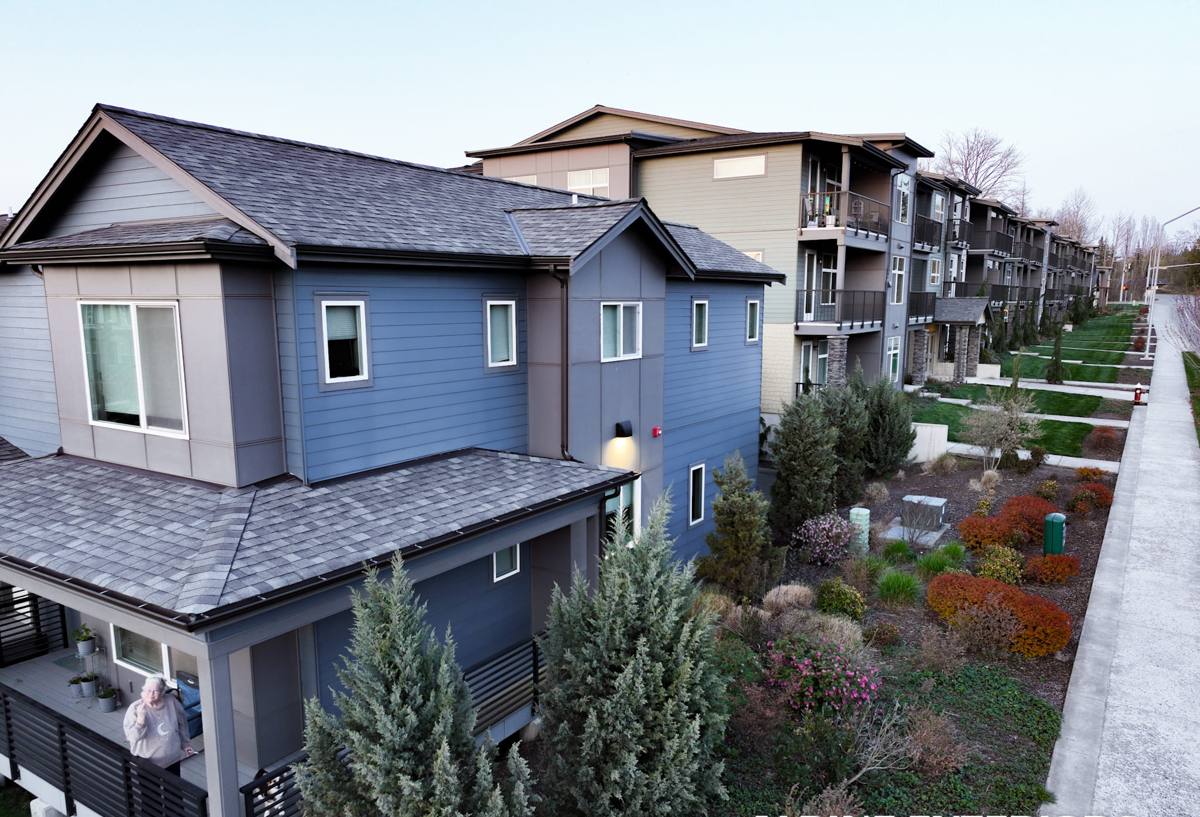
Why We Only Install James Hardie on Homes Like These
We install James Hardie fiber cement exclusively — not LP SmartSide, not vinyl, not Cemplank or Allura, not primed cedar or spruce. On a hillside site facing Bellingham Bay weather, that's not a brand preference, it's a materials decision. Fiber cement is non-combustible and dimensionally stable, so it doesn't swell, cup, or telegraph moisture the way wood-based products can when they take on repeated wetting. James Hardie's ColorPlus factory finish is baked on under controlled conditions rather than field-applied, which matters a lot in a climate where paint failure on job-site-primed products is one of the most common callback issues we see.
Hardie also builds climate-specific HZ product lines rather than one generic formulation for the whole country. For the Pacific Northwest, that means a product engineered around moisture exposure and freeze-thaw cycling — not a siding designed for a dry climate and shipped here anyway. That distinction shows up over years, not in the first season.
What We're Not Installing, and Why
LP SmartSide and similar engineered wood products use real merit in dry, sheltered regions — but they're wood-based at the core, and wood-based siding depends on an unbroken paint film to keep water out. One missed touch-up, one piece of storm damage left unpatched, and moisture gets a path into the substrate. On a wind- and rain-exposed hillside lot, that's a maintenance burden we don't think is fair to hand a homeowner. Vinyl siding is inexpensive and low-maintenance in the sense that it doesn't need painting, but it's a thin, flexible material that isn't rated for the kind of wind-driven rain and fastening precision this site demands, and it doesn't offer the fire resistance fiber cement does. We'd rather explain the trade-off up front than install something we know is a poor match for this microclimate.
What a Correct Fiber Cement Installation Actually Involves
Fiber cement siding fails prematurely almost never because of the board itself — it fails because of what's underneath it or how it was fastened. On a site with this much wind-driven rain exposure, the installation details matter more than the product choice.
The Water Management Layer
Correct installation starts before a single piece of siding goes up. That means a continuous, properly lapped weather-resistive barrier, correctly integrated window and door flashing, and rainscreen or drainage-gap detailing where the wall assembly calls for it. Fiber cement is durable, but it's not a substitute for a wall that can't drain and dry. On South Hill in particular, where wind pushes rain sideways into laps and joints, we pay close attention to head flashing above windows and doors and to kick-out flashing at roof-wall intersections — two details that are easy to skip and are exactly where we find failures on older homes during tear-off.
Fastening and Clearances
James Hardie specifies exact fastener types, spacing, and penetration depth, and those specs change slightly depending on exposure category — which is precisely why an exposed hillside job gets treated differently than a sheltered one. We also hold to Hardie's minimum clearances: siding kept clear of the roofline, deck surfaces, and grade, so water has somewhere to go instead of wicking up into the bottom edge of the board. In a salt-air environment we're also deliberate about fastener material, since the wrong hardware can start corroding — and staining the face of the siding — well before the board itself shows any wear.
Joints, Caulking, and Finish
Butt joints get factory-primed cut ends sealed and, where possible, backed with H-channel or properly lapped rather than simply caulked and left. Caulk is a maintenance item, not a permanent seal, and we don't design an installation that depends on it holding perfectly forever in a wet climate.
How This Plays Out Over a Real South Hill Job
| Stage | What We're Doing | Why It Matters Here |
|---|---|---|
| Assessment | Inspect existing siding, sheathing, and trim for hidden moisture damage, check exposure on wind-facing walls | Older South Hill homes often have decades of moss and rain exposure that hide rot behind the siding face |
| Tear-off | Remove old siding and inspect sheathing before covering anything back up | Water-resistive barrier and sheathing repairs are cheap now and expensive later |
| Water management | Install or repair house wrap, flashing at every penetration, drainage detailing | This is the layer that actually keeps water out — siding is the second line of defense |
| Siding install | Hardie boards fastened to spec, correct clearances, sealed joints | Consistent execution is what prevents the callbacks we see on rushed jobs |
| Final detail | Trim, caulking review, site cleanup, walk-through | Small gaps at trim and penetrations are where most future leaks start |
Reading the Signs Your Current Siding Is Losing the Fight
Most South Hill homeowners come to us after noticing one or two of these — rarely all at once, and rarely dramatic at first:
- Persistent moss or dark streaking that returns within a season or two of cleaning
- Soft or spongy spots when you press on wood-based or engineered wood siding
- Paint that's bubbling, peeling, or failing faster than the last time you repainted
- Visible gaps opening up at butt joints, corners, or trim
- Rust streaking below nail heads or metal flashing
- Rooms with an unexplained musty smell along exterior walls
- Warping, cupping, or delamination at board edges, especially on rain-facing elevations
None of these mean the whole house needs to be resided immediately, but they're worth having looked at before the next wet season adds another layer of damage underneath.
What Drives Cost on a Job Like This
We don't quote prices without seeing the house, but these are the factors that actually move the number on a South Hill fiber cement project — useful to know before you start comparing bids:
| Factor | Why It Affects Cost |
|---|---|
| Condition of the sheathing underneath | Rot repair found during tear-off is the most common source of change orders on older homes |
| Wall complexity | Dormers, multiple gables, and lots of trim take more labor per square foot than a simple rectangular wall |
| Siding profile chosen | Lap siding, shingle-style panels, and board-and-batten each have different material and labor costs |
| Access and site conditions | Hillside lots, steep grades, and limited staging space can add setup time |
| Existing flashing and water management | Homes with no drainage plane or damaged flashing need that work done properly before siding goes on |
| Paint vs. ColorPlus finish | Factory-applied ColorPlus finish costs more up front but removes a recurring maintenance expense |
Keeping Fiber Cement Siding Looking Right Through Whatcom County Winters
Fiber cement is low-maintenance compared to wood, but "low" isn't "zero," especially with this much moss pressure. A soft wash once or twice a year — never a high-pressure blast that can force water behind joints or damage the finish — keeps moss and algae from getting established. It's worth checking caulked joints and trim annually, since caulk is the one component in the system that does wear out and need occasional attention. Keeping gutters clear and grade sloped away from the foundation does more for long-term siding performance than most people expect, because a lot of the moisture load on lower courses comes from splash-back and poor drainage, not just rainfall on the wall itself.
Why Local Experience on South Hill Actually Matters
A crew that mostly installs siding in drier parts of the state will still build a technically correct wall on paper — but exposure category, flashing emphasis, and fastener choice all shift when the job sits on a hillside catching weather off Bellingham Bay. Working repeatedly in Fairhaven and the surrounding Whatcom County neighborhoods means we already know which elevations on a hillside lot take the worst of the driving rain, where moss tends to establish first, and which older construction details in this area's housing stock need extra attention during tear-off. That's the kind of judgment that doesn't show up in a manufacturer spec sheet but shows up in how the siding performs five and ten years out.
If you're weighing a siding replacement on South Hill or anywhere else in the Fairhaven area, we're happy to take a look and give you a straight, no-pressure assessment of what your home actually needs. Use the form below to request a free estimate.