 Fairhaven Siding
 South Hill's Climate Is Harder on Siding Than It Looks
South Hill sits up above Bellingham Bay, and that elevation and water exposure come with a trade-off. Homes here catch wind-driven rain that doesn't fall straight down — it drives sideways into laps, seams, and trim joints in a way that flatter, more sheltered lots rarely experience. Siding that isn't detailed correctly at every joint will eventually let that water find a way in.
Then there's the salt air. Fine salt carried up off the bay settles on every exterior surface, and over years it accelerates corrosion on cheap fasteners, exposed trim metal, and anything not built to resist it. You see it first as rust streaks at nail heads, then as caulk joints that won't hold, then as paint that peels earlier than it should.
Add in Whatcom County's long wet season — many months where shaded, tree-covered, or north-facing walls simply don't dry out — and you get ideal conditions for moss and algae to take hold on any siding that doesn't shed water and dry quickly. On the wrong material, that moisture doesn't just sit on the surface; it works into the substrate underneath.
Put those three factors together — driving rain, salt air, and a stretched-out moss season — and siding on South Hill needs to do more than look good. It needs to be moisture-tolerant, correctly flashed and gapped at every joint, and durable against a slow, constant exposure rather than the occasional bad storm.
Why We Install Only James Hardie Fiber Cement
We made a deliberate call: we don't install vinyl, LP SmartSide, Cemplank, Allura, primed spruce, or cedar. That's not because those products can never be installed correctly — it's because, weighed against the climate South Hill homes actually sit in, the trade-offs work against the homeowner over time.
Wood-based products — cedar, primed spruce, engineered wood siding like LP SmartSide — depend on an unbroken cycle of caulking, painting, and maintenance to keep moisture out of the wood fiber. Skip a maintenance cycle in a climate that stays wet half the year, and rot gets a foothold before anyone notices. Vinyl is low-maintenance in a different way, but it's a thin plastic product that can crack under impact and shows its age at the seams. Other fiber cement brands like Cemplank and Allura are legitimate products, but James Hardie's factory-applied ColorPlus finish, its climate-engineered product zones, and the warranty and supply support behind it are what we've standardized our crews around. Fiber cement is also non-combustible, which more homeowners are factoring into their decision.
The HZ5 System: Engineered for Salt Air and Driving Rain
James Hardie doesn't make one generic product for the whole country — it engineers its siding formulations by climate zone. Western Washington falls into the HZ5 zone, which is formulated to hold up under sustained moisture exposure without the swelling, cracking, or water absorption you'd see from standard fiber cement or wood siding built for a drier climate. It's also non-combustible and resistant to the pest damage — woodpeckers, insects — that wood siding attracts.
Plank Profiles That Suit Hillside Homes
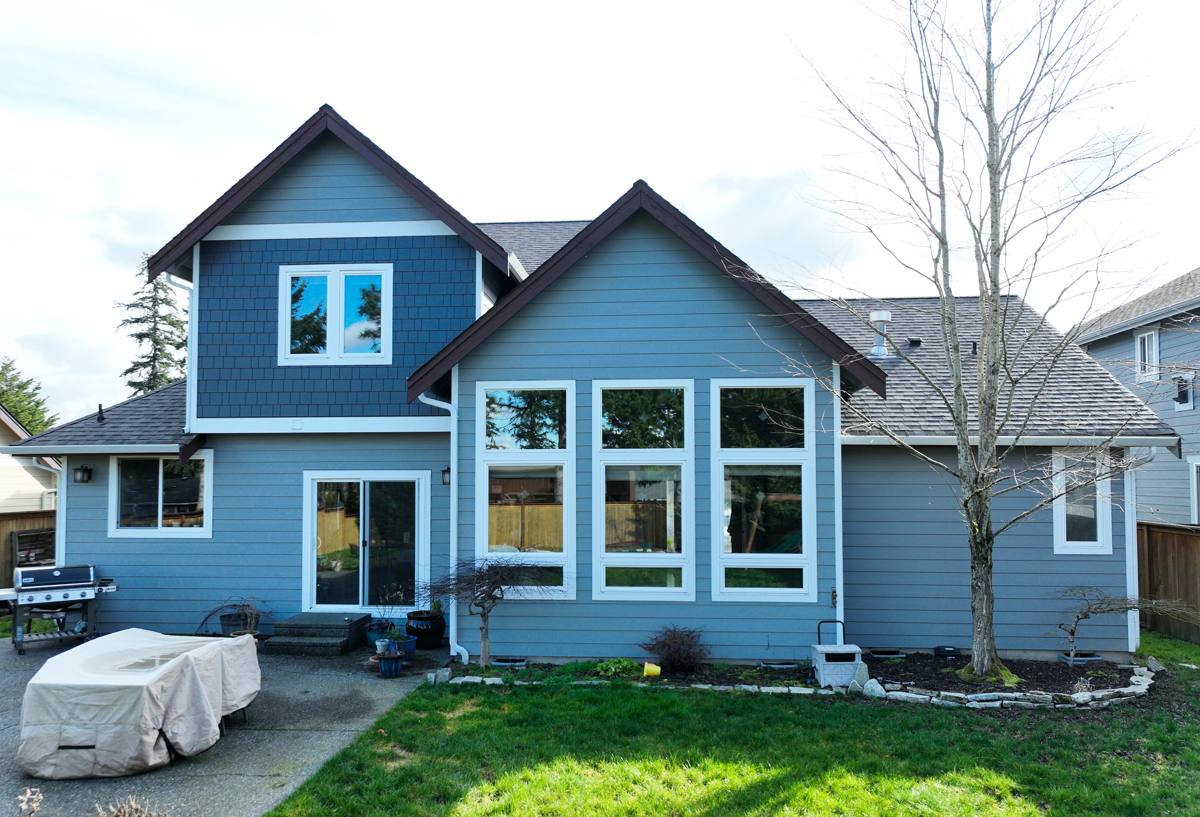
South Hill has a real mix of home styles, and the right Hardie profile depends on the house. HardiePlank lap siding comes in several widths and textures — smooth or cedarmill grain — and works as the primary field siding on most homes. HardieShingle siding gives older, more character-driven homes a shingle-style accent at gables or dormers without the maintenance burden of real cedar shingles. HardiePanel suits more modern or contemporary exteriors. The profile you choose affects both the look and how water sheds off the wall, so it's worth getting right at the planning stage.
What a Correct Installation Looks Like on a South Hill Home
Fiber cement siding is only as good as its installation, and in a climate like this, the details that get skipped on a rushed job are exactly the ones that cause problems years later.
- Proper clearance from grade and hardscape — a minimum of 2 inches, more where possible — so splashback and standing water don't wick into the bottom edge of the siding.
- Correct clearance at the roofline, generally a minimum of 1/4 inch, with kick-out flashing installed at every roof-to-wall intersection.
- A drainage gap or rainscreen behind the siding, so any moisture that does get behind the cladding has somewhere to go and the siding can actually dry out between rain events.
- Corrosion-resistant fasteners — galvanized or stainless — spaced and set to manufacturer spec rather than whatever's fastest for the crew.
- Properly caulked or factory-mitered joints at trim and butt seams, not just a bead of caulk smeared over a gap.
Kick-out flashing deserves special mention. It's a small piece of metal at the base of a roof-wall intersection that directs water away from the wall instead of letting it run down behind the siding. It's one of the most common things missed on lower-cost jobs, and it's also one of the most common sources of hidden rot we find behind existing siding in wet climates like this one.
ColorPlus Finish, Moss, and Long-Term Maintenance
James Hardie's ColorPlus finish is baked on at the factory in multiple coats, which makes it considerably more durable and fade-resistant than paint applied on site after installation. That translates to a much longer stretch before the siding needs to be repainted compared to field-finished materials.
That said, no siding in this climate is maintenance-free. A few habits keep South Hill homes looking their best: keep gutters and downspouts clear so water isn't sheeting down the wall face, trim back vegetation that's shading a wall and keeping it damp, and give the siding an occasional gentle rinse with a hose and soft brush rather than a pressure washer, which can force water up under the laps instead of cleaning it off. Compare that to raw wood or primed spruce siding, which needs the same upkeep plus a full repaint cycle every few years — Hardie's factory finish takes that second burden off the table.
James Hardie vs. Other Siding Options in This Climate
| Product | Moisture Behavior Here | Maintenance | Why It's Not What We Install |
|---|---|---|---|
| James Hardie fiber cement | Engineered for wet, marine climates (HZ5); doesn't swell or rot | Occasional rinse; factory finish holds for years | This is what we install |
| Vinyl siding | Sheds water on the surface but seams and thin panels can let moisture behind them | Low, but panels crack under impact and can't be spot-repaired invisibly | Durability and repairability don't hold up to our standard |
| LP SmartSide (engineered wood) | Wood-fiber core is vulnerable if the factory coating is ever breached | Requires consistent caulk and paint upkeep | Too maintenance-dependent for this rainfall and moss season |
| Cedar / wood siding | Absorbs moisture; prone to rot and moss growth without diligent upkeep | Regular re-staining or painting, moisture monitoring | Maintenance burden is too high long-term in this climate |
| Primed spruce or other fiber cement (Cemplank, Allura) | Varies by product; primed wood needs a full paint system to perform | Ranges from moderate to high depending on product | We standardized on Hardie's climate-zoned system and warranty support |
Our Installation Process, Start to Finish
- Site walk and moisture assessment — we look at existing siding, trim, and any signs of water intrusion before quoting the job.
- Tear-off and sheathing inspection — old siding comes off and the sheathing underneath gets inspected. Any rot or water damage gets addressed before anything new goes on; we don't cover up a problem.
- Weather-resistant barrier and rainscreen installation — this is the drainage layer that lets the wall assembly dry properly in a climate that stays wet for months at a time.
- Flashing installed at every penetration and roof-wall intersection, including kick-out flashing, before siding goes up.
- Starter course and Hardie planks installed to manufacturer nailing pattern, gap spec, and clearance requirements.
- Trim, joints, and penetrations sealed and caulked per spec.
- Final walk-through inspection with the homeowner before we call the job done.
What to Ask Before You Hire a Siding Crew for South Hill
- Do they install James Hardie regularly in Whatcom County, or is it one of several products they rotate through?
- Will they show you a written scope that includes flashing, gap clearances, and fastener spec — not just "siding replacement"?
- Do they specifically plan for kick-out flashing and roof-wall intersections, or do those get left off to save time?
- Is a drainage gap or rainscreen part of the installation, given how much rain this area gets?
- What does the warranty actually cover — product only, or labor too — and who's responsible if a flashing detail fails down the road?
- Can they speak to how older, character-style homes in this area get detailed differently than a newer build?
What Influences Your Project Cost
| Factor | Why It Matters |
|---|---|
| Home size and number of stories | More surface area and harder-to-access walls both add labor time |
| Removal and sheathing repair | Hidden rot found during tear-off has to be fixed before new siding goes on |
| Trim complexity | Dormers, bay windows, and multiple gables all add flashing and cutting work |
| Siding profile chosen | Lap, shingle-style accents, and panel systems each install differently |
| Color selection | Standard ColorPlus colors versus premium options can shift material cost |
Every South Hill home is a little different, and the only way to give you real numbers is to walk the house and look at what's actually there. If you're weighing your options for a siding replacement in this neighborhood, we're happy to come take a look and put together a free, no-pressure estimate — use the form below to get started.