 Fairhaven Siding
 Why Bellingham Decks Wear Out Faster Than You'd Expect
A deck in Bellingham doesn't fail the way a deck in a dry inland climate fails. It doesn't just fade and get a little gray. It rots from underneath, it corrodes from the fastener out, and it grows a slick green coat of moss in places that never get a chance to dry. That's the combination working against every outdoor structure this close to Bellingham Bay: salt-laden air moving in off the water, long stretches of driving rain, and a moss season that can run from early fall through late spring in shaded yards under fir and cedar canopy.
None of that means a deck can't last for decades here. It means the build has to account for those three forces from the footings up, not just at the surface. A deck that looks fine on the walkthrough but was framed and fastened like it was going into a dry climate will show its problems within a few wet seasons — soft spots near the ledger, rust streaks bleeding out of screw heads, boards that stay damp and dark for days after a storm. We build for the climate Bellingham actually has, not the one the lumber yard's default spec sheet assumes.
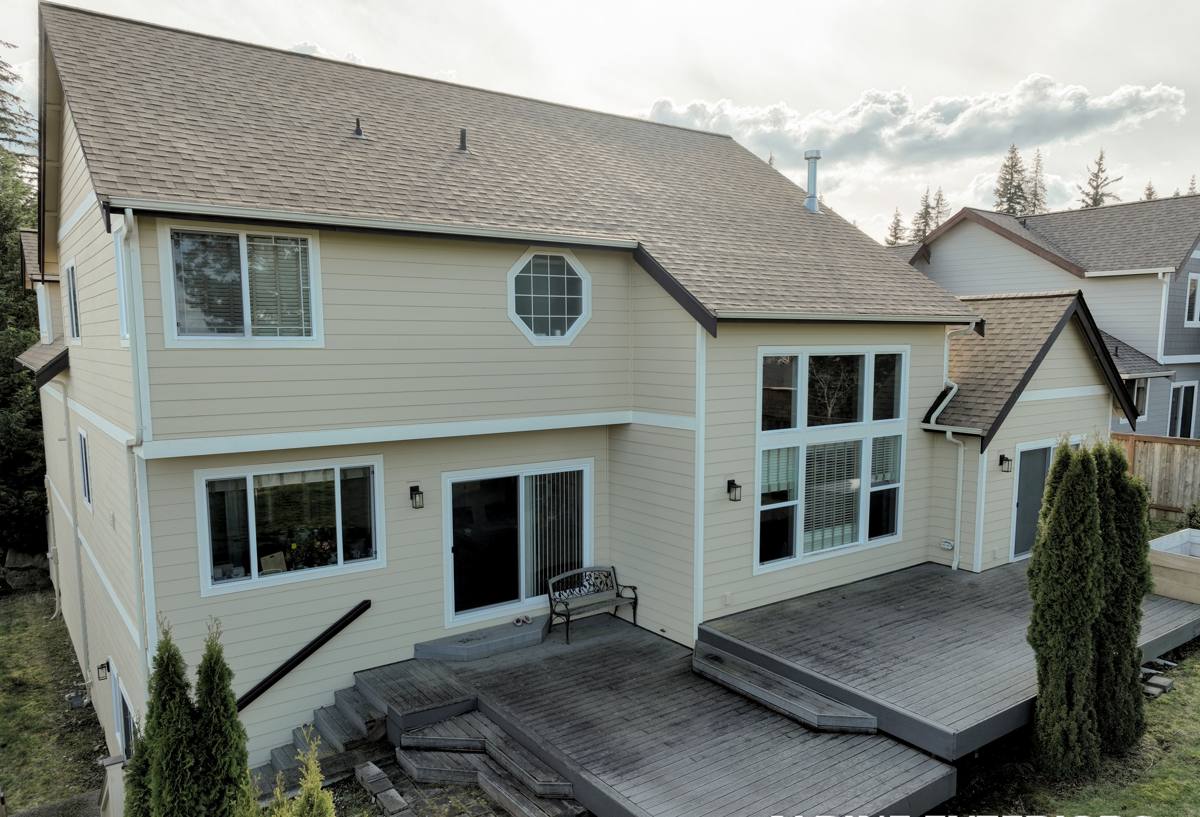
What Correct Deck Building Looks Like Here
The Ledger Connection
Most deck failures we get called out to inspect trace back to one spot: where the deck attaches to the house. If that ledger board isn't flashed correctly — with the flashing lapped properly under the house's water-resistive barrier and siding, not just caulked on top of it — water works its way behind the ledger every time it rains. In a climate with as much sustained rainfall as Whatcom County gets, that's not an occasional problem, it's a guaranteed one over a few years. Correct flashing detail at the ledger is non-negotiable, and it's the single easiest thing for a rushed builder to get wrong because it's covered up almost immediately.
Framing and Fasteners
Pressure-treated framing lumber is standard, but not all treated lumber is rated the same, and not all fasteners are compatible with it. Modern treated lumber uses copper-based preservatives that accelerate corrosion in the wrong metal — using standard galvanized or uncoated fasteners in ground-contact or salt-exposed framing shortens their working life dramatically. We spec fasteners and structural connectors rated for both the treated lumber and the coastal air, which usually means hot-dip galvanized or stainless hardware at every structural connection, not just the visible ones.
Airflow Underneath
A deck built low to the ground with poor airflow underneath will trap moisture indefinitely in this climate. That trapped moisture is exactly what feeds rot in the joists and what keeps the underside of the decking damp enough for moss and algae to take hold. Proper framing height, joist spacing that allows air movement, and keeping vegetation clear of the underside all matter more here than they would in a drier region.
Choosing Decking Material for Salt Air and Moss
There isn't one universally "right" decking material — there's a right material for your budget, your maintenance appetite, and how much shade and moisture your particular yard sees. Here's how the common choices actually perform under Whatcom County conditions:
| Material | How it handles salt air & rain | Moss/algae resistance | Maintenance |
|---|---|---|---|
| Pressure-treated fir/pine | Good if properly sealed and refinished | Low — needs regular cleaning and treatment | Annual cleaning, refinish every 2-3 years |
| Cedar | Naturally rot- and insect-resistant, ages well with moisture | Moderate — still needs periodic cleaning in shaded spots | Cleaning plus occasional oil or stain |
| Composite decking | Excellent — doesn't absorb water or rot | Moderate to good depending on the surface texture | Periodic washing; no staining or sealing |
| Tropical hardwood (ipe and similar) | Excellent, very dense and rot-resistant | Moderate — dense surface sheds water but can still film with algae in full shade | Occasional oiling to maintain color; low structural maintenance |
We're candid with homeowners about the trade-offs rather than pushing whatever has the best margin. Composite costs more up front and some formulations can get slippery when a moss film builds up in shaded areas if they're not cleaned periodically — that's a maintenance-schedule issue, not a defect, but it's worth knowing before you buy. Wood costs less initially and looks the most natural, but it asks for a real maintenance commitment in a climate this wet, or it will show weathering and soft spots years before it should.
Substructure and Drainage: The Part No One Sees
The visible decking is maybe a third of what makes a deck last. The rest is underneath: footing depth suited to our soil and frost conditions, proper drainage away from posts and footings so water doesn't pool against untreated end grain, and joist tape or flashing on top of the framing members so fastener holes and cut ends aren't left exposed to standing water. Skipping joist protection is one of the most common shortcuts we see on decks built by crews that don't work this climate regularly — it doesn't show up as a problem for a year or two, then it shows up as rot right where you can't easily inspect it.
Grading around the base of the deck matters too. If runoff from the yard or roof is draining toward the footings instead of away from them, you're feeding the exact moisture cycle that causes long-term structural problems, regardless of how good the decking above it is.
Railings, Stairs, and Code Requirements
Any elevated deck needs a railing system that meets current building code for height and baluster spacing, and stairs need proper stringer support and rise/run consistency — this isn't optional detail work, it's the difference between a safe structure and a liability. Whatcom County and the City of Bellingham have permitting requirements for most new decks, particularly anything elevated above grade or attached to the house. We handle the permit process as part of the job rather than leaving it for the homeowner to sort out, because an unpermitted deck can complicate a home sale or insurance claim down the road.
Our Deck Building Process
- On-site assessment — we look at drainage, sun/shade exposure, existing structure if it's a replacement, and how the space will actually be used.
- Design and material selection — sizing, layout, and a material recommendation based on your budget and how much upkeep you want to take on.
- Permitting — we prepare and submit what's required through the local jurisdiction before any work starts.
- Demolition and site prep (if replacing an existing deck) — including inspection of the ledger and framing behind the old structure.
- Framing and flashing — ledger connection, footings, joists, and structural hardware installed to the standard the climate requires, not the minimum code allows.
- Decking, railing, and stairs — installed with attention to fastener pattern, gapping for drainage and material movement, and a clean finish.
- Final walkthrough — we go over care and maintenance expectations specific to the material you chose before we consider the job done.
Maintenance Reality: What Bellingham Decks Need Each Year
Every deck in this climate needs some seasonal attention — the material just changes how much. Here's a practical baseline for a Bellingham property:
- Clear leaves and debris from between boards and off railings before fall rains set in — trapped debris holds moisture and feeds moss growth.
- Wash the deck surface at least once a year, more often in heavily shaded yards, to remove the algae film that makes boards slick.
- Check and re-tighten any loose fasteners or connectors, especially after the first year of a new build as lumber settles.
- Inspect the ledger flashing and the area where the deck meets the house for any signs of staining or soft wood.
- Re-seal or re-stain wood decking on the schedule appropriate to the product — don't wait until it's visibly gray and weathered.
- Keep gutters and downspouts near the deck clear so roof runoff isn't dumping extra water onto or under the structure.
Cost Factors on a Bellingham Deck Project
Every project is different, but the same handful of variables drive the price on almost every deck we build:
| Factor | Why it moves the price |
|---|---|
| Decking material | Pressure-treated wood costs the least up front; composite and hardwood cost more but need less ongoing maintenance |
| Height and footing complexity | A deck built on a slope or well above grade needs more substructure, engineering, and labor |
| Size and layout | Multiple levels, built-in seating, or non-rectangular shapes add material and labor time |
| Railing style | Cable, glass, and custom railing systems cost more than standard baluster railing |
| Permitting and inspection | Required for most attached or elevated decks in this jurisdiction; adds time and a modest fee |
| Demolition | Removing and disposing of an existing deck adds cost before the new build even starts |
We'd rather walk you through these factors honestly during the estimate than give you a number that doesn't hold up once the project starts.
Why Hiring a Crew That Already Works Bellingham Matters
A contractor who mostly builds in a dry climate and occasionally takes a Bellingham job will default to specs and details that work fine somewhere else and fail here. The flashing detail at the ledger, the fastener grade, the joist protection, the framing height for airflow — none of that is exotic knowledge, but it only gets applied consistently by a crew that deals with Whatcom County's rain, salt air, and moss on every job, not just occasionally. We're based right in Fairhaven, and the decks we build have to hold up to the same weather our own roofs and siding deal with. That's not a sales pitch — it's just the reason the details above aren't optional to us.
Ready to Talk Through Your Project
If you're weighing whether to repair, replace, or build new, we're happy to come take a look and give you an honest read on what your yard and your budget call for. Reach out for a free, no-pressure estimate using the form below — we'll walk the site, talk through material options, and give you a straight answer, not a sales pitch.