 Fairhaven Siding
 Why Marietta Decks Take a Beating
Marietta sits low and close to the water on Bellingham Bay, and that location shapes how a deck ages here more than most homeowners realize. Salt-laden air off the bay works into fastener heads, joist hangers, and other metal connectors faster than it does a few miles inland. Driving rain off Puget Sound rarely falls straight down — wind pushes it sideways under railings, through gaps between decking boards, and against the wall of the house where the deck ties in. And Whatcom County's long, wet moss season means anything horizontal — decking, stair treads, even the tops of railing caps — stays damp for weeks at a stretch between fall and spring.
None of that means a deck in Marietta is doomed to fail early. It means a deck built or repaired without those conditions in mind will fail years before it should, and almost always starting in the same handful of predictable spots.
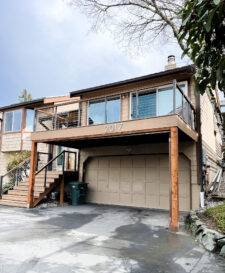
Common Deck Problems We See in Marietta
Rot at the ledger board
The ledger board — the framing member that bolts the deck to the house — takes on more water than any other part of the structure because it sits at a seam between two building systems. When flashing behind it is missing, undersized, or was installed before code required it, water gets behind the siding and into the rim joist. By the time it shows on the surface, the framing underneath is often already compromised.
Corroded fasteners and hardware
Standard galvanized nails and screws have a service life in salt air that's noticeably shorter than the same hardware would see inland. Once the coating on a fastener breaks down, it corrodes from the inside of the wood outward — you'll often see a screw head that looks fine but pulls out of soft, stained wood around it.
Moss, algae, and slick surfaces
Wood and composite decking that stays damp through a Whatcom County winter grows moss and algae in the grain and in fastener recesses. Beyond looking bad, it holds moisture against the board and turns stairs and walking surfaces genuinely dangerous underfoot.
Soft or spongy decking and framing
Boards that flex, joists that feel bouncy, or a stair stringer that has started to sag are signs that repeated wet-dry cycles have broken down the wood fiber. This is different from surface weathering — it's structural, and it's the most common reason a homeowner calls us after ignoring smaller signs for a season or two.
The Ledger Board: Where Most Deck Failures Start
If we had to pick one place on a Marietta deck that decides whether a repair holds up, it's the ledger connection. This is where flashing quality, fastener spacing, and drainage all come together — and it's also the hardest area to inspect without opening it up, because the siding covers most of it.
When we repair a deck that's showing rot anywhere near the house, we don't patch around the ledger and hope. We pull enough siding and decking to see the flashing condition directly, confirm the rim joist underneath is sound, and correct the water path before we put anything back. A deck that looks solid everywhere else but has a compromised ledger connection is not a deck we'll certify as repaired — it's a deck that needs that one area done right first.
Signs Your Deck Needs Repair
Most deck problems in this area give warning signs well before anything becomes unsafe. Worth checking for, especially heading into or coming out of moss season:
- Boards that feel spongy, springy, or noticeably different underfoot than the boards around them
- Rust-colored streaks running down from screw heads, joist hangers, or post bases
- A visible gap, dark staining, or a soft seam where the deck meets the house wall
- Railing posts that wiggle at the base or where they attach to the deck frame
- Moss or algae that keeps returning to the same boards no matter how often it's cleaned off
- Stair stringers that have started to lean, split, or separate from their fasteners
- Visible daylight or gaps around post bases sitting directly on concrete or grade
- A deck that was built more than 12–15 years ago and has never had the framing inspected
Any one of these on its own might be a minor fix. Two or three together, especially near the ledger or stairs, usually means it's worth having someone look before the next wet season.
Our Deck Repair Process
We approach a deck repair the same way regardless of how the deck looks on the surface, because surface condition and structural condition aren't always the same thing.
- Full inspection. We check the ledger connection, every joist we can access, post bases, stair stringers, and railing attachment points — using a moisture meter and a probe on any wood that looks or feels suspect, not just a visual walk-around.
- Honest scope. We tell you what's cosmetic, what's structural, and what's borderline. If a board is rotted but the framing under it is sound, that's a different job than framing that needs to come out.
- Repair the cause, not just the symptom. If rot is tracing back to bad ledger flashing or a drainage problem, we fix that first — replacing boards over a still-leaking connection just buys a year or two before the same repair comes back.
- Rebuild with coastal-appropriate materials. Fasteners, flashing, and hardware are matched to the salt-air exposure here, not generic inland specs.
- Code check on railings and stairs. Any repair that touches guardrails or stair framing gets brought up to current code-minimum height, spacing, and attachment — not left at whatever standard was in place when the deck was originally built.
- Walk-through. We show you what was found, what was replaced, and what to keep an eye on going forward.
Repair vs. Rebuild: How We Help You Decide
Not every deck problem in Marietta calls for a full teardown, and not every deck is worth patching. The honest answer usually comes down to how much of the framing — not just the decking surface — is affected.
| Situation | Typical scope | What drives the decision |
|---|---|---|
| A few soft or split deck boards, framing solid | Spot repair / board replacement | Rot hasn't reached joists; problem is limited to surface boards |
| Rot at ledger board or rim joist | Targeted structural repair | Flashing and framing at the house connection need to be opened up and corrected |
| Multiple joists soft, stair stringers compromised | Partial rebuild | Structural members need replacing but posts/footings are still sound |
| Posts, footings, and framing all showing age or rot | Full rebuild | Cheaper long-term than repeated partial repairs on a failing structure |
| Deck is structurally sound but chronically mossy/slick | Cleaning, maintenance repair, drainage correction | No structural repair needed — the issue is moisture management, not decay |
We'll give you a straight answer on which category your deck falls into, including when a repair is genuinely the right call and a rebuild would be spending more than the problem requires.
Materials and Fasteners for a Coastal Climate
What goes into a repair matters as much as the workmanship. For fasteners and hardware near salt air, we use stainless or coated fasteners rated for the exposure rather than standard galvanized hardware — the cost difference is small relative to the labor of doing the repair again in a few years. Flashing gets installed to shed water past the ledger and siding, not just tucked in and caulked over; caulk is a backup, not a waterproofing strategy on its own.
On decking material, we'll talk through wood versus composite honestly. Wood costs less up front and can look great, but it needs regular sealing or staining to hold up through repeated wet-dry cycles, and it's more prone to moss growth without upkeep. Composite costs more initially, sheds moss more easily, and doesn't need refinishing — but it's not maintenance-free, it can still trap moisture underneath if airflow isn't right, and not every composite product handles this climate the same way. We'll tell you the real trade-offs for your specific deck rather than push whatever earns the bigger margin.
Keeping a Repaired Deck Healthy Through Moss Season
A repair is only as good as the maintenance that follows it. In this climate, that means a few habits worth building in:
- Sweep or blow off standing leaves and debris before the wet season settles in — trapped organic matter is what feeds moss and holds moisture against boards
- Rinse or gently brush off moss buildup before it gets thick enough to stain the wood underneath
- Check fastener heads and hardware once a year for early rust streaking
- Keep gutters and downspouts near the deck clear so runoff isn't draining directly onto or under it
- Re-seal or re-stain wood decking on the schedule the product actually calls for, not just when it looks faded
None of this is complicated, but it's the difference between a repair that lasts a decade and one that needs revisiting in three years.
Why Hire a Crew That Already Works in Marietta
A deck repair done by someone unfamiliar with Whatcom County's coastal conditions often looks fine on day one and starts failing in the same spots within a couple of wet seasons — because the fasteners, flashing details, and drainage assumptions were built for a drier, less salt-exposed climate. Working in and around Marietta and the broader Fairhaven area, we've seen how quickly standard-grade hardware corrodes here, how moss actually behaves on local decks through the winter, and where builders in this area tend to cut corners on ledger flashing. That's not a substitute for a good inspection on your specific deck, but it does mean we're not guessing at what this coastline does to a structure over time.
If your deck has any of the warning signs above, or you just want an honest read on its condition before another wet season, we're glad to take a look. Estimates are free and there's no pressure — fill out the form below and we'll get back to you.