 Fairhaven Siding
 James Hardie Siding, Installed for What Bellingham Actually Throws at a House
Bellingham sits close enough to Bellingham Bay and the Salish Sea that its exterior materials deal with a specific combination most inland Washington towns never see: salt-tinged marine air, rain that comes in sideways as often as it falls straight down, and a moss and mildew season that can run most of the year on shaded and north-facing walls. We install James Hardie fiber cement siding on Bellingham homes because it is the one system we have found that holds up to that combination without asking the homeowner to babysit it every few years. This page is about that one job, done right, on this specific stretch of Whatcom County.
A siding replacement is a big enough investment that it deserves more than a generic pitch. What follows is what Bellingham's climate does to exterior materials, what James Hardie's product system actually offers in response, what correct installation looks like in practice, and how our process runs from first look to final walk-through.
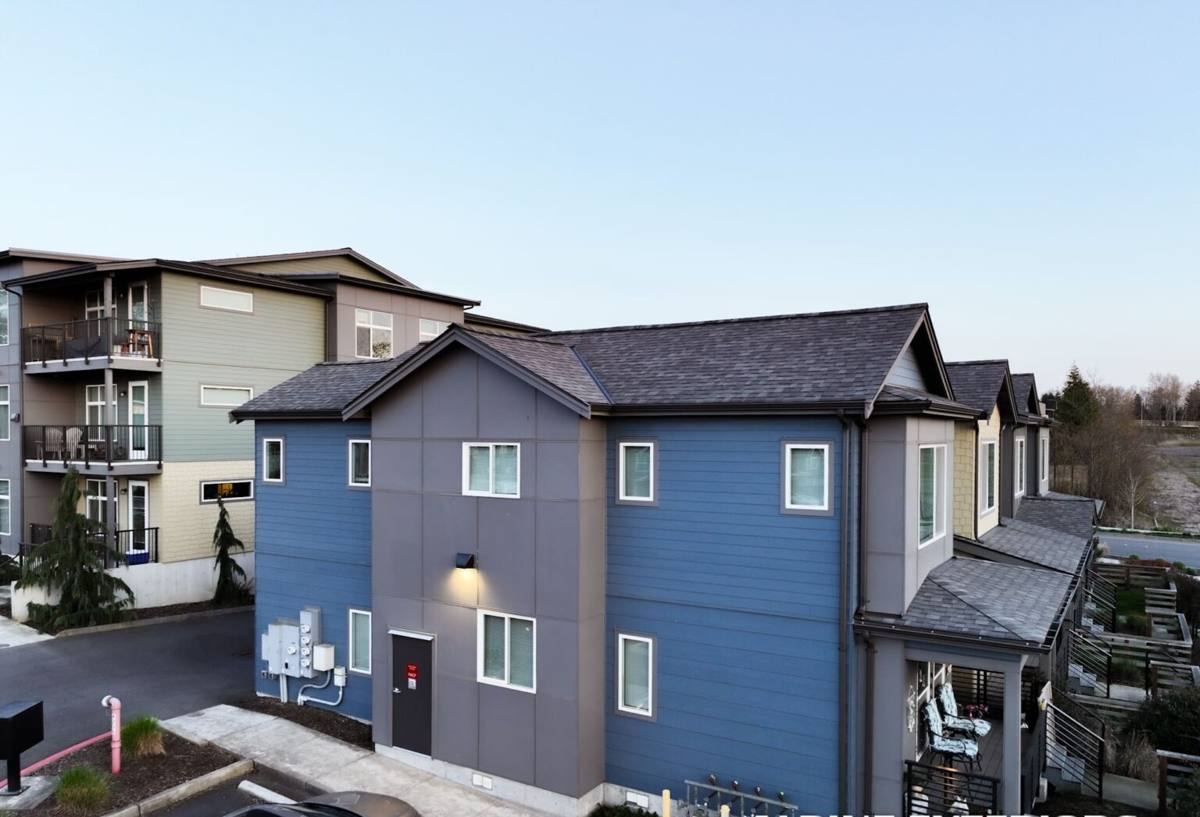
What Bellingham's Climate Puts Siding Through
Salt Air Off the Bay
Homes closer to the water get a steady drift of moisture-laden, salt-tinged air, not just on stormy days but as a low, constant background condition. That kind of exposure is slow to show damage but hard on fasteners, flashing, and lower-grade finishes over time. It's the reason we pay close attention to fastener material and finish quality on every Bellingham job, not just the siding panel itself.
Wind-Driven Rain
Rain here doesn't fall straight down nearly as often as people assume. Wind off the water pushes it sideways into wall penetrations, trim seams, and lap joints from angles that a purely vertical rainfall assumption would miss entirely. A siding system, house wrap, and flashing detail that would perform fine in a calmer, drier region can still let water in here because of that lateral pressure.
A Long Moss and Mildew Season
Mild temperatures, heavy tree cover in and around Bellingham, and near-constant dampness add up to extended moss and mildew growth wherever a wall stays shaded or damp longer than it dries. Any siding material with even slight porosity, or one that traps moisture against the substrate instead of shedding it, becomes a growth surface. It tends to show up first in the spots nobody checks often: behind shrubs, under eaves, on the north side of the house.
Why We Only Install James Hardie in This Climate
We don't offer a rack of siding brands and let price decide. We install James Hardie fiber cement, and the reason comes from what we consistently see on Bellingham tear-offs and repair calls, not from a sales brochure.
- Non-combustible fiber cement core: It doesn't feed a fire the way wood-based siding products can, which matters for household safety and can matter for insurance.
- Factory-cured ColorPlus finish: The color coat is baked on under controlled factory conditions instead of brushed on at the job site, so it holds up against fading and moisture intrusion far longer than field-applied paint.
- HZ5 formulation for this exact climate: Hardie engineers its HZ5 product line for regions with heavy sustained moisture and freeze-thaw cycling, which is a closer match to coastal Whatcom County than a generic national spec.
- Dimensional stability: Fiber cement doesn't swell, cup, or warp the way engineered wood products can after repeated wet-season moisture cycles.
- A strong, transferable warranty: Hardie backs its products with one of the more substantial warranty structures in the industry, provided installation follows spec, which is precisely why the installation details below matter as much as the product choice itself.
We don't install LP SmartSide, vinyl siding, Cemplank, Allura, primed spruce, or cedar. Those are legitimate products, and other contractors install them well. Our decision to standardize on one system came from wanting to stand fully behind what we put on a house rather than offer a cheaper option that quietly shifts maintenance risk onto the homeowner a few years down the line, once the crew that installed it is long gone.
Matching the Hardie Product Line to the House
James Hardie isn't a single product; it's a system with several lines, and picking the right one for a given Bellingham home is part of doing the job correctly rather than just defaulting to whatever is cheapest to stock.
| Product Line | Best Fit | Notes for This Climate |
|---|---|---|
| HardiePlank lap siding | Most single-family homes, traditional and modern styles | Widest color and texture range; the default recommendation for most Bellingham houses |
| HardiePanel vertical siding | Modern builds, accent walls, gable ends | Fewer horizontal laps means fewer joints for wind-driven rain to find |
| HardieTrim board and batten | Farmhouse and craftsman styles, accent sections | Needs precise fastening and caulk detailing at every batten to stay watertight |
| HardieShingle | Character homes, gable accents, older Bellingham neighborhoods | More labor-intensive to install correctly; worth it where the look matters |
On most jobs we recommend HardiePlank lap siding in the HZ5 formulation, with trim and accent details filled in from the other lines where the home's style calls for it. The right mix depends on the house, not on a one-size answer.
What a Correct Installation Actually Involves
James Hardie siding fails early almost exclusively because of installation mistakes, not because the material itself gave out. In a climate that pushes rain sideways and keeps things damp for long stretches, the details below are not optional extras. They're the difference between a wall system that sheds water and one that quietly traps it.
The Water-Resistive Barrier Comes First
Before a single piece of siding goes up, the house needs a properly lapped, taped, and flashed water-resistive barrier underneath. Hardie siding is not itself the primary defense against water intrusion; it's the outer layer of a system, and the barrier behind it is what actually keeps a wind-driven rain event from reaching the sheathing.
Flashing at Every Penetration and Transition
Windows, doors, deck ledgers, hose bibs, electrical penetrations, and roof-to-wall transitions all need flashing detailed to shed water outward and downward, not just caulk smeared over a gap. Caulk is a backup, not a flashing plan, and treating it as the primary seal is one of the most common shortcuts we find behind failing siding.
Fastener Placement and Gapping
Hardie specifies exact nailing patterns, fastener types, and minimum gaps between panels, trim, and adjoining surfaces to allow for expansion and drainage. Fasteners placed too high, too low, or too close to panel edges are a leading cause of cracking and premature wear, and it's a mistake that isn't visible from the ground once the job is finished.
Starter Strips and Bottom Clearance
The first course needs a proper starter strip, and the bottom edge of the siding needs clearance above grade, decks, and roof lines so water has somewhere to go instead of wicking up into the panel's cut edge, which is the most vulnerable part of any fiber cement board.
Field-Cut Edges Get Sealed
Every cut edge exposes the panel's core, and every exposed edge needs to be sealed with the manufacturer-approved product before installation. Skipping this step is invisible on install day and shows up as swelling or paint failure at cut edges within a few wet seasons.
Our Process, Start to Finish
- On-site assessment: We walk the whole exterior, not just the obviously worn sides, and check for hidden moisture damage at trim, penetrations, and grade-level siding before quoting anything.
- Scope and product selection: We recommend the Hardie product mix that fits the home's style and exposure, and we explain why, rather than defaulting to whatever is easiest to install.
- Tear-off and substrate check: Old siding comes off and we inspect the sheathing underneath for rot or prior water damage before anything new goes up, since covering a hidden problem with new siding just delays a much bigger repair.
- Water-resistive barrier and flashing: This is the step that actually determines whether the house stays dry, and we don't shortcut it to save a day of labor.
- Hardie installation to spec: Correct fastening, gapping, starter strips, and sealed cut edges throughout, not just on the sections a customer is likely to inspect closely.
- Final walk-through: We go over the finished job with the homeowner and point out anything worth knowing for long-term care.
Common Problems We Find on Bellingham Tear-Offs
When we remove old siding on a Bellingham home, a handful of issues show up often enough to be worth calling out before they become surprises during a quote.
- Missing or poorly lapped water-resistive barrier, found only once the old siding comes off
- Caulk used as a substitute for real flashing at windows and roof-to-wall transitions
- Siding installed tight against grade or a deck surface with no drainage clearance
- Moss and mildew staining concentrated on shaded, north-facing, or tree-covered walls
- Fastener corrosion consistent with sustained salt-air exposure closer to the water
- Unsealed field-cut edges showing early swelling on trim boards and panel ends
None of these are unusual for the climate. They're exactly what you'd expect after enough years of salt air and driving rain meeting an installation that cut a corner somewhere. Catching them at tear-off, rather than after new siding goes over the top of them, is part of why the substrate check matters as much as the siding itself.
Living With Hardie Siding in This Climate
Correctly installed James Hardie siding is low-maintenance, not no-maintenance. A periodic rinse to knock moss and grime off shaded walls, a visual check of caulking at penetrations every year or two, and prompt attention if a gutter starts overflowing onto a wall are about the extent of what it asks for. Compared to a wood-based or vinyl alternative that needs repainting, resealing, or panel replacement on a much shorter cycle in this climate, that's a modest ask for a siding system built to last decades when it's put on right.
Why Local Experience on This Job Matters
A crew that only occasionally works this stretch of coastline can install Hardie siding competently by the book and still miss the details that matter most for Bellingham specifically: how far to hold siding off a deck given how much rain actually collects there, which walls need extra attention for moss exposure based on tree cover and sun angle, and how aggressively to detail flashing given how often wind actually drives rain sideways in a given season. That's the kind of judgment that comes from doing this job repeatedly in this exact climate, not from a general contractor's license alone.
If your Bellingham home needs new siding, or you want a second opinion on whether an existing installation was done to spec, we're happy to take a look. Estimates are free, there's no pressure, and you'll get a straight answer about what your home actually needs.