 Fairhaven Siding
 Birchwood Roofs Take a Different Kind of Beating
Birchwood sits close enough to the water that its roofs deal with a combination most inland homes never see: salt-laden air, wind-driven rain coming off Bellingham Bay, and a moss season that can run eight months or longer in a wet year. None of these problems are dramatic on their own. They're slow. A little corrosion here, a little trapped moisture there, a little moss creeping under a shingle tab — and a few years later a homeowner is dealing with a stained ceiling or a soft spot in the decking that could have been a fifteen-minute fix if it had been caught earlier.
Roof repair in this part of Whatcom County isn't the same job as roof repair in a dry inland climate. The materials, the sequencing, and the things we check for are shaped by what the climate actually does to a roof here, not by a generic checklist.
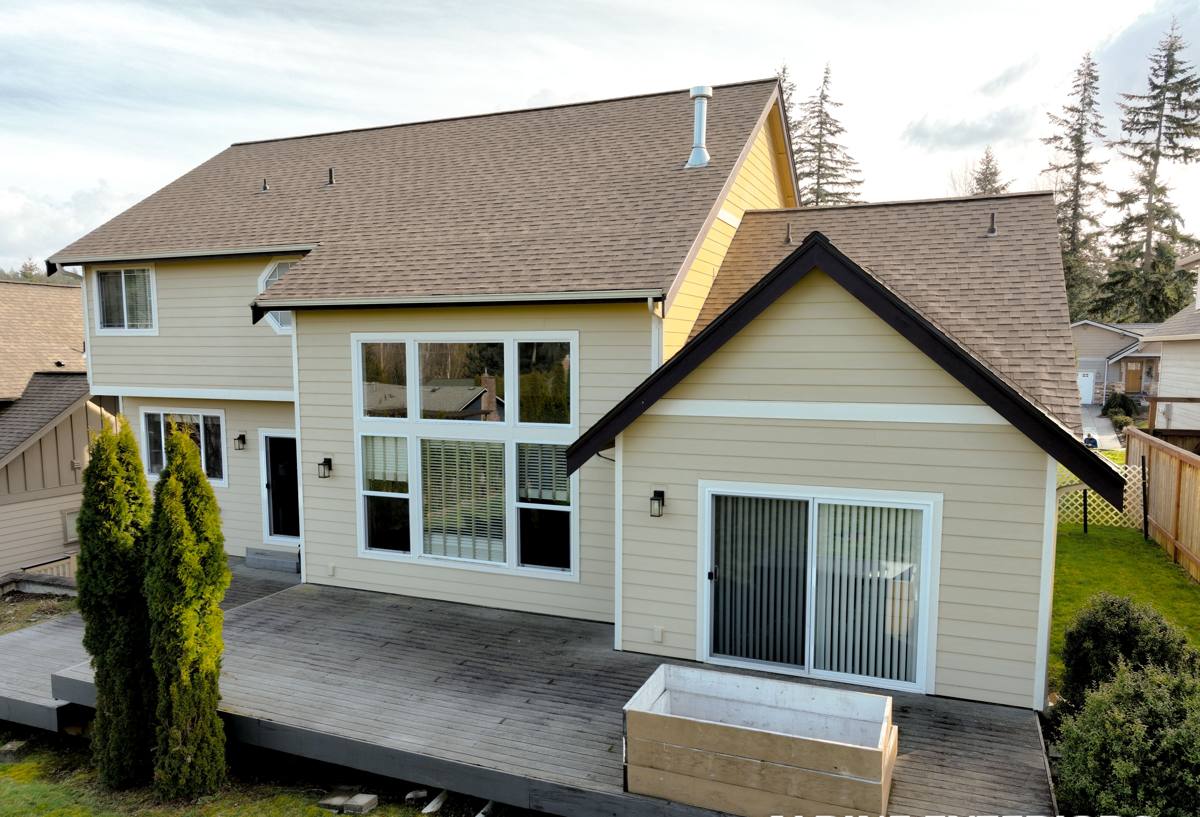
Common Roof Problems We Find on Birchwood Homes
Moss and Organic Growth
Moss doesn't just sit on top of shingles — it works its way under the tabs, holds moisture against the roofing material, and slowly lifts shingle edges as it grows. On north-facing slopes and shaded sections, moss can hold a roof damp for days after the rest of the neighborhood has dried out. Left alone long enough, it accelerates granule loss on asphalt shingles and can rot the decking underneath.
Corrosion on Metal Components
Salt air speeds up corrosion on anything metal — nail heads, flashing, gutter hangers, and vent caps. A fastener that would last decades inland can start rusting and backing out years sooner this close to the water. Once a fastener loosens or a flashing seam corrodes through, water has a direct path into the roof assembly.
Wind-Driven Rain Intrusion
Rain here doesn't always fall straight down. Storms off the water push rain sideways, which means water finds gaps that would never leak in a calm rain — around chimneys, skylights, dormers, and valleys. A flashing detail that's "good enough" for vertical rain often isn't good enough for driving rain.
Valley and Gutter Backups
Moss debris, needles, and leaf litter collect in valleys and gutters faster than most homeowners expect in this climate. Once a valley backs up during a heavy rain, water can back up under the shingles above it rather than running off the roof.
What a Correct Roof Repair Actually Involves
A repair that just covers the visible symptom — a cracked shingle, a stained ceiling patch — without addressing what let water in doesn't hold up in this climate. A correct repair traces the problem back to its source and fixes the whole path water could take, not just the spot where it showed up inside the house.
That usually means checking several things together, even for a repair that looks small from the ground:
- Condition of the decking underneath the damaged area — soft, delaminated, or discolored wood needs to be addressed, not covered over
- Underlayment condition around the repair zone, since a torn or degraded underlayment defeats the point of a new shingle on top of it
- Flashing at the nearest penetrations, valleys, or wall intersections, since a leak that shows up mid-roof often traces back to a flashing failure elsewhere
- Fastener condition in the surrounding field, especially in older sections where corrosion may already be underway
- Attic ventilation, since poor airflow traps moisture that accelerates the very problems driving the repair
Flashing and Fasteners We Trust in This Climate
We use corrosion-resistant fasteners and flashing metals suited to a marine environment rather than the standard-grade materials that are fine for drier, inland areas. It costs a little more up front, but it's a maintenance and moisture-behavior decision, not a marketing one — a fastener that corrodes and backs out in eight years turns a repair job into a repeat service call. On flashing details specifically, we favor step flashing and counter-flashing assemblies that shed wind-driven rain rather than sealant-dependent patches, since sealant alone breaks down faster in this climate than a properly lapped flashing detail.
Repair or Replace? Weighing the Cost Factors
Not every roof problem in Birchwood needs a full roof replacement, and not every leak can be fixed with a patch. The right call depends on the roof's age, how much of it is affected, and what's happening underneath the surface layer.
| Factor | Leans Toward Repair | Leans Toward Replacement |
|---|---|---|
| Roof age | Under roughly two-thirds of expected shingle lifespan | Nearing or past expected lifespan |
| Extent of damage | Isolated to one section, penetration, or valley | Spread across multiple slopes or the whole roof |
| Decking condition | Solid, dry decking around the damaged area | Widespread soft spots or rot found during inspection |
| Granule loss / shingle wear | Localized to the repair area | Uniform wear across most of the roof surface |
| Repair history | First or second repair in that area | Same area has needed repeat repairs |
We'll always tell you honestly which side of that table your roof falls on. A roof that's a good repair candidate doesn't need to be sold a replacement, and a roof that's genuinely at the end of its life shouldn't be patched indefinitely — that just spends money without solving the underlying problem.
Our Roof Repair Process
- Inspection and diagnosis. We get on the roof (not just a ground-level look) and trace the actual water path, checking flashing, valleys, penetrations, and the surrounding field, not just the spot where damage is visible from inside.
- Written scope and honest recommendation. You get a clear explanation of what's actually wrong, what needs to be repaired, and why — including whether repair or replacement makes more sense for your situation.
- The repair itself. We fix the source of the leak first, then address any secondary damage — decking, underlayment, or flashing — before finishing the visible repair.
- Cleanup. Old materials, debris, and moss buildup removed from the work area; gutters and valleys near the repair cleared while we're already up there.
- Follow-up. We stand behind the work and are reachable if anything comes up after the next few storms — not just after the invoice is paid.
Signs Your Birchwood Roof Needs Repair Now
- Visible moss buildup on shingles, especially on shaded or north-facing sections
- Granules collecting in gutters or at downspout outlets
- Staining or discoloration on interior ceilings, especially after wind-driven storms
- Rusted or discolored streaking below flashing, vents, or nail heads
- Shingles that look curled, lifted, or cracked at the edges
- Sagging or soft-feeling spots when walking the attic near the roofline
- Daylight visible through the roof deck from inside the attic
- Gutters or valleys that overflow or back up during heavy rain
Any one of these on its own doesn't necessarily mean a major problem, but they're worth having looked at before the next wet season rather than after.
Why a Crew That Already Works in Birchwood Matters
Roof repair diagnosis is largely about pattern recognition, and that pattern looks different close to the water than it does a few miles inland. A crew that regularly works Birchwood and the surrounding Fairhaven area already knows which roof orientations tend to hold moss longest, which flashing details tend to fail first in wind-driven storms, and roughly how a given roof age and material have held up under this specific combination of salt air and rainfall. That local pattern recognition shortens the diagnosis and reduces the odds of misdiagnosing a symptom as the cause.
There's also a practical side: familiarity with Whatcom County permitting requirements and local building department expectations for repair versus replacement work, so a repair doesn't stall out on paperwork it didn't need to hit in the first place.
Maintenance Between Repairs
In a moss-heavy, salt-air climate, a roof repair holds up longer when it's paired with basic maintenance in between service visits:
- Clear moss and debris from valleys and shaded slopes before it has a chance to hold moisture against shingles for extended periods
- Keep gutters and downspouts clear year-round, not just once in the fall, since debris accumulates continuously in this climate
- Trim back overhanging branches that keep sections of the roof shaded and slow-drying
- Have the roof looked at after any unusually strong wind or rain event, since that's when flashing and fastener issues tend to reveal themselves
- Address small issues — a lifted shingle tab, a loose fastener — as soon as they're noticed rather than waiting for a full inspection cycle
None of this replaces a proper inspection, but it meaningfully extends the time between repairs and keeps small issues from becoming structural ones.
Get an Honest Look at Your Roof
If you're seeing moss buildup, staining, or you just want a second opinion on a roof that's showing its age, we're happy to take a look. We'll give you a straightforward assessment of what's actually going on and what it would take to fix it — no pressure, no upsell. Fill out the form below to schedule a free estimate.