 Fairhaven Siding
 Why Chuckanut Decks Wear Differently Than Decks Inland
Chuckanut sits right where Fairhaven's wooded hillsides meet the water, and that location is exactly why decks here take a beating that a deck twenty minutes inland never sees. You've got salt-laden air coming off the bay, driving rain that comes in sideways during winter storms, and heavy tree cover that keeps everything shaded and damp long after the rain stops. Add in the moss season that Whatcom County residents know runs longer than most of the year, and you've got a combination that goes after wood, fasteners, and finishes from every angle at once.
We've repaired enough decks in this stretch of Fairhaven to know the failure patterns aren't random. They follow the terrain, the tree canopy, and the exposure each deck has to wind off the water. A deck repair here isn't the same job as a deck repair in a dry, open subdivision — and treating it like one is how you end up doing the same repair twice.
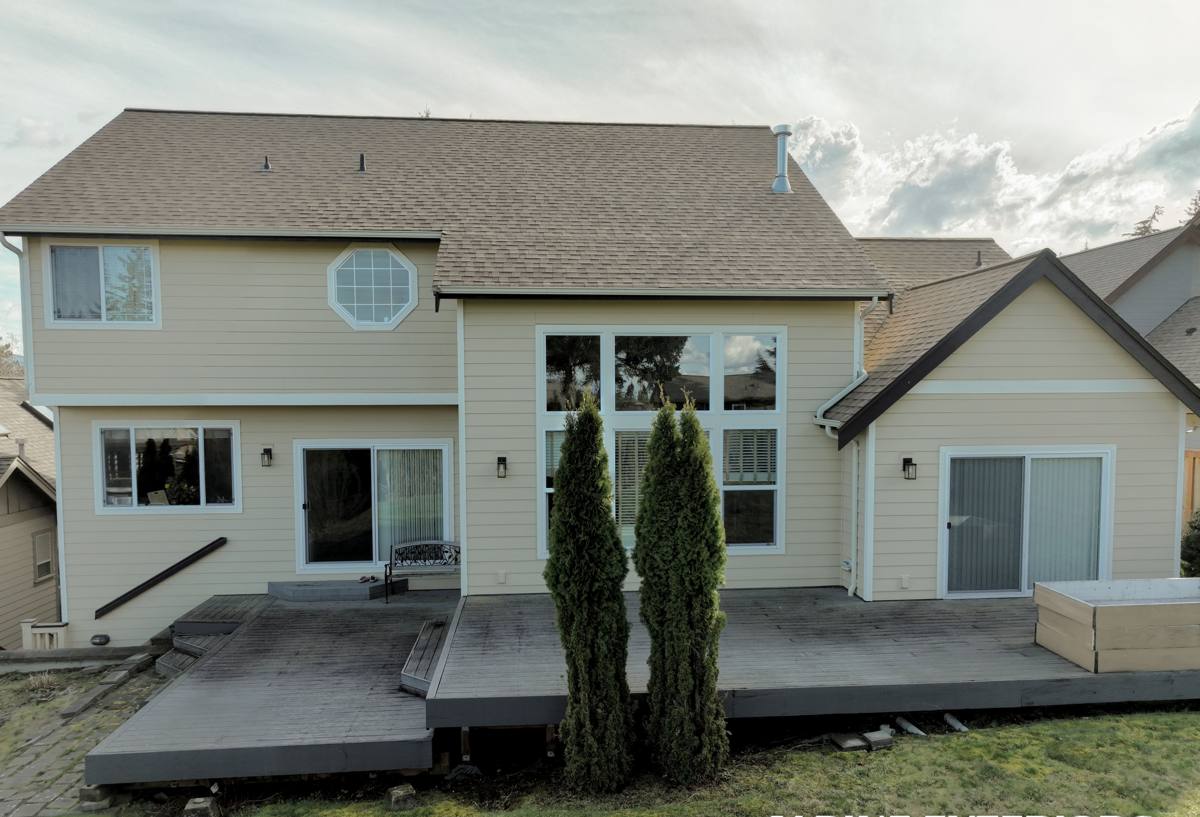
How Chuckanut's Terrain and Tree Cover Drive Deck Damage
Shade, Moss, and Slow Drying
Many Chuckanut properties sit under a mix of evergreens and deciduous trees that block direct sun for large parts of the day. That shade is part of what makes the area beautiful, but it also means deck boards stay damp far longer after a rain than they would in full sun. Moisture that lingers on wood is what feeds moss and algae growth, and moss holds even more moisture against the board surface — a cycle that accelerates rot if it isn't interrupted.
Cliffside and Sloped Lots
A fair number of homes along the Chuckanut corridor are built on sloped or elevated lots looking toward the bay. Decks on these lots often carry more structural load-bearing responsibility than a simple ground-level deck, since they may be the primary outdoor living space and sometimes tie into stairs or lower landings. When support posts, ledger boards, or footings on these decks start to fail, it's rarely just cosmetic — it's a structural issue that needs to be caught early.
Salt Air and Metal Fatigue
Proximity to the water means airborne salt settles on every exposed surface, including fasteners, brackets, and any exposed metal hardware. Standard coated screws and nails corrode faster here than they would further inland, and corroding fasteners are one of the most common hidden causes of a deck that feels "loose" or "bouncy" well before the boards themselves look bad.
Signs Your Chuckanut Deck Needs Repair
Most deck problems don't show up as one obvious failure — they show up as a handful of small signs that add up. Walk your deck and check for the following:
- Soft, spongy, or springy spots underfoot, especially near the house or stair landings
- Persistent moss or green-black staining that comes back within weeks of cleaning
- Rust streaks below screw heads or around metal brackets and post connectors
- Gaps opening up between boards or boards that have visibly cupped or crowned
- Railings that flex or wiggle when you lean on them
- Ledger board area (where the deck attaches to the house) showing dark staining or separation
- Stair stringers that feel uneven or show splitting at the base
- Standing water that takes more than a day to fully drain after rain
Any one of these on its own might be minor. Two or three together usually means moisture has been working on the structure for a while, and it's worth having someone look underneath, not just at the surface.
What a Correct Deck Repair Actually Involves
Structural Inspection First
Before we touch a single board, we get underneath the deck and check the framing — joists, beams, posts, and footings — along with the ledger connection to the house. Surface repairs on a deck with a compromised frame are a waste of money, because the new boards will fail again once the structure underneath keeps moving or rotting.
Board-Level and Localized Repair
Where the frame is sound, repair often means replacing individual damaged boards rather than the whole surface, sistering a cracked joist rather than tearing out the deck, or resetting fasteners that have backed out or corroded. This is the more affordable path when the problem hasn't spread beyond a few localized areas.
Fasteners, Flashing, and Water Management
A repair that ignores water management just resets the clock on the same failure. That means correcting flashing at the ledger board where the deck meets the house, making sure boards have proper gapping and drainage, and upgrading to fasteners rated for coastal or high-moisture exposure where the originals have already started corroding.
Railings and Stairs
Railings and stair stringers take constant hand contact and weather exposure, and on sloped Chuckanut lots they also carry real safety weight. We check post connections, baluster spacing against current code, and stringer integrity as part of any repair — not as an afterthought.
Repair vs. Full Replacement: What Actually Drives the Decision
Homeowners understandably want a straight answer on repair versus replacement, but the honest answer depends on a handful of factors we evaluate on site.
| Factor | Favors Repair | Favors Replacement |
|---|---|---|
| Framing condition | Joists, beams, posts sound and dry | Rot or soft spots in multiple structural members |
| Extent of damage | Isolated boards or fasteners | Damage spread across most of the deck surface |
| Age of the deck | Under 10-15 years, built to a solid standard | Original construction is decades old or undersized for current use |
| Ledger connection | Properly flashed and attached | Improperly flashed or showing water intrusion into the house rim joist |
| Budget goals | Lower upfront cost, targeted fix | Better long-term value if most of the deck needs work anyway |
In our experience on Chuckanut properties, decks that were built with decent framing but have suffered surface-level moss, board, and fastener damage are usually strong repair candidates. Decks where the ledger or main framing has been compromised by long-term moisture are where replacement starts making more financial sense than repeated repairs.
Choosing Materials That Actually Hold Up Here
When we're replacing boards or rebuilding sections, material choice matters more in a climate like this than it does in drier parts of the state.
Pressure-Treated Lumber
Pressure-treated lumber remains a solid, affordable option for framing and can work for decking boards too, but it requires consistent maintenance — cleaning, sealing, and re-staining on a regular cycle — to keep performing in a shaded, damp environment. Skipping that maintenance is the single biggest reason we see premature rot on wood decks in this area.
Cedar
Cedar has natural rot resistance and looks the part of a Pacific Northwest deck, but it's a softer wood that still needs periodic sealing to hold up against the moss and moisture cycle Chuckanut sees for much of the year. It's a good fit for homeowners who want a wood look and are committed to the upkeep.
Composite Decking
Composite boards trade a higher upfront material cost for a much lower maintenance burden — no staining, better moisture resistance, and better resistance to the algae and moss staining common under tree cover. We recommend it as our default suggestion for repair sections on shaded or heavily exposed Chuckanut decks, though the substructure underneath still needs to be real, treated wood framing regardless of what decking material sits on top.
Whichever material you choose, the fasteners and hardware matter just as much as the boards. On a property exposed to salt air, we default to stainless steel or coated fasteners specifically rated for coastal and marine-adjacent use, since standard hardware corrodes faster here and hidden fastener failure is a common cause of "mystery" deck movement.
Our Deck Repair Process
- On-site assessment — we inspect the deck surface, framing, ledger connection, and hardware, and walk you through exactly what we find, good or bad.
- Honest scope and estimate — you get a clear breakdown of what's repair-only versus what would need replacement, with reasoning, not just a number.
- Repair work — targeted board, framing, fastener, or flashing repairs using materials suited to your deck's specific exposure.
- Structural check and cleanup — we confirm the deck is solid underfoot and railings are secure before we consider the job done, and we clean up fully before we leave.
Why It Matters to Hire a Crew That Already Works in Chuckanut
Deck repair looks like a simple trade until you're standing under a deck built on a sloped lot, trying to figure out why moss keeps coming back in the same spot every six months, or why fasteners a contractor from out of the area used are already rusting through. A crew that regularly works Fairhaven and the Chuckanut area has already seen how shade patterns, slope, and salt exposure play out on real decks nearby — not just in a textbook. That local pattern recognition is what separates a repair that lasts from one that needs redoing in two years.
If your deck has soft spots, recurring moss, loose railings, or you're just not sure whether it needs a repair or a rebuild, we're happy to take a look. Reach out for a free, no-pressure estimate using the form below, and we'll give you a straight answer about what your Chuckanut deck actually needs.