 Fairhaven Siding
 Deck Repair Built for Ferndale's Climate
Ferndale sits close enough to the water and far enough into Whatcom County's marine weather pattern that decks here age differently than decks fifty miles inland. Salt-tinged air off the Strait, long stretches of driving rain from fall through spring, and a moss season that can run eight months out of the year all work on wood, fasteners, and finishes at the same time. A deck that would last two decades in a dry climate can start showing real structural problems in half that time here if it wasn't built or maintained with this weather in mind.
We repair decks throughout Ferndale and the surrounding Fairhaven service area, and most of what we see falls into a short list of recurring problems: soft or delaminating boards, rusted or failing fasteners, moss and algae holding moisture against the surface, and ledger or post connections that have quietly loosened over the years. None of these are exotic issues. They're the predictable result of Whatcom County weather meeting a structure that's exposed to it 365 days a year.
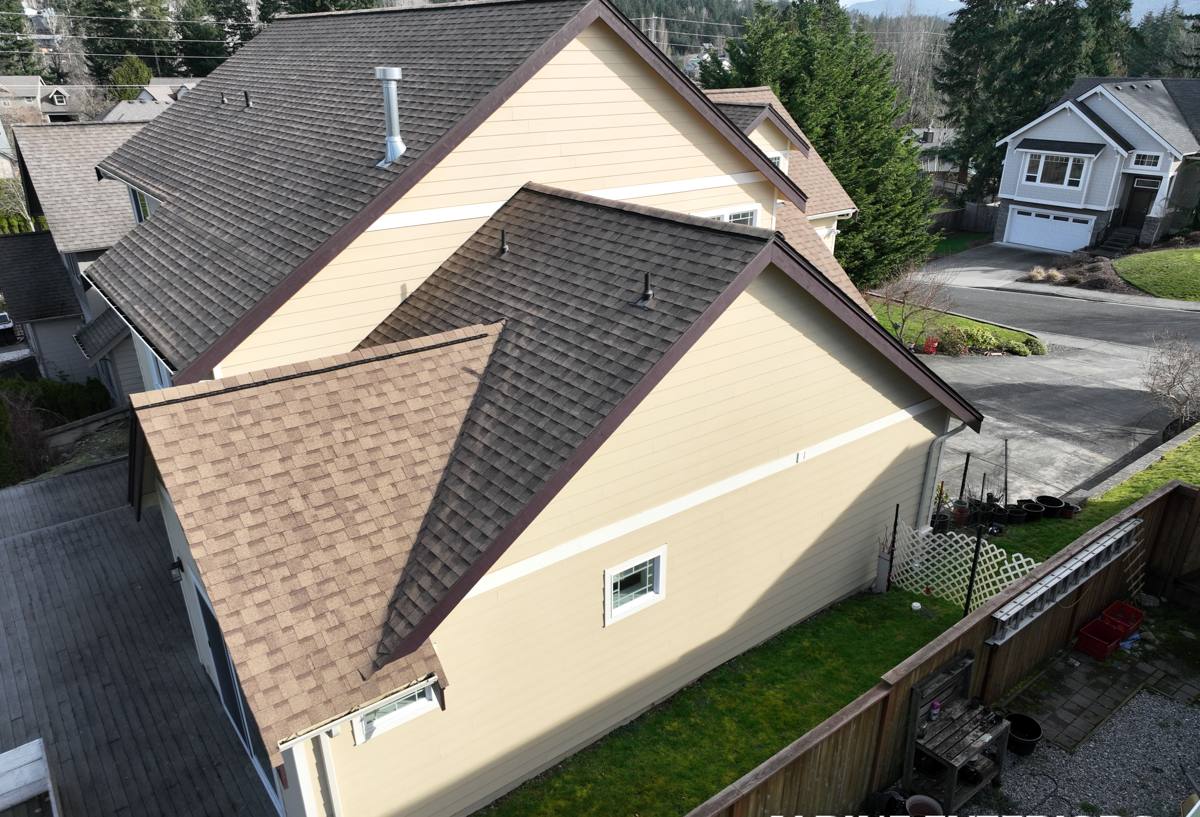
Why Decks Fail Faster Near Fairhaven
Salt Air and Metal Fasteners
Proximity to the water means airborne salt settles on exposed surfaces, including the metal that holds a deck together. Nails, screws, joist hangers, and bolts that aren't rated for coastal exposure corrode faster than most homeowners expect. Corrosion doesn't just look bad — it weakens the connection long before the rust is visible from the surface, which is why fastener failure is one of the most common "hidden" problems we find during a deck inspection.
Driving Rain and Standing Moisture
Whatcom County doesn't just get rain, it gets rain pushed sideways by wind for days at a stretch. Water finds its way into every joint, screw hole, and end-grain cut that isn't properly sealed. On older or poorly maintained decks, that moisture gets trapped under boards, between ledger boards and the house, and inside post bases — areas that never fully dry out between storms.
Moss, Algae, and Surface Breakdown
The long moss season here isn't just a cosmetic nuisance. Moss and algae hold moisture directly against decking boards and stair treads, which accelerates rot and turns a walking surface slick and dangerous. Left untreated over a few winters, moss growth can do as much damage to a deck surface as the rain itself.
What a Correct Deck Repair Actually Involves
A lot of "deck repair" in this region amounts to replacing a rotten board and calling it done. That fixes the symptom, not the cause. A repair that actually holds up through another Whatcom County winter needs to address what caused the failure in the first place.
- Full structural inspection — ledger board attachment, post bases, joist hangers, and beam connections, not just the visible decking surface
- Moisture source identification — flashing gaps, missing ledger flashing, poor drainage, or grade issues pushing water toward the structure
- Fastener assessment — checking for corrosion in hidden connectors, not just surface screws
- Board-by-board evaluation — distinguishing surface weathering from actual rot or delamination
- Railing and stair safety check — loose posts and worn stair treads are a common liability issue on older decks
Skipping the inspection step is how homeowners end up paying for the same repair twice. If a ledger board is leaking behind the siding, replacing the deck boards in front of it buys a year or two at most.
Repair vs. Rebuild: How We Help You Decide
Not every deck problem needs a full rebuild, and not every deck is worth patching. The honest answer depends on how much of the structure — not just the surface — has been compromised.
| Condition | Likely Fix | What Drives the Decision |
|---|---|---|
| Isolated soft or cracked boards, structure sound | Board replacement | Framing and posts test solid; problem is limited to a few boards |
| Rust staining, loose railings, minor movement | Fastener and hardware replacement | Corroded connectors can be swapped without rebuilding the frame |
| Ledger board moisture damage | Ledger repair with proper flashing | Addresses the root cause, protects the house band joist too |
| Widespread rot in joists or beams | Partial or full rebuild | Repairing individual framing members piecemeal rarely holds up |
| Deck over 20-25 years old, multiple systems failing at once | Full rebuild | Cost of repeated repairs starts to exceed the cost of rebuilding |
We'll always give you the repair option first if the structure supports it. A rebuild recommendation only comes when the numbers and the safety picture actually point that way.
Materials That Hold Up in This Climate
Material choice matters more here than in drier parts of the state, and it matters differently depending on which part of the deck you're talking about.
Decking Surface
Composite and PVC decking have become popular for repairs and replacements because they resist moisture absorption and don't need refinishing. The trade-off is upfront cost and the fact that not every composite handles moss and algae growth the same way — some surfaces need occasional cleaning to stay slip-resistant. Pressure-treated lumber is still a reasonable, lower-cost option for structural framing and for homeowners who prefer to maintain a wood deck with regular sealing.
Fasteners and Hardware
Given the salt air exposure common near Fairhaven, we use fasteners and structural connectors rated for coastal or high-corrosion environments rather than standard-grade hardware. It costs a little more upfront and it's the difference between hardware that lasts the life of the deck and hardware that needs replacing again in five years.
Flashing and Moisture Barriers
Ledger board flashing is non-negotiable on any repair where the deck attaches to the house. It's inexpensive relative to the rest of the job and it's the single most effective way to prevent the kind of hidden rot that turns a simple repair into a rebuild.
Our Deck Repair Process
- On-site inspection — we walk the full structure, not just the visible surface, and check framing, fasteners, and moisture points
- Honest assessment — you get a clear explanation of what's failing, why, and what the realistic repair options are
- Written scope and estimate — no vague verbal quotes; you see exactly what's being repaired and why
- Repair work — structural fixes first, then surface and cosmetic work, using fasteners and materials suited to this climate
- Final walkthrough — we check railings, stairs, and surface for safety before we consider the job done
Signs Your Ferndale Deck Needs Attention
Most deck problems give warning signs well before they become safety issues. Catching them early is what keeps a repair small.
- Boards that feel spongy, spring back slowly, or flex more than they used to
- Rust streaks running down from screws, nails, or metal connectors
- Persistent moss or dark green-black staining on the surface or under railings
- Gaps opening up where the deck meets the house siding
- Railings or stair posts that wiggle or feel less solid than before
- A musty smell coming from underneath the deck, especially after rain
- Visible daylight or water staining around the ledger board
If you're seeing more than one of these at once, it's worth having the structure looked at rather than waiting for a single board to give way.
Maintenance That Extends the Life of a Repair
A good repair done right can last a long time in this climate, but only if it's paired with basic upkeep. We tell every homeowner the same thing: the biggest threat to a Whatcom County deck isn't one bad storm, it's years of moisture and moss being ignored.
- Clear leaves and debris from between boards before they trap moisture through the winter
- Treat moss and algae growth early in the season rather than letting it establish
- Check railings and stair connections for looseness once or twice a year
- Keep gutters and downspouts near the deck clear so water isn't dumping directly onto or under it
- Reseal wood decking on the manufacturer's recommended schedule if you've chosen a wood surface
Why Hire a Crew That Already Works in Ferndale
Deck repair done by a crew unfamiliar with this specific stretch of Whatcom County often misses the climate-specific causes behind the damage — a contractor used to drier inland conditions may replace boards without addressing the salt-air corrosion or moisture patterns that caused the failure in the first place. We work on decks across the Fairhaven area regularly, which means we recognize these patterns immediately: which fastener types hold up here, where moss tends to establish first, and which framing details tend to trap water in this climate. That familiarity shows up as a repair that solves the actual problem instead of one that needs to be redone in a few years.
Get a Free, No-Pressure Estimate
If your deck in Ferndale is showing soft boards, rust stains, loose railings, or persistent moss, it's worth getting an honest look before small problems turn into structural ones. We offer free, no-pressure estimates and will tell you plainly whether you're looking at a targeted repair or something bigger — use the form below to get started.