 Fairhaven Siding
 Why Edgemoor Roofs Take a Different Kind of Beating
Edgemoor sits close enough to the water that salt air is just part of daily life. That salt doesn't stay outside — it settles on every exterior surface, including your roof, and it accelerates corrosion on fasteners, flashing, and any metal that isn't built for a marine environment. Combine that with the driving, wind-blown rain that comes through Whatcom County off the Strait, and a roof here is working harder than the same roof would fifty miles inland. Add a moss season that can run eight or nine months out of the year in the shade of the mature trees common to this neighborhood, and you've got three separate stresses — salt, water, and organic growth — all landing on the same roof at once.
Asphalt shingles were never designed around all three of those at the same time. They granulate faster in salt-laden air, they're a magnet for moss because their surface texture gives spores something to grip, and once moss takes hold it holds moisture against the shingle mat year-round. Metal roofing, installed correctly, answers all three problems directly. That's the whole reason we're writing this page specifically for Edgemoor rather than pointing you to a generic metal roofing brochure — the climate here is specific, and the installation details that matter here aren't the same ones that matter in a dry inland town.
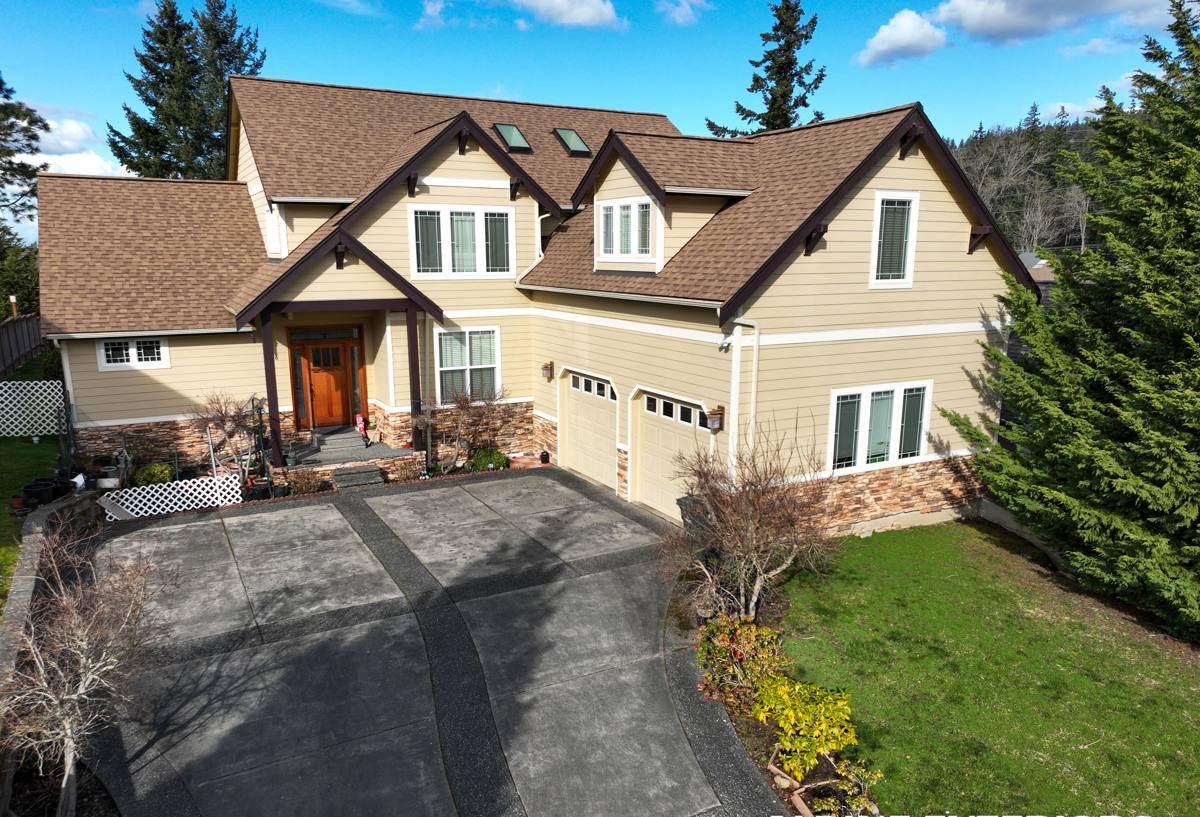
What a Coastal Metal Roof Actually Needs to Do
A metal roof that's going to hold up in Edgemoor's conditions has to manage three things at once, not just one:
- Shed water fast and completely — driving rain off the water doesn't fall straight down, it drives sideways under wind load, which means laps, seams, and flashing details all get tested harder than a calm-weather roof.
- Resist corrosion from salt exposure — this affects the panel coating, the fastener material, and every piece of flashing and trim, not just the field of the roof.
- Shed moss and organic debris instead of collecting it — panel profile, slope, and surface finish all affect whether moss spores get a foothold or simply wash off.
Get any one of those wrong and you end up with a roof that looks fine from the ground for a few years and then fails from the inside — corroded fasteners backing out, moss-choked valleys holding water against the deck, or seams that were never really weathertight in a sideways storm.
Salt Air and Metal Coatings
Not every metal roofing product is rated the same way for coastal exposure. Coating systems and base metals both have documented resistance to salt spray, and in a neighborhood this close to the water, that rating isn't a marketing detail — it's the difference between a panel that still looks and performs the same at year fifteen and one that's showing white rust or coating breakdown at year five. We select panel and fastener systems with coastal-rated finishes for Edgemoor work as a matter of standard practice, not an upgrade you have to ask for.
Driving Rain and Panel Seams
Wind-driven rain finds every weak seam. On a standing seam roof, the mechanically or hand-crimped seam is the single most important detail on the entire roof — it's what keeps wind-pressurized water from being pushed backward under the panel. On an exposed-fastener panel, the exposed screw and washer at every fastener point is the vulnerable spot, and it's why we're careful about fastener spacing, torque, and washer condition on every job.
Moss and Panel Profile
Moss needs three things to establish itself: shade, moisture, and a surface it can grip. A smooth, properly sloped metal panel gives it almost nothing to hold onto compared to a shingle mat, but valleys, low-slope transitions, and areas under heavy tree cover still need attention. We pay particular attention to valley design and slope transitions on Edgemoor homes with mature tree canopy, because that's where moss and needle debris actually collect even on an otherwise moss-resistant roof.
What a Correct Installation Involves
Metal roofing rewards correct installation and punishes shortcuts more than almost any other roofing material — because there's no second layer of material to hide a mistake the way there can be with layered shingles. A few details we treat as non-negotiable on every job:
Deck Inspection and Prep
We don't install over a deck we haven't actually looked at. Soft spots, old fastener patterns, and any existing moisture damage get addressed before a single panel goes down. On a home with an older roof coming off, this is also the point where we can see firsthand how much damage prior moss growth or slow leaks may have already done to the sheathing.
Underlayment Choice
A synthetic or self-adhered underlayment rated for metal roofing does two jobs: it's a secondary water barrier if wind-driven rain ever does get past a seam, and it protects the deck during installation. In a driving-rain climate, we don't treat underlayment as an afterthought — it's specified as part of the assembly, not just whatever's on hand.
Fastening and Flashing
Every fastener, clip, and piece of flashing on the roof is a potential entry point for water or a potential corrosion site. Matching fastener material to panel material avoids galvanic corrosion, and every penetration — vent stacks, chimneys, skylights — gets flashed as its own detail rather than caulked over as a shortcut. Caulk is a maintenance item, not a waterproofing method, and we treat it that way.
Ventilation
A metal roof still needs a ventilated assembly underneath it. Proper intake and exhaust ventilation controls condensation on the underside of the panels and keeps the attic or roof assembly from becoming its own moisture problem, which matters even more in a humid, marine climate than it does inland.
Comparing Roofing Options for a Home Like Yours
Metal isn't the only option, and it isn't automatically the right one for every Edgemoor home. Here's how it stacks up against the alternatives most homeowners are actually weighing:
| Factor | Metal Roofing | Architectural Asphalt Shingle | Cedar Shake |
|---|---|---|---|
| Typical lifespan | 40–60+ years with correct install | 20–30 years | 20–30 years, shorter in shade |
| Moss resistance | High if slope and profile are right | Low — textured surface holds spores | Low — organic material, moisture-retentive |
| Salt air / coastal durability | High with coastal-rated coating and fasteners | Moderate — granule loss accelerates near salt air | Moderate to low — accelerated weathering |
| Maintenance burden | Low — periodic debris clearing and inspection | Moderate — moss treatment, granule loss monitoring | High — moss treatment, re-coating, plank replacement |
| Upfront cost | Higher | Lowest | High |
| Installation sensitivity | High — details matter, workmanship-dependent | Moderate | High |
We install metal roofing because, for the climate we work in, it's the option that best balances the salt, rain, and moss problem in one material — but we'll say plainly if a particular home, budget, or roof geometry points toward a different answer. There's no upside to us pushing a product that isn't right for your specific situation.
Standing Seam vs. Exposed Fastener Panels
Within metal roofing itself, the two most common systems for residential work are standing seam and exposed-fastener panels. Standing seam has no exposed fasteners in the field of the roof — the panels interlock and the fastening clips are hidden underneath — which gives it the best long-term performance against driving rain and eliminates the maintenance item of re-torquing or replacing exposed screws over time. Exposed-fastener panel systems cost less upfront but carry a real maintenance obligation: the neoprene washers under each screw head do wear out, and in a wet, salty climate that timeline is shorter than it would be inland. We install both, and we'll walk you through which one makes sense for your roof, your budget, and how long you plan to own the home.
How Our Process Works
Every metal roofing job we do in Edgemoor follows the same sequence, because skipping steps is where problems start:
- On-site assessment — we walk the roof and the attic or crawlspace where accessible, checking deck condition, existing ventilation, and any signs of past moss or moisture damage.
- Written proposal — panel system, coating, underlayment, flashing details, and price are spelled out before any work starts, not decided on the fly.
- Tear-off and deck repair — old roofing comes off, the deck gets inspected in daylight, and any repairs are made and documented before underlayment goes down.
- Underlayment and flashing installation — the water-management layer goes in first, including all valley, penetration, and edge flashing.
- Panel installation — panels are set, seamed or fastened per the specified system, with attention to consistent reveal and alignment.
- Final inspection and walkthrough — we go over the finished roof with you, including what routine maintenance actually looks like for your specific system.
We don't sub out the core installation to a rotating crew — the same team that assesses your roof is the one installing it, which matters when so much of a metal roof's performance depends on details that don't show up on a spec sheet.
Living With a Metal Roof in a Moss-Heavy, Salt-Air Climate
A correctly installed metal roof is genuinely low-maintenance, but "low-maintenance" doesn't mean "no maintenance," especially in this climate. A simple, honest checklist for what upkeep actually looks like:
- Clear needle and leaf debris from valleys and gutters at least twice a year, more often under heavy tree cover.
- Check gutters and downspouts for granule-free, unobstructed flow — metal roofs shed water fast, and clogged gutters can back that water up under the drip edge.
- Look for any early moss establishment in shaded valleys or north-facing slopes and address it before it spreads.
- Have flashing around chimneys, vents, and skylights inspected periodically — these are the highest-risk points on any roof, metal included.
- After major windstorms, do a visual check for any lifted panel edges or debris impact, particularly if you're closer to mature trees.
None of this requires the annual re-treatment or re-coating that cedar shake or aging asphalt shingles do — that's the actual maintenance payoff of metal in this climate, not a marketing claim.
What Drives the Cost
Metal roofing costs more upfront than asphalt shingles, and the honest answer to "how much" depends on several factors that are worth understanding before you get quotes:
| Cost Factor | Why It Matters |
|---|---|
| Panel system (standing seam vs. exposed fastener) | Standing seam costs more in materials and labor but has lower long-term maintenance. |
| Roof complexity | Valleys, dormers, and multiple planes all add seaming, flashing, and labor time. |
| Coating and gauge | Coastal-rated coatings and heavier gauge panels cost more but hold up longer against salt air. |
| Deck condition | Any sheathing repair or replacement found during tear-off adds to the scope. |
| Tear-off vs. overlay | Full tear-off costs more than an overlay but lets us properly inspect and prep the deck — we recommend it in nearly all cases here. |
We'll break these down specifically for your roof in a written estimate rather than quoting a ballpark number that doesn't reflect your actual home.
Why It Matters That We Already Work in Edgemoor
A crew that's worked roofs in this specific neighborhood already knows which slopes hold moss longest through the wet season, which fastener and coating specs actually hold up against the salt air coming off the water, and how the wind-driven rain patterns here differ from what you'd plan for a few miles inland. That's not something you can fully substitute with a general contractor working from a national spec sheet. It shows up in small decisions — where we add extra flashing attention, which panel coating we default to, how we handle a valley under heavy tree cover — that add up to a roof that actually performs the way it's supposed to for its full lifespan, not just the first few dry summers.
If you're weighing metal roofing for your Edgemoor home, we're happy to walk the roof with you, talk through what your specific situation needs, and give you a straightforward, no-pressure written estimate. There's no cost and no obligation to get that conversation started — just use the form below.