 Fairhaven Siding
 Why Decks in Ferndale Wear Out Faster Than People Expect
Ferndale sits close enough to the water and to the marine weather pattern that moves through Whatcom County that decks here age differently than decks inland. Salt-laden air corrodes fasteners and hardware years before the boards themselves show real damage. Driving rain — the kind that comes in sideways off a windstorm rather than falling straight down — gets up under railings, around post bases, and into ledger connections that were never flashed to handle it. And the long stretch of grey, wet months every fall through spring means moss and algae get a real foothold on any decking that doesn't shed water fast or resist organic growth.
None of that is unusual for this part of Washington. It's just something a deck built somewhere drier was never designed for. When we get called out to look at a deck that's failing early, it's rarely one dramatic problem — it's this combination of salt air, moisture, and moss working on the structure a little every year until the cumulative damage shows up all at once.
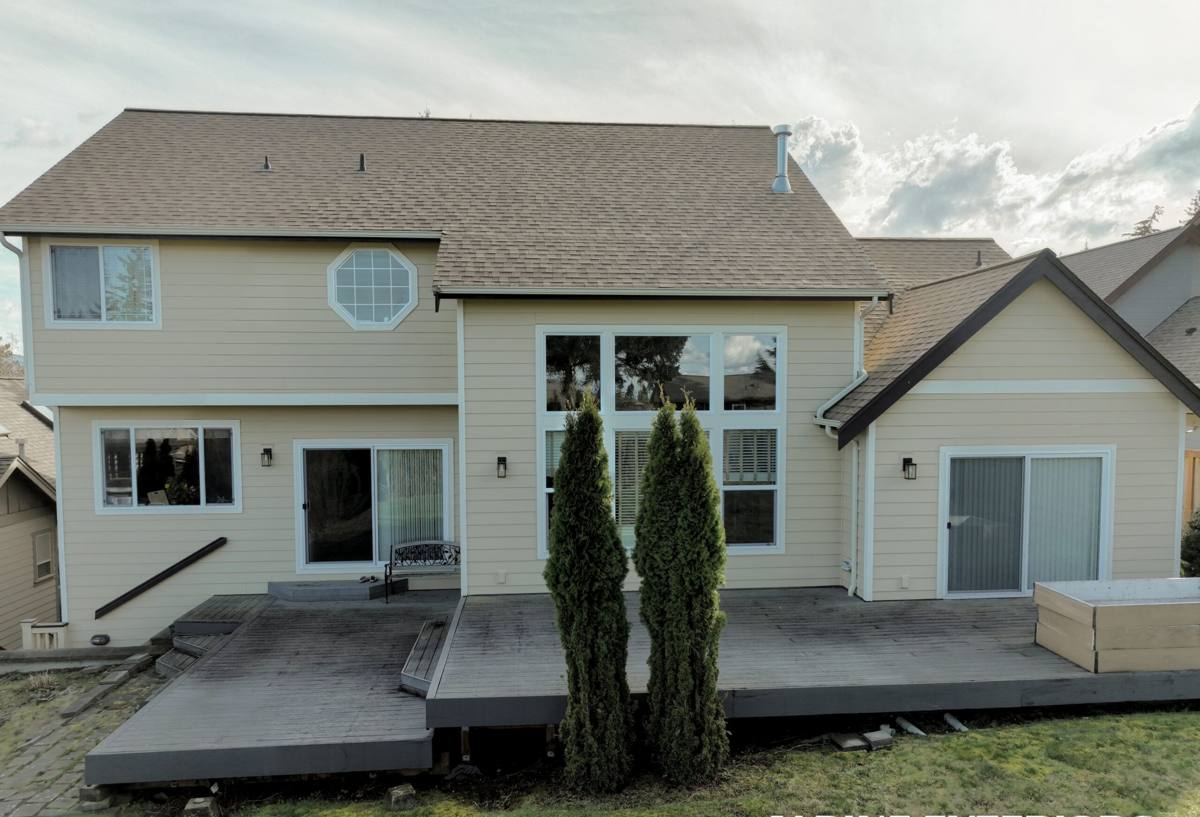
Signs a Deck Needs Replacement, Not Another Repair
Homeowners often ask us to patch a board or two, and sometimes that's the honest answer. But there's a point where spot repairs stop making sense and a full replacement is the more cost-effective, safer path. Here's what we look for during an inspection:
- Soft, spongy decking in more than one or two isolated spots — usually means moisture has gotten into the framing below, not just the surface boards
- Rust streaking or crumbling around fastener heads, which points to corroded hardware that's no longer holding the structure together properly
- A ledger board (where the deck attaches to the house) that's discolored, soft, or pulling away — this is a safety issue, not a cosmetic one
- Persistent moss or black-green staining that comes back within weeks of cleaning, meaning the surface no longer sheds water the way it should
- Wobble or movement in railings or posts, which often means the post bases or footings have degraded
- A deck older than 15-20 years built with original-era pressure-treated lumber and fasteners not rated for today's treated wood chemistry
If we find one or two of these, repair is often still reasonable. If we find several at once, replacement usually costs less over time than chasing repairs on a structure that's failing systemically.
Choosing Decking Material for Whatcom County Conditions
There's no single "best" decking material — there's the material that fits your budget, your maintenance tolerance, and the specific exposure your deck gets (full sun, deep shade, close to salt air, sheltered by trees). We walk every homeowner through the honest trade-offs rather than pushing whatever's easiest for us to install.
Pressure-Treated Wood
Still the most affordable option and a reasonable choice if you're willing to stay on top of maintenance — cleaning, sealing, and re-staining on a regular cycle. In a climate with this much rain and moss pressure, skipping that upkeep for even a couple of seasons lets moisture and organic growth get ahead of you.
Cedar
Naturally more rot- and insect-resistant than most softwoods and it has real aesthetic appeal, but it's a softer wood that shows wear from foot traffic and weather faster than composite, and it still needs periodic sealing to hold its color and resist the moss and mildew that thrive in this climate.
Composite and Capped Composite
Higher upfront cost but no staining or sealing, and the better capped products resist moisture absorption and staining far better than wood — which matters when moss and algae are a year-round concern rather than a seasonal nuisance. The trade-off is that lower-quality composite (older, uncapped formulations) can hold moisture within the board itself and support mold growth internally, so we're selective about which composite lines we'll install and stand behind.
| Material | Upfront Cost | Maintenance | Moss/Moisture Resistance | Typical Lifespan |
|---|---|---|---|---|
| Pressure-Treated Wood | Lowest | High — annual cleaning/sealing | Fair, depends on upkeep | 10-15 years |
| Cedar | Moderate | Moderate — periodic sealing | Good naturally, needs help long-term | 15-20 years |
| Capped Composite | Highest | Low — occasional washing | Very good | 25-30+ years |
What a Correct Deck Replacement Actually Involves
The decking boards are the part everyone sees, but the parts that determine whether a new deck lasts 10 years or 25 are almost all hidden underneath. This is where we spend most of our attention, because it's also where driving rain and salt air do the most damage over time.
Ledger Board and Flashing
The ledger — where the deck bolts into the house rim joist — is the single most common point of failure we see on older decks in this area. Proper flashing, installed so water is directed out and away from the house rather than trapped behind the board, is non-negotiable on every replacement we do. Sideways-driving rain finds any gap here.
Footings and Framing
Footings need to be sized and set to current code depth, and framing hardware — joist hangers, post bases, structural screws — has to be rated for ground contact and treated-lumber contact where applicable. We don't cut corners on footings just because the old ones were "probably fine."
Fasteners and Hardware
Given how much salt air accelerates corrosion here, we use stainless steel or heavy hot-dip galvanized fasteners and connectors rather than the lighter coated hardware that's adequate in drier, inland climates. This is one of the cheapest upgrades in the whole project and one of the most important for longevity.
Ventilation and Drainage Beneath the Deck
Low decks with poor airflow underneath trap moisture and become a breeding ground for moss and mildew that eventually creeps up into the deck boards themselves. We grade and, where needed, add ventilation so water actually leaves the space instead of sitting under the structure through the wet season.
Our Deck Replacement Process
- On-site assessment — we inspect the existing deck, ledger, framing, and footings to determine what's failing and why, specific to how your deck is exposed to weather and sun.
- Material and layout discussion — we go over decking options, railing style, and any layout changes, with honest cost and maintenance trade-offs for each.
- Permitting — most full deck replacements in Whatcom County require a permit; we handle that process rather than leaving it to the homeowner.
- Demolition and disposal — full removal of the old structure, checking framing and ledger condition once the decking is off.
- Framing and flashing repair or replacement — this is where we correct whatever was contributing to the original deck's failure.
- Decking, railing, and stair installation — installed to manufacturer spec, with fastener spacing and hardware matched to the material and our local climate standard.
- Final walkthrough — we go over the finished deck with you, including what maintenance (if any) it needs going forward.
Cost Factors for a Ferndale Deck Replacement
Every deck is different, so we won't quote a number without seeing the site, but these are the factors that move a project up or down in cost:
| Factor | Effect on Cost |
|---|---|
| Deck size and shape (multiple levels, curves, cutouts) | Larger and more complex layouts increase labor and material |
| Decking material chosen | Composite runs higher upfront than wood; lifetime cost often favors composite |
| Condition of existing framing and footings | Structural repair or footing replacement adds cost but is not optional if failing |
| Height and stair requirements | Taller decks and multiple stair runs add railing and structural work |
| Permit and code requirements | Guardrail height, baluster spacing, and footing depth are code-driven, not optional |
| Access to the site | Difficult access for material delivery or equipment can add time |
Keeping a New Deck Ahead of Moss and Moisture
Whatever material you choose, a little seasonal maintenance goes a long way in this climate. Clear leaves and debris out of gaps between boards before fall rains set in — trapped organic matter is what gives moss its foothold. Keep gutters and downspouts near the deck clear so runoff isn't dumping directly onto or under the structure. For wood decks, plan on a cleaning and sealing cycle rather than waiting until problems show up. For composite, an occasional wash with a soft brush and mild cleaner keeps the surface looking new and prevents the buildup that can eventually stain even the better capped products.
Why It Matters That We Already Work in Ferndale
A deck built to a generic national spec sheet isn't necessarily built for this specific stretch of coastline. Knowing how far salt air travels inland in this area, which exposures take the worst of the driving rain, and how aggressively moss establishes itself on a shaded north-facing deck versus a sunny one — that comes from working on decks in this county repeatedly, not from a manual. We size footings, choose hardware, and detail flashing based on what we've seen actually fail on Whatcom County decks, not just what passes minimum code somewhere drier.
If your deck is showing its age or you're planning ahead rather than waiting for a failure, we're happy to take a look and give you a straightforward assessment — no pressure, no obligation. Use the form below to request a free estimate for your Ferndale deck replacement.