 Fairhaven Siding
 Why Ferndale Roofs Wear Differently Than Roofs Inland
Ferndale sits close enough to Puget Sound and the Strait of Georgia that homes here deal with a combination most inland Washington towns don't: salt-laden air, long stretches of driving rain off the water, and a moss season that can run eight or nine months out of the year. None of those things alone would be a big deal. Together, they shorten the useful life of a roofing system faster than most homeowners expect, especially on roofs that were installed with standard practices instead of practices suited to this specific stretch of Whatcom County.
Salt air accelerates corrosion on exposed metal — flashing, fasteners, vent caps, gutter hardware. Driving rain, especially when it comes in sideways during a windstorm, finds every weak lap, every under-sized flashing detail, and every place where underlayment wasn't run far enough up a wall or valley. And moss doesn't just sit on the surface looking bad — its root structure lifts shingle edges, holds moisture against the roof deck, and opens the door to rot that you won't see until it's already spread into the sheathing.
A new roof installation in Ferndale isn't just "put shingles on a house." It's a system that has to be built, from the deck up, to shed water fast, resist wind-driven rain, and slow down moss regrowth for as long as realistically possible.
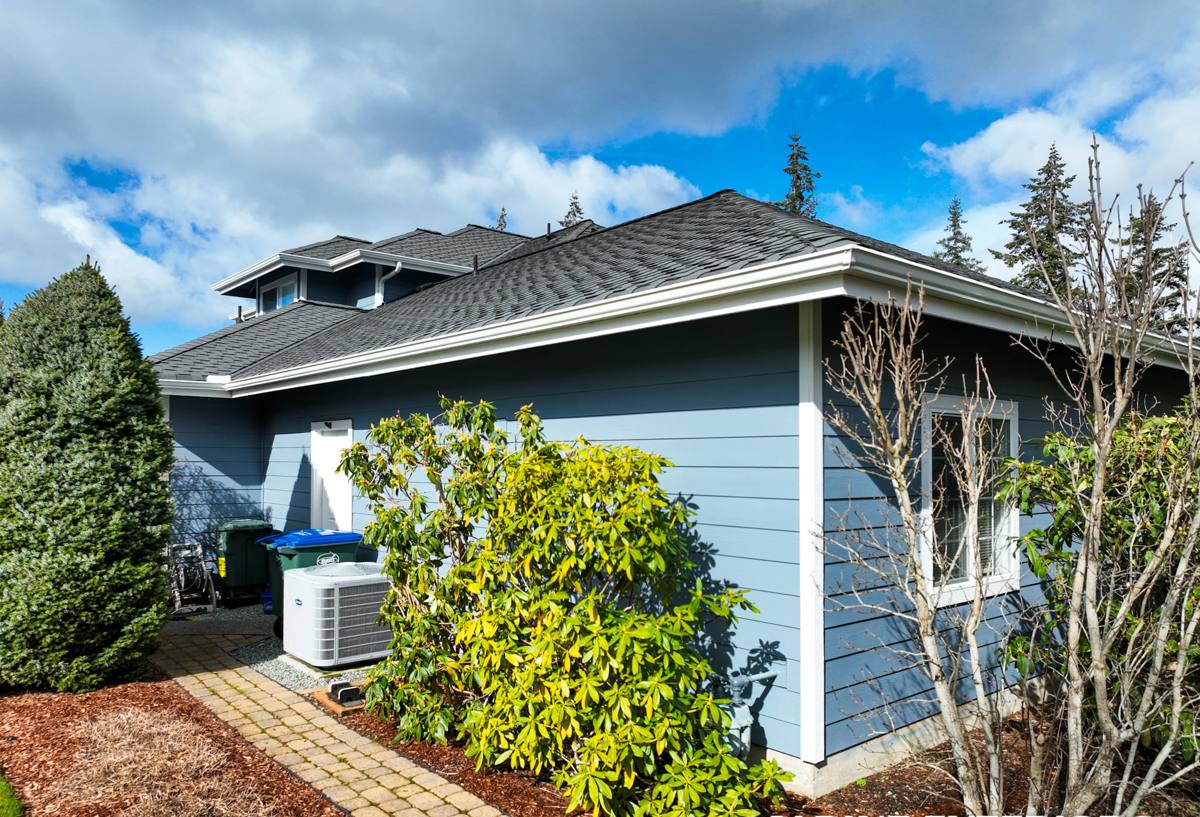
Signs It's Time for a New Roof, Not Another Repair
Most homeowners call about a leak. Sometimes a leak is a fifteen-minute flashing fix. Other times it's the first visible symptom of a roof that's been failing quietly for years. A few things that usually mean replacement makes more sense than another patch:
- Granule loss heavy enough that you can see bare asphalt on multiple slopes, not just one worn patch
- Shingles that are cupping, curling, or cracking across large sections rather than isolated spots
- Moss that keeps returning within a season or two of cleaning, especially on north-facing slopes
- Soft or spongy decking felt underfoot during inspection, a sign moisture has already reached the sheathing
- Repeated leaks in different locations each winter rather than one consistent trouble spot
- A roof that's 20+ years old and has never had underlayment or ventilation upgraded
If a roof is showing two or more of these at once, patch repairs tend to become a pattern — a fix every wet season, each one buying less time than the last. At that point, a full replacement usually costs less over five years than the sum of the repairs it would have taken to limp along.
Choosing a Roofing Material for This Climate
There isn't one "best" roofing material for every Ferndale home — it depends on the roof's pitch, the home's style, and what the homeowner wants to spend on installation versus long-term upkeep. What matters is understanding the real trade-offs for a marine climate before deciding, not just the sticker price.
| Material | Moss & Moisture Resistance | Wind-Driven Rain Performance | Typical Lifespan Here | Maintenance Reality |
|---|---|---|---|---|
| Architectural (laminate) asphalt shingle | Moderate — improves with algae-resistant granules | Good when properly nailed and sealed | 20-30 years | Periodic moss treatment recommended |
| 3-tab asphalt shingle | Lower — flatter profile holds moisture longer | Fair, more prone to lifting in gusts | 15-20 years | More frequent moss and wear checks |
| Standing seam metal | Excellent — sheds moss and water quickly | Excellent | 40-50+ years | Low, but coastal salt requires quality coatings and fasteners |
| Composite/synthetic shake | Good | Good | 30-40 years | Low to moderate |
Standing seam metal performs the best against moss and coastal salt air, but it costs more up front and isn't the right visual fit for every home. Architectural asphalt remains the most common choice in Ferndale because it balances price, appearance, and durability reasonably well — provided it's paired with the right underlayment and ventilation, which matters more than the shingle brand printed on the wrapper.
A Note on Product Choices We Steer Away From
We don't install every product on the market, and that's a deliberate professional standard rather than a knock on any manufacturer. Some lower-end shingle lines and certain wood-shake products carry maintenance burdens or moisture-related warranty exclusions that don't hold up well in a climate with this much sustained rainfall and moss pressure. When we steer a homeowner away from a product, it's because we've seen how it performs specifically in marine Northwest conditions, not because of anything the manufacturer claims elsewhere.
What a Correct Installation Actually Involves
A roof is only as good as what's underneath the shingles. On a Ferndale home, the layers below the visible surface are doing most of the work of keeping water out.
Tear-Off and Deck Inspection
We remove the old roofing down to the deck rather than layering over it. This lets us actually see the sheathing — soft spots, rot around vent penetrations, and prior leak damage don't show up until the old material is gone. Any compromised decking gets replaced before anything new goes down; installing new roofing over a weak deck just hides the problem for a few more years.
Ice and Water Shield in the Right Places
Self-adhering waterproof membrane goes in eaves, valleys, around chimneys, skylights, and any low-slope transitions — the areas where wind-driven rain and ice damming (yes, it happens here too, even if briefly) put the most stress on a roof. This is one of the details that separates a roof built for this climate from a roof built to a national minimum spec.
Synthetic Underlayment Across the Field
Synthetic underlayment resists moisture absorption better than old-style felt, stays intact longer if a roof sits open during a work day, and gives a second line of defense under the shingles across the whole roof, not just the high-risk zones.
Flashing That Actually Sheds Water
Step flashing at walls, proper counter-flashing at chimneys, and correctly lapped valley metal matter more to leak prevention than the shingle itself. Salt air corrodes cheap or thin flashing metal faster here than inland, so material choice and installation sequence both matter.
Ventilation and Moisture: The Part Most Homeowners Never See
A new roof without correct attic ventilation is set up to fail early, and it's one of the most commonly skipped details on lower-bid jobs. In a climate as wet as Whatcom County's, an attic that can't breathe traps moisture from everyday household humidity, and that trapped moisture condenses against the underside of the deck. Over a few years that shows up as rot, mold, and premature failure of the very roof that was just installed.
Balanced ventilation — intake at the eaves, exhaust at or near the ridge — keeps air moving through the attic space so moisture doesn't sit and accumulate. It also helps regulate attic temperature, which reduces the freeze-thaw stress that contributes to moss taking hold along shaded, damp slopes. On a replacement, this is the point to fix ventilation that was never adequate in the first place, not an optional upsell.
Our Installation Process, Start to Finish
- On-site inspection and estimate — we walk the roof, check the attic, and assess deck condition and ventilation before quoting anything
- Material selection — we walk through options based on your home's pitch, style, and budget, with honest trade-offs explained
- Scheduling around weather — we plan tear-off for a dry weather window where possible and stage materials to minimize how long any section of deck sits exposed
- Tear-off and deck repair — old roofing removed, deck inspected, any damaged sheathing replaced
- Waterproofing and underlayment — ice and water shield at vulnerable areas, synthetic underlayment across the field
- Ventilation correction — intake and exhaust balanced to current standards
- Flashing and installation — new flashing at all penetrations and transitions, shingles or panels installed to manufacturer spec
- Cleanup and final walkthrough — job site cleared of debris and nails, roof reviewed with the homeowner before we consider it done
What Affects the Cost of a New Roof
Every roof is different, so exact pricing depends on a site visit, but the main cost drivers are consistent from job to job:
| Factor | Why It Matters |
|---|---|
| Roof size and number of planes | More square footage and more cuts/valleys mean more labor and material |
| Roof pitch and accessibility | Steep or hard-to-access roofs take longer and require more safety equipment |
| Deck condition | Rotted or soft sheathing found during tear-off adds repair cost |
| Material choice | Asphalt, composite, and metal carry very different material costs |
| Ventilation upgrades | Correcting inadequate intake/exhaust adds labor but prevents early failure |
| Layers of existing roofing | Multiple old layers mean more tear-off labor and disposal |
As a broad range, a full asphalt shingle replacement on an average Ferndale home typically falls somewhere in the low-to-mid five figures, with metal roofing running higher due to material and labor. The only way to get a number that means anything is a walk of your specific roof.
Permits and Working Around Whatcom County Weather
Roof replacements in Ferndale typically require a permit through Whatcom County or the city, depending on your property's location, and we handle that as part of the job rather than leaving it on the homeowner's plate. Scheduling is the other local variable worth planning for: dry windows can be tighter here than in drier parts of the state, so we watch the forecast and stage the job to keep the deck covered and protected any time weather looks uncertain mid-project. Rushing a tear-off into a rain system is how roofs end up with hidden water damage before the new material ever goes on.
After Installation: Keeping a New Roof Performing
A correctly installed roof still benefits from basic upkeep in this climate. A short annual routine goes a long way:
- Clear gutters and downspouts each fall before the heavy rain sets in
- Check for moss buildup each spring, especially on shaded north-facing slopes
- Trim back overhanging branches that keep sections of the roof damp and shaded
- Look at flashing around chimneys and vents after major windstorms
- Schedule a professional inspection every few years, even without an obvious problem
None of this is complicated, but skipping it is exactly how a well-installed roof loses years off its lifespan.
Why Local Experience in Ferndale Matters
A crew that primarily works inland or in drier climates isn't automatically going to default to marine-grade underlayment coverage, corrosion-resistant fasteners, or ventilation sized for Whatcom County humidity — those aren't universal minimums, they're regional judgment calls. A crew that already works Ferndale roofs knows which slopes hold moss the longest, which details fail first in a coastal windstorm, and how to sequence a tear-off around a weather window that can close faster here than homeowners expect. That local pattern recognition is the difference between a roof that looks right at installation and one that's actually built to hold up through a real Whatcom County winter.
If you're weighing a repair against a full replacement, or just want an honest read on where your current roof stands, we're happy to take a look. Reach out for a free, no-pressure estimate using the form below.