 Fairhaven Siding
 Why Happy Valley Roofs Wear Out Differently
Happy Valley sits close enough to Bellingham Bay that homes here deal with a combination of conditions that inland roofs in Whatcom County rarely face all at once: salt-laden air moving up from the water, driving rain that comes in sideways during winter storms, and a moss season that can run eight months or longer in a wet year. Any one of these is manageable on its own. Together, they shorten the useful life of a poorly installed or poorly maintained asphalt shingle roof by years.
Salt air speeds up corrosion of exposed metal — flashing, fasteners, drip edge — faster than it does further inland. Driving rain, meaning rain pushed sideways by wind off the Salish Sea, finds gaps that would never leak in a calm downpour, working its way under shingle tabs and around chimneys, vents, and skylights. And moss doesn't just sit on the surface looking bad; it holds moisture against the shingle mat and lifts tabs as it grows, which is how a small patch of moss on a shaded north slope turns into a slow leak two winters later.
A roof built for Happy Valley has to account for all three from the start — not patched in later, but built into the underlayment, the flashing details, and the ventilation from the first day of the install.
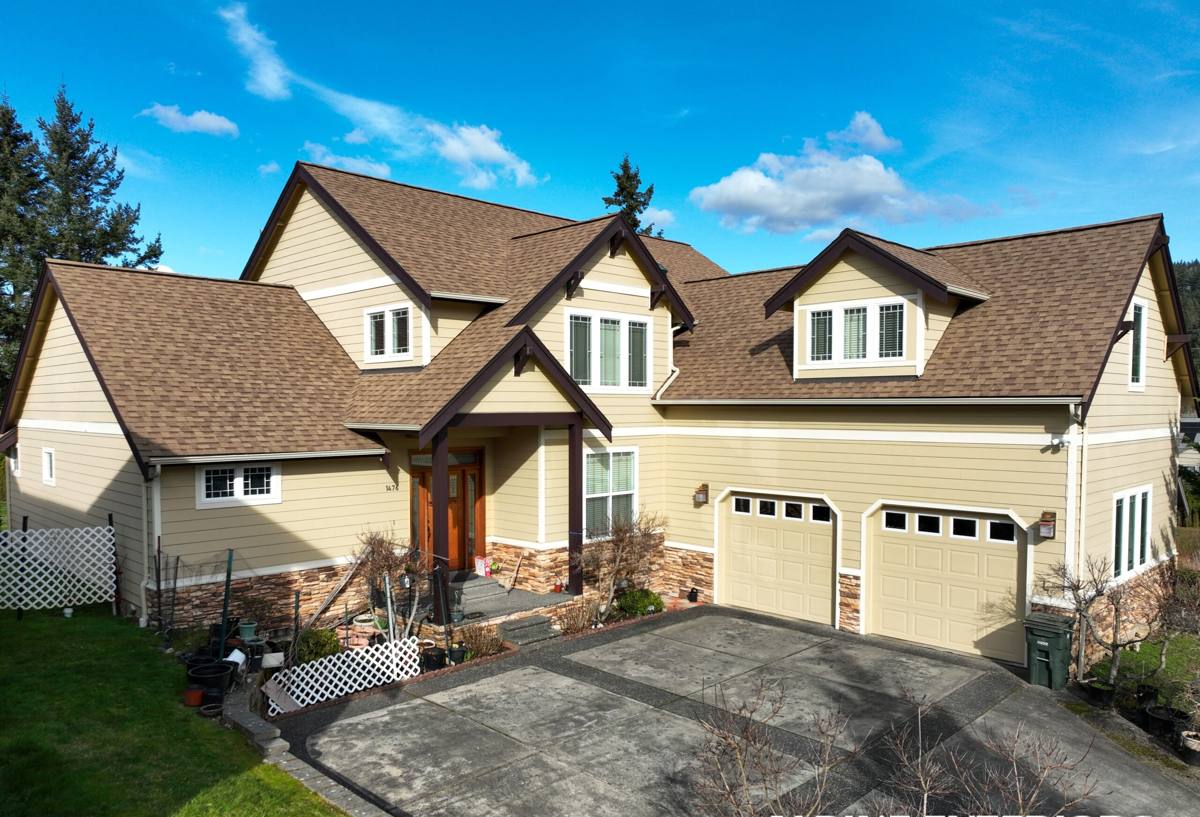
What a Correctly Installed Roof Needs in This Climate
Underlayment and Water Protection
Code-minimum underlayment is a starting point, not a finish line. In areas that see regular wind-driven rain, we run self-adhered ice-and-water membrane at eaves, valleys, and around every roof penetration, then cover the rest of the deck with a synthetic underlayment. That combination gives water two chances to be stopped before it ever reaches the decking, which matters when rain is being pushed uphill under shingle edges rather than simply running down.
Flashing That Actually Holds Up
Flashing failure — not shingle failure — is the most common source of roof leaks we find on Happy Valley homes. Step flashing at walls and chimneys, properly layered with each course of shingles, and a full-width drip edge along eaves and rakes keep water moving off the roof instead of behind it. In a salt-air environment we favor corrosion-resistant coated metal over bare galvanized for anything exposed to the weather long-term; it costs a little more up front and holds up a lot longer, which matters more here than in a drier inland climate.
Ventilation That Fights Moisture, Not Just Heat
Balanced intake and exhaust ventilation does more in this region than regulate attic temperature — it keeps moist air from sitting against the underside of the roof deck, which is exactly the kind of damp, still environment that encourages rot and helps moss get a foothold from below as well as above. A roof that looks fine from the ground can still have a chronically damp attic if the ventilation was never balanced correctly during a past re-roof.
Choosing a Shingle That Can Actually Handle These Conditions
Not every asphalt shingle is built the same way, and the difference shows up fastest in a climate like this one. The table below is a general comparison, not a specific product recommendation — the right choice depends on your roof's exposure, pitch, and how much shade it gets.
| Shingle Class | Algae/Moss Resistance | Wind Rating | Best Fit For |
|---|---|---|---|
| Standard 3-tab | Basic, unless algae-resistant granules specified | Lower end of typical ranges | Budget projects on sunnier, less-shaded roof planes |
| Architectural / laminate | Good, especially with copper or zinc-infused granules | Mid-to-high, depending on line | Most Happy Valley homes, especially shaded or north-facing slopes |
| Premium/designer laminate | Best available in asphalt, longest-lasting granule protection | Highest typical ratings | Steep, highly visible, or heavily shaded roofs where moss pressure is worst |
For roof planes that stay damp and shaded for much of the year — a common situation on tree-lined Happy Valley lots — we generally steer homeowners toward algae-resistant architectural shingles rather than basic 3-tab product. The upfront cost difference is modest; the difference in how the roof looks and performs after five moss seasons is not.
Our Installation Process
Every asphalt shingle roof we install in Happy Valley follows the same sequence, adjusted for the specifics of your roof:
- On-site inspection of the existing roof, decking, flashing, and ventilation before any work is scheduled or quoted
- Full tear-off of old roofing material down to the deck — we don't install over existing layers
- Deck inspection, with any soft, rotted, or delaminated sheathing replaced before anything new goes down
- Ice-and-water membrane at eaves, valleys, and penetrations, followed by synthetic underlayment across the field
- New drip edge and step/apron flashing at all walls, chimneys, and penetrations
- Shingle installation starting at the eave, working up, with attention to nailing pattern and exposure — both of which affect wind performance more than most homeowners realize
- Ridge vent and ridge cap installation to complete the ventilation system
- Full cleanup, including a magnetic sweep for stray nails and fasteners
- Final walkthrough so you can see the completed work and ask questions before we consider the job done
Problems We See Most Often on Happy Valley Roofs
- Moss colonies on shaded, north-facing slopes that have lifted shingle tabs enough to let water underneath
- Dark algae streaking on shingles that were never rated or treated for algae resistance
- Cracked or lifted tabs along eaves and rakes from years of wind-driven rain working at the same edges
- Corroded or undersized flashing around chimneys and skylights, especially on older re-roofs
- Granule loss and thinning on south- and west-facing slopes that take the brunt of sun and weather
- Moss and debris buildup in valleys that blocks water flow and forces it to back up under shingles
Living With Moss Season: Maintenance That Actually Matters
No asphalt shingle roof in this part of Whatcom County is maintenance-free — the climate simply doesn't allow it. The good news is that the maintenance that matters is straightforward and doesn't need to happen constantly.
- Inspect the roof before and after moss season each year, especially shaded and north-facing slopes
- Keep gutters and valleys clear so water has an open path off the roof
- Treat moss growth early with zinc or copper strips or an approved low-pressure treatment — never a pressure washer, which strips protective granules and shortens shingle life
- Trim back tree branches that shade the roof and slow drying after rain
- Check attic ventilation periodically, not just at install — insulation shifts and vents can get blocked over time
- Address lifted, cracked, or missing shingles promptly rather than waiting for a visible leak
What Drives the Cost of a Happy Valley Roofing Job
Every roof is different, so we'd rather explain what actually moves the price than quote a number that doesn't apply to your house. These are the factors that matter most on the roofs we see in this area:
| Cost Factor | Why It Matters |
|---|---|
| Roof pitch and steepness | Steeper roofs take longer to work safely and need additional fall protection |
| Number of existing layers | Multiple layers mean more tear-off labor and disposal before new material goes down |
| Decking condition | Rotted or soft sheathing found during tear-off has to be replaced before shingles go on |
| Roof complexity | Valleys, dormers, and multiple penetrations all add flashing work and material |
| Shingle tier selected | Standard, architectural, and premium lines carry different material costs and warranty lengths |
| Ventilation upgrades | Adding or correcting intake/exhaust venting adds labor but pays off in roof lifespan |
Why Hiring a Crew That Already Works Happy Valley Matters
A roofing crew that only occasionally works this close to the bay will often treat a Happy Valley roof the same way they'd treat one twenty miles inland — same underlayment spec, same flashing choices, same assumptions about how much moss pressure to expect. That's how roofs end up needing moss treatment or flashing repair years earlier than they should.
Working this neighborhood regularly means knowing which slopes need extra attention because of shade and orientation, understanding how quickly wind-driven rain off the water can expose a weak flashing detail, and being available quickly if a winter storm causes damage. It also means we're not guessing at what holds up here — we're building on what we've already seen hold up, and what hasn't.
Ready for a Straight Answer About Your Roof
If you're dealing with moss buildup, a leak that's hard to trace, or you're simply due for a re-roof, we're happy to take a look and give you an honest assessment — no pressure, no upsell. Use the form below to request a free estimate, and we'll walk the roof, explain what we find, and tell you plainly what your options are.