 Fairhaven Siding
 Happy Valley sits close enough to Bellingham Bay and the Fairhaven waterfront that its houses take a different kind of beating than homes further inland in Whatcom County. Salt-laden air moves up off the water, wind-driven rain finds every gap in a wall assembly, and the long gray stretch from October through April keeps north-facing siding damp enough, long enough, for moss and algae to get comfortable. Siding in this neighborhood isn't just cosmetic — it's the first line of defense against a climate that never really dries out. This page is about one job, done right, in one place: fiber cement siding installed on Happy Valley homes by a crew that already works this area.
What Happy Valley's Climate Actually Does to Siding
Before talking about installation, it's worth being specific about the stresses involved, because they're not generic "Pacific Northwest weather" — they're a combination that hits certain products harder than others.
Salt Air
Homes closer to the water pick up airborne salt that settles on exterior surfaces. It's not enough to cause the kind of corrosion you'd see on a boat, but it does accelerate the breakdown of paint films and raw wood fiber over years of exposure, and it can corrode unprotected fasteners over time.
Driving, Wind-Blown Rain
Fairhaven's exposure means rain rarely falls straight down — it comes in sideways, especially during winter storms. That matters because it pushes water into laps, seams, and butt joints that would stay dry in a calmer climate. Siding that isn't installed with correct overlaps and flashing details will let water behind the cladding, not just wet the face of it.
A Long Moss and Algae Season
Shaded walls, north exposures, and anything near overhanging trees stay damp for months at a stretch. Organic growth needs sustained moisture, and Whatcom County gives it plenty. Siding that holds surface moisture — or that has a paint film prone to chalking and losing its seal — grows moss and algae streaking faster than siding with a factory-cured, moisture-resistant finish.
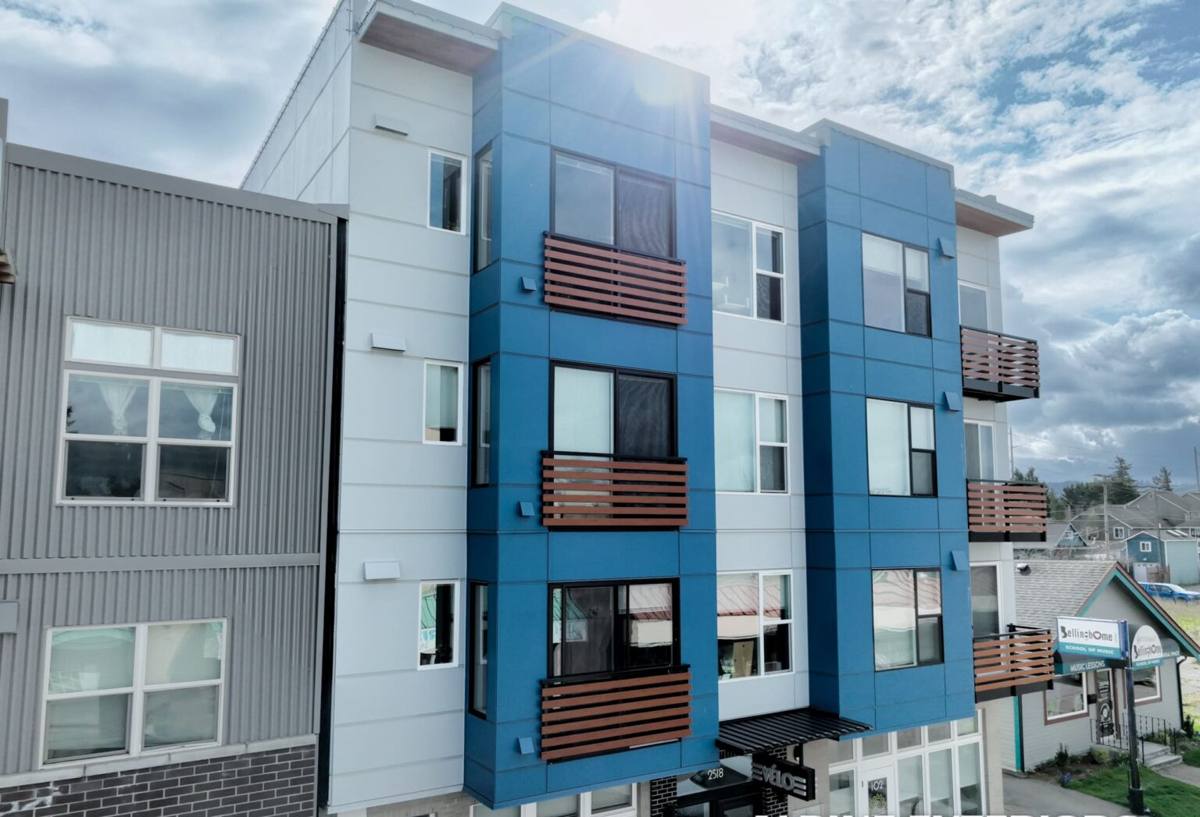
Why We Install James Hardie Fiber Cement — and Nothing Else
This crew installs one siding product: James Hardie fiber cement. We don't install vinyl, LP SmartSide, primed spruce, cedar, or other fiber cement brands like Cemplank or Allura. That's a deliberate standard, not a sales pitch, and here's the honest reasoning behind it for a climate like this one.
- Non-combustible core: fiber cement won't contribute fuel to a fire the way wood-based products can, which matters for insurance and peace of mind alike.
- Engineered for wet climates: Hardie's HZ10 product line is specifically formulated for Pacific Northwest-style moisture exposure, not a one-size-fits-all national spec.
- Factory-applied ColorPlus finish: the color and protective coating are baked on in a controlled factory environment, which holds up to UV and moisture far more consistently than field-applied paint, and resists the chalking that lets algae get a foothold.
- Dimensionally stable: fiber cement doesn't swell, cup, or split the way wood-based siding can when it cycles between soaked and dry through a Whatcom County winter.
- Transferable, substantial warranty: a real manufacturer warranty backing the product, which follows the house if it's sold.
We're not going to tell you every other product is worthless — vinyl is cheap and low-maintenance, cedar has real character, LP SmartSide has its fans. But each of those has a trade-off — heat sensitivity, moisture vulnerability at cut edges, ongoing maintenance — that we've decided isn't worth carrying on a home exposed to salt air and driving rain. Hardie is what we stand behind, so it's the only thing we put on a wall.
What a Correct Fiber Cement Job Looks Like Here
Fiber cement is only as good as its installation. In a marine-exposure neighborhood like Happy Valley, a few details matter more than they would in a drier climate.
Water-Resistive Barrier and Rainscreen
A weather-resistant barrier goes on the sheathing first, and on homes with heavier rain exposure we build in a rainscreen gap behind the siding. That gap lets any moisture that does get past the cladding drain and dry out instead of sitting against the wall assembly — a meaningful difference over a 20- or 30-year lifespan in this climate.
Flashing at Every Penetration
Windows, doors, hose bibs, light fixtures, vents — every penetration is a place wind-driven rain can find a way in. Correct flashing, installed in the right sequence relative to the water-resistive barrier, is what actually keeps a house dry, far more than the siding material itself.
Fastener and Clearance Details
Hardie specifies fastener type, spacing, and minimum clearances from grade, decks, and roof lines. Skipping these — a common shortcut on rushed jobs — is exactly what lets moisture wick into the bottom edge of the siding and cause problems years down the road.
Caulking and Joint Treatment
Butt joints and trim transitions need the right sealant, applied correctly, and Hardie's own installation guidance is specific about which joints should be caulked and which shouldn't. Over-caulking can trap moisture just as easily as under-caulking lets it in.
Our Process for a Happy Valley Job
- Walk the house: we look at exposure direction, existing moisture damage, trim condition, and anything specific to the lot — tree cover, drainage, wind exposure off the water.
- Written estimate: product line, color, trim details, and scope, laid out clearly before any work starts.
- Tear-off and inspection: once old siding comes off, we check the sheathing underneath for rot or existing moisture damage before anything new goes on.
- Barrier and flashing: water-resistive barrier, rainscreen where called for, and flashing at every penetration, done before siding installation begins.
- Hardie installation to spec: correct fasteners, clearances, and joint treatment throughout.
- Final walkthrough: we go over the finished job with you before calling it done.
Why Hiring a Crew That Already Works This Neighborhood Matters
A siding crew that's worked other Happy Valley and Fairhaven jobs already knows which walls take the worst of the wind off the bay, where moss tends to build up fastest, and how local permitting and inspection tends to run in this part of Whatcom County. That's not a marketing point — it changes real decisions on the job, like where to add extra flashing attention or how a rainscreen gets detailed around a tricky roofline. A crew unfamiliar with this specific exposure is more likely to treat it like a generic PNW job instead of the salt-air, driving-rain environment it actually is.
Comparing Siding Options for This Climate
Homeowners in Happy Valley often ask how fiber cement stacks up against the alternatives they're weighing. Here's an honest comparison focused on the specific stresses this neighborhood deals with.
| Factor | James Hardie Fiber Cement | Vinyl | Wood / LP SmartSide |
|---|---|---|---|
| Salt air resistance | Strong — factory finish resists chalking and fade | Moderate — can become brittle over time | Weaker — finish and substrate both vulnerable |
| Moss/algae resistance | Strong with correct install and rainscreen | Moderate — grows on any damp surface | Weaker — organic substrate, more moisture uptake |
| Driving-rain performance | Strong when flashed and lapped to spec | Moderate — seams can leak under wind pressure | Depends heavily on maintenance and sealing |
| Fire resistance | Non-combustible core | Combustible | Combustible |
| Maintenance over 20 years | Low — factory finish, occasional wash | Low but limited repair options | Higher — repainting, sealing, rot checks |
Cost Factors Homeowners Should Know
Every Happy Valley home is different, so we won't quote a number without seeing the house, but the real cost drivers are worth understanding upfront.
- Tear-off scope: removing existing siding, especially if there's rot or water damage underneath, adds labor and sometimes sheathing repair.
- Wall complexity: dormers, bump-outs, and multiple roof intersections mean more flashing and cutting time.
- Siding profile and trim package: lap width, trim boards, and accent details all affect material and labor.
- Rainscreen inclusion: adding a drainage gap is extra material and labor but pays off in a climate this wet.
- Color: factory ColorPlus finishes come in a set palette; custom field-painted colors are a different cost path.
Signs Your Happy Valley Home May Need Attention Now
- Persistent moss or algae streaking on north- or shade-facing walls that comes back within a season of cleaning
- Soft or spongy spots when you press on the siding, especially near the bottom edge or around windows
- Paint that's chalking, peeling, or has lost adhesion in patches
- Visible gaps, warping, or separated joints at trim and corners
- Musty smell or staining on interior walls that share an exterior wall with heavy weather exposure
None of these mean the whole house needs new siding tomorrow, but they're worth a professional look before another wet Whatcom County winter works on them further.
Get a Free, No-Pressure Estimate
If you're in Happy Valley or elsewhere around Fairhaven and want a straight answer on what your siding needs — full replacement, repair, or just a maintenance check — we're happy to come take a look. The estimate is free, there's no pressure, and you'll get a clear explanation of what we see and why. Use the form below to get started.