 Fairhaven Siding
 Lummi Island's Climate: What Siding Is Actually Up Against
Lummi Island sits in Whatcom County waters, reached only by a short ferry crossing near Fairhaven, and that setting shapes everything about how a home's exterior ages. Homes here take on salt-laden air carried off Hale Passage and the surrounding Salish Sea, long stretches of wind-driven rain that finds its way into laps and seams other siding tolerates fine inland, and a moss season that runs longer than it does on drier, more open lots around Bellingham. None of that is exotic — it's just persistent, and persistent is what wears siding out over time.
The practical effect shows up gradually: fasteners corrode faster in salt-laden air, factory or field finishes chalk and fade sooner under sun reflecting off open water, and anything that traps moisture against a wall — a failed caulk joint, shade from tree cover, a north-facing elevation that never fully dries — stays wet longer than it would on a sheltered mainland site. A siding system that performs adequately on a protected inland lot can fail outright on an exposed island wall within a fraction of its expected life.
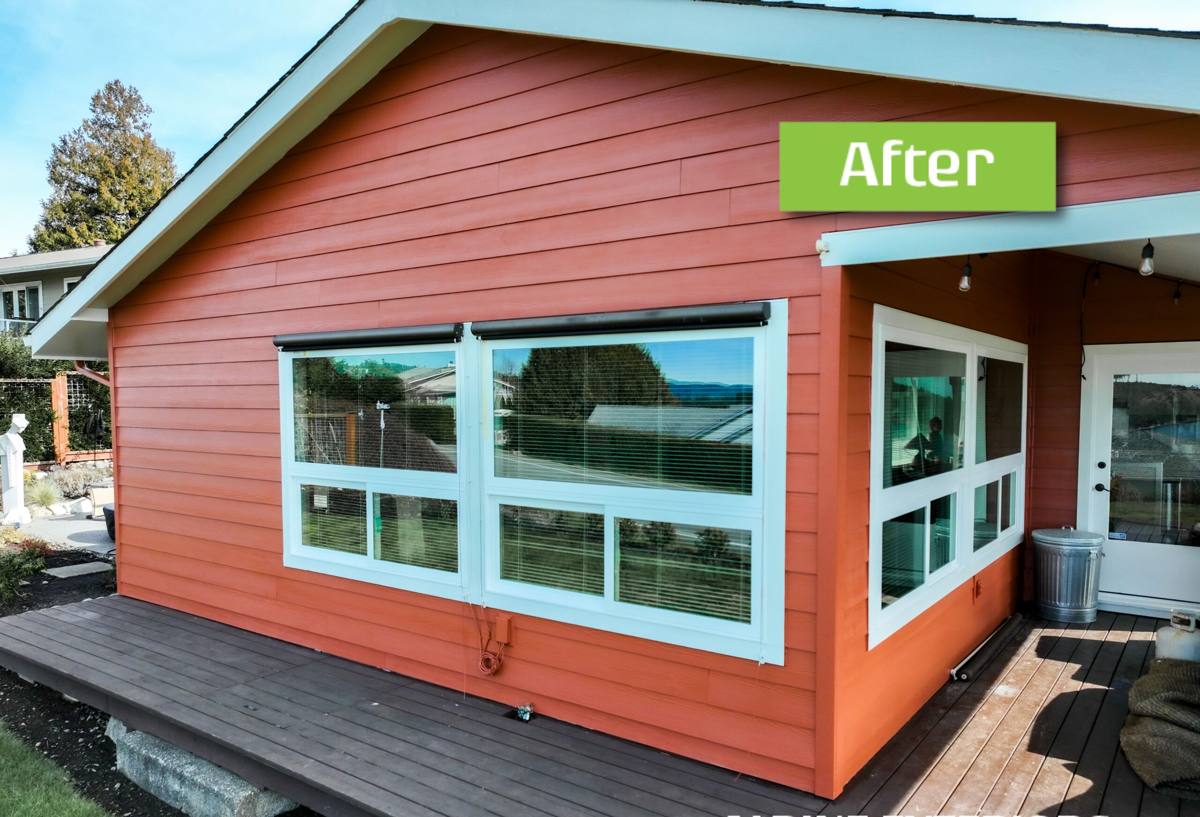
Why Fiber Cement Is the Right Material for This Exposure
Fiber cement is cement, sand, and cellulose fiber pressed into a dense, dimensionally stable board. It doesn't absorb water the way solid wood does, it doesn't go brittle in a hard cold snap the way some lower-grade composites can, and it doesn't offer the porous surface that moss and algae favor during the island's damp shoulder seasons. For a home taking direct salt air and driving rain off the water, that stability is the entire point of choosing it.
Salt Air and Fastener Corrosion
Salt doesn't just sit on a surface — it works into any gap, seam, or exposed fastener head and accelerates corrosion year over year. A correct fiber cement installation on Lummi Island calls for corrosion-resistant fasteners rated for the exposure, set flush and sealed rather than left proud and exposed. Skipping that detail is exactly the kind of shortcut that shows up as rust streaks and loosening boards within a few winters, long before the siding itself is due for any attention.
Driving Rain and Drainage Planes
Wind-driven rain off open water doesn't fall straight down — it hits a wall sideways and gets pushed up under laps and around penetrations. A correct installation manages that with a continuous drainage plane behind the siding, proper lap overlap, and flashing at every window, door, and horizontal trim transition, so any water that does get behind the cladding has somewhere to go besides the sheathing underneath it.
Why We Install Only James Hardie
Fiber cement is a category, not a single interchangeable product, and the brands in it don't all handle the details that matter on an exposed island site the same way. We standardized on James Hardie for every project we take on, including Lummi Island, because of the combination of a factory-applied finish, region-specific formulations, and a warranty that actually transfers if the home is sold. That's the standard we're willing to put our name behind.
ColorPlus Factory Finish
Hardie's ColorPlus finish is baked on at the factory under controlled conditions rather than brushed or sprayed on site. That matters most in a marine environment: a factory-cured finish resists fading and chalking from UV reflected off open water noticeably better than field-applied paint, and it carries its own finish warranty separate from the underlying product warranty.
HZ5 Climate-Engineered Formulation
Hardie produces region-specific formulations rather than one product for the whole country. The HZ5 line is engineered for wetter, harsher climates, distinct from the HZ10 formulation built for dry Southwest conditions. For Whatcom County's rain totals, plus the added salt exposure on an island like Lummi, that's not a marketing distinction — it's the product actually engineered for the weather this siding will sit in for decades.
What a Correct Installation Involves
Fiber cement is unforgiving of shortcuts. Installed to manufacturer spec, it will outperform almost anything else on an exposed wall. Installed loose, with tight joints, missing flashing, or the wrong fasteners, it can trap moisture and fail early in ways that are expensive to trace back to the install. A correct job includes:
- A continuous weather-resistive barrier behind the siding, lapped correctly at every seam
- Flashing integrated at windows, doors, deck ledgers, and any horizontal trim or transition
- Manufacturer-specified gapping at butt joints and trim to allow for expansion and drainage
- Corrosion-resistant fasteners set to the manufacturer's pattern and depth, never overdriven
- Caulking only where Hardie's installation guide actually calls for it, not as a substitute for flashing
- Factory-primed edges used wherever possible, with any field cuts sealed to spec
On an island site, we also plan around what ferry scheduling and limited barge crossings mean for material staging. Siding, trim, fasteners, and flashing get ordered and delivered as one coordinated load rather than piecemeal, so a crew isn't standing around a job site waiting on a part that missed a sailing.
Choosing the Right Hardie Product Line
Most Lummi Island homes end up on one of these configurations, sometimes combined on the same house for a horizontal-lap body with a panel or shingle accent.
| Product | Typical Use | Why It Works Here |
|---|---|---|
| HardiePlank Lap Siding | Primary wall cladding, most of the house | Overlapping courses shed wind-driven rain well; widest range of profiles and ColorPlus colors |
| HardiePanel Vertical Siding | Gable ends, accent walls, board-and-batten look | Fewer horizontal seams for water to work into on the most exposed elevations |
| HardieShingle | Accent sections, dormers | Traditional shingle look without cedar shingle's moisture uptake and moss susceptibility |
Our Process for a Lummi Island Project
Ferry Logistics and Scheduling
Working on the island means the ferry schedule sets the pace, not the other way around. We build crossings, tide-dependent loading, and weather windows into the project timeline up front, so a homeowner isn't guessing at how a mainland-normal siding job translates to an island one. It generally takes longer to plan and shorter to execute once material and crew are actually on site, since we don't leave and come back for forgotten items.
A typical project moves through these stages:
- On-site assessment of the existing siding, trim, and any signs of moisture already behind the wall
- Material take-off and a single coordinated delivery timed to ferry availability
- Removal of existing siding and inspection of the sheathing underneath for hidden damage
- Weather-resistive barrier and flashing installation at every penetration and transition
- Hardie siding installation to manufacturer specification, elevation by elevation
- Final caulking, touch-up, cleanup, and a walk-through before we leave the site
Cost Factors for Island Siding Projects
Every project is priced on its own specifics, but the factors that move the number on a Lummi Island job are fairly consistent from house to house:
| Factor | Why It Matters |
|---|---|
| Ferry and transport logistics | Material and crew crossings need to be scheduled and consolidated, which affects timeline more than raw cost |
| Existing siding removal and disposal | Tear-off and haul-away volume varies with what's currently on the house |
| Sheathing condition | Hidden moisture damage found once old siding comes off can require repair before new siding goes on |
| Home size and wall complexity | Cut-up elevations, dormers, and trim detail take more labor per square foot than a simple rectangular wall |
| Product line and accents | Combining lap siding with panel or shingle accents adds material and labor variety, not just square footage |
In broad terms, a full tear-off and Hardie re-side on the island falls in the same general range as a comparably sized mainland project, with ferry logistics factored in as a planned line item rather than a surprise. We'll walk through the specifics for a given home during the estimate rather than quoting from a generic per-square-foot number.
Maintaining Fiber Cement Siding Through Moss Season
Correctly installed Hardie siding is low-maintenance, not no-maintenance, and the island's damp shoulder seasons make a short annual routine worth the time:
- Rinse the siding once a year to clear accumulated salt film, especially on the ocean-facing elevation
- Keep gutters and downspouts clear so runoff isn't sheeting down the wall face
- Trim back vegetation and tree cover that shades a wall and slows drying after rain
- Check caulking at trim and penetrations annually; replace it before it fails, not after
- Avoid high-pressure washing directly into laps and seams — a garden hose and soft brush is enough
- Watch shaded, north-facing sections for early moss growth and address it before it spreads
Why Hiring a Crew That Already Works Lummi Island Matters
An island job isn't a mainland job with an extra boat ride. Scheduling around ferry sailings, staging enough material to avoid mid-project crossings, and knowing how the exposure differs wall to wall on an island property all come from having actually done it before — not from reading a spec sheet. A crew that already works Lummi Island builds that logistics planning into the estimate from day one, instead of discovering it partway through the project at the homeowner's expense.
It also means fewer surprises once the old siding comes off. Crews who've opened up island walls before know what kind of hidden moisture damage tends to show up in this exposure and plan for it as a possibility rather than treating it as an unexpected change order.
If you're weighing a siding replacement on Lummi Island, we'd rather walk your home in person than guess from a description. Reach out for a free, no-pressure estimate — the form below gets you started.