 Fairhaven Siding
 Marietta's Climate Is Harder on Siding Than Most Homeowners Realize
Marietta sits close enough to Bellingham Bay that salt-laden air is a daily fact of life, not an occasional weather event. Add Whatcom County's driving winter rain — often pushed sideways by wind off the water — and a moss season that can stretch from October well into spring, and you have three separate stresses working on a home's exterior at the same time. Most siding materials are engineered for one or two of these conditions. Few are built to shrug off all three, year after year, without babysitting.
Salt air accelerates corrosion on fasteners, hinges, and any exposed metal trim. Driving rain finds every gap in flashing, caulk, and lap joints and pushes water sideways and upward, not just down. And prolonged dampness combined with tree cover — common throughout this part of Fairhaven and the surrounding Marietta area — creates ideal conditions for moss and algae to take hold on north-facing and shaded walls. Siding that isn't dimensionally stable, isn't properly detailed at the joints, or absorbs moisture the way wood-based products do will show the damage from all three within a handful of years.
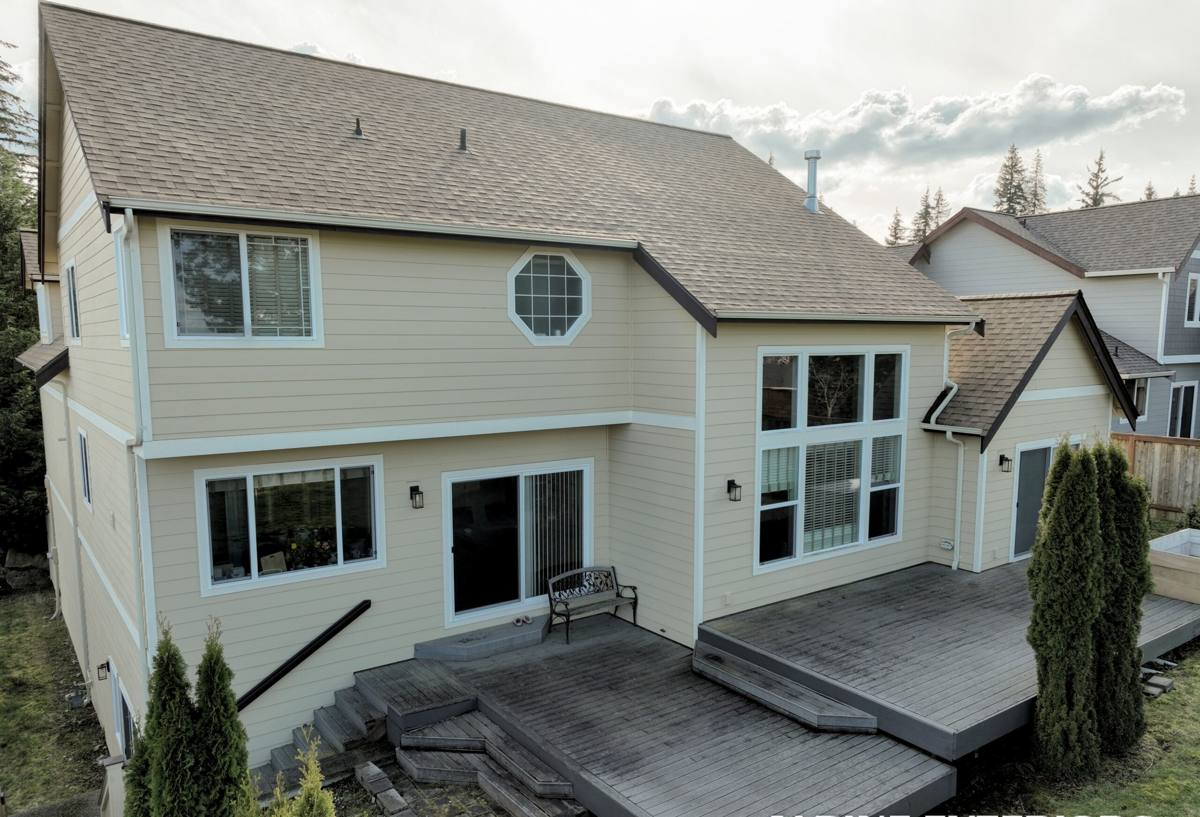
Why James Hardie Fiber Cement Fits This Environment
James Hardie siding is fiber cement — a mix of cement, sand, and cellulose fiber that doesn't swell, rot, or delaminate the way wood, wood-composite, or engineered wood products can when they take on repeated moisture. It's also non-combustible, which matters given the dry summer wildfire smoke seasons the region now sees even in a generally wet climate.
Climate-Engineered Product Lines
James Hardie manufactures its siding in different formulations for different climate zones, and Marietta falls in the zone where the primary threat is moisture rather than deep freeze-thaw cycling. The HZ5 formulation is engineered for exactly that: wet, marine-influenced climates where the siding needs to resist moisture-related damage over decades, not just look good the day it goes up. This isn't a marketing detail — it affects how the board is formulated and how it performs against the kind of driving, wind-blown rain Marietta gets off the bay.
ColorPlus Factory Finish
Salt air is hard on paint. A factory-applied ColorPlus finish is baked on and backed by its own finish warranty, which holds up better against salt exposure and UV than field-applied paint that's mixed and sprayed on site. For homes within a few miles of open water, this is one of the more practical reasons to choose a factory-finished product over anything that relies on a site-applied topcoat.
Matching the Right Profile to Marietta's Homes
Marietta and the surrounding Fairhaven area have a mix of older coastal cottages, craftsman-influenced homes, and newer builds. James Hardie's product line covers this range without forcing a single look on every house:
- HardiePlank lap siding — the most common choice, available in several exposure widths and textures (smooth or cedar-grain) to match traditional lap profiles already common in the neighborhood.
- HardieShingle — for homes with a shingle-style front or accent gable, staggered or straight-edge panels that mimic cedar shingle without the moisture uptake.
- HardiePanel — vertical panel siding, often used for modern facades or as an accent alongside lap siding.
- HardieTrim — matching trim boards so window, corner, and fascia detailing is dimensionally stable and finished in the same ColorPlus system as the field siding.
The right choice depends on the home's existing lines, roof pitch, and how much of the wall faces prevailing wind and rain versus a more sheltered side — details we walk through on site rather than assume from a photo.
What a Correct Installation Actually Involves
Fiber cement siding performs exactly as well as its installation. A rushed or generic install on a coastal property will fail early regardless of the product behind it. A correct job on a Marietta home includes:
- Full removal of old siding and inspection of the sheathing underneath for hidden rot or moisture damage before anything new goes up.
- A weather-resistant barrier (WRB) installed and lapped correctly, shingle-style, so water sheds outward at every seam.
- A rainscreen gap behind the siding on exposures that see the most wind-driven rain, so any moisture that does get behind the cladding can drain and dry instead of sitting against the sheathing.
- Correct flashing at every window, door, and roofline intersection — this is where the vast majority of siding leaks actually start, not in the field of the wall.
- Fasteners sized, spaced, and driven per James Hardie's published installation instructions — over- or under-driven nails void warranty coverage and create early failure points.
- Corrosion-resistant fastener material appropriate for a salt-air environment, so trim screws and nail heads don't bleed rust streaks down the face of the siding within a few years.
- Properly caulked and painted cut edges, since any factory-finished board that's field-cut exposes raw material that needs to be sealed to maintain the warranty and keep water out.
Where Marietta Installs Differ From a Typical Inland Job
On a more sheltered inland property, some of the above can be handled with standard details. Closer to Bellingham Bay, we treat rainscreen gaps, flashing overlaps, and fastener corrosion resistance as non-negotiable rather than optional upgrades, because the failure modes we see locally trace back almost every time to one of those three shortcuts.
James Hardie Compared to Other Siding Options in This Climate
| Factor | James Hardie Fiber Cement | Vinyl | Wood / LP-Type Composite |
|---|---|---|---|
| Moisture behavior | Doesn't absorb or swell; engineered HZ5 formulation for wet marine climates | Doesn't absorb, but can warp or gap, opening paths for water behind it | Absorbs moisture at cut edges and joints; prone to swelling and rot if compromised |
| Salt air / coastal exposure | Factory ColorPlus finish resists fading and chalking near salt air | Can become brittle and discolored faster near open water | Finish and substrate both vulnerable to accelerated wear near salt air |
| Moss / algae resistance | Dense, stable surface; doesn't feed fungal growth the way wood fiber can | Resists growth but shows dirt and mildew film readily | More susceptible to moss and mildew, especially at seams and edges |
| Fire resistance | Non-combustible | Combustible; can melt or deform near heat sources | Combustible |
| Finish longevity | Factory-baked finish, separate finish warranty | Color molded through, can fade unevenly over decades | Field-applied paint typically needs repainting on a shorter cycle |
This is a straightforward reason this company installs only James Hardie: for a coastal Whatcom County property, the trade-offs on the alternatives — moisture sensitivity, finish life, or combustibility — show up as real maintenance and repair costs down the road, not just theoretical differences.
Our Process for a Marietta Siding Project
- On-site inspection. We walk the whole exterior, check the sheathing and trim where accessible, and note which walls take the most wind-driven rain.
- Product and profile selection. We match plank exposure, texture, and color to the home's existing style and confirm HZ5 product specification.
- Written estimate. Scope, materials, and timeline in plain terms, with tear-off and any sheathing repair called out separately so there are no surprises once we open the walls.
- Installation. Tear-off, sheathing repair as needed, WRB, rainscreen where called for, flashing, siding installation, and trim — in that order, with each stage checked before the next covers it up.
- Final walkthrough. We go over the finished job with you, including care and touch-up guidance specific to a salt-air, high-moss environment.
What Affects the Cost of a Hardie Siding Job Here
| Cost Factor | Why It Matters in Marietta |
|---|---|
| Extent of tear-off and sheathing repair | Older homes near the water more often have hidden moisture damage under the existing siding that needs addressing before new siding goes on |
| Home size and wall complexity | Dormers, bump-outs, and multiple gables all add cutting, flashing, and trim detail |
| Siding profile and trim package | Lap siding alone costs less than a job that mixes lap, shingle accents, and full HardieTrim detailing |
| Rainscreen and flashing detail | Exposures facing prevailing wind and rain get the fuller moisture-management assembly, which adds labor but reduces long-term risk |
| Color and finish | Standard ColorPlus colors versus custom field-painted options affect both material cost and finish warranty terms |
Living With Hardie Siding in a Moss-Prone, Salt-Air Neighborhood
Correctly installed Hardie siding is low-maintenance, not zero-maintenance. A short annual routine keeps it performing the way it's supposed to:
- Rinse the exterior once or twice a year, especially shaded or tree-covered walls, to keep moss and algae from getting a foothold.
- Check caulking at trim joints, window returns, and butt joints annually — caulk is the first thing to wear in a wet climate and the cheapest thing to fix before it becomes a leak.
- Keep gutters clear and downspouts directing water away from the foundation and lower courses of siding.
- Trim back vegetation and tree limbs that keep a wall shaded and damp longer than the rest of the house.
- Watch for any rust streaking at fastener heads or trim screws, which signals a corrosion-resistant fastener wasn't used and should be addressed before it stains the finish.
Why It Matters That We Already Work in Marietta
A crew that installs siding across a wide range of climates tends to apply the same generic details everywhere. A crew that regularly works this specific stretch of Whatcom County knows which walls in Marietta take the worst of the wind-driven rain off the bay, how far moss season actually runs in a given year, and which fastener and flashing choices hold up here versus somewhere drier or more sheltered. That local pattern recognition is the difference between a siding job that looks right on installation day and one that's still performing correctly ten and twenty years later.
If you're planning a siding project in Marietta or elsewhere in the Fairhaven area, we're happy to walk your property, look at what your home is actually dealing with, and put together a straightforward, no-pressure estimate — no obligation, just a clear look at what correct James Hardie installation would involve for your house.