 Fairhaven Siding
 Why Sunnyland Roofs Age Differently Than Roofs Inland
Sunnyland sits close enough to Bellingham Bay that salt-laden air is a daily fact of life, not an occasional nuisance. Add Whatcom County's long, wet winters and the moss season that follows them, and you've got a roofing environment that's genuinely harder on materials than what you'd find twenty miles inland. Fasteners corrode faster. Algae and moss get a foothold on anything with consistent shade or a north-facing slope. Driving rain off the Sound doesn't just fall straight down — it pushes sideways under poorly lapped shingles and around weak flashing details that would never leak in a drier climate.
None of that means Sunnyland homes need exotic solutions. It means the ordinary parts of a roof replacement — underlayment choice, flashing, ventilation, fastener selection — have to be done right, every time, because this climate finds every shortcut eventually.
Signs a Sunnyland Roof Needs Replacement, Not Another Patch
Roof repairs make sense when a problem is isolated. Replacement makes sense when the roof's overall ability to shed water and dry out has broken down. Here's how we tell the difference on a typical inspection:
- Granule loss heavy enough that you can see bare, shiny patches on multiple slopes, not just one spot
- Moss or algae established across large sections rather than a stray patch near a chimney
- Shingles that are cupping, curling, or cracking when you press on them — a sign the mat has lost flexibility
- Soft or spongy decking felt underfoot during inspection, usually from long-term moisture intrusion
- Multiple past repairs in different areas, suggesting the whole roof is failing at roughly the same rate
- Daylight visible through the attic sheathing, or consistent staining on rafters and insulation
- A roof approaching or past 20-25 years old for asphalt composition, regardless of visible damage
One or two of these on their own might still be repairable. Several together usually mean the roof's underlayment and decking have absorbed years of moisture cycling, and a repair would just be patching a system that's already compromised underneath.
Moss Season and Why It's More Than Cosmetic
Moss on a roof isn't just an appearance problem. Moss holds moisture against the shingle surface long after rain has stopped, which accelerates granule loss and, over years, works into fastener penetrations and shingle laps. On shaded or north-facing slopes around Sunnyland, moss can re-establish within a season or two of cleaning if the underlying roof is already older and rougher-surfaced. When we're replacing a roof here, we factor moss resistance into material and detail choices from the start rather than treating it as a maintenance afterthought.
Roofing Materials That Actually Hold Up Here
There's no single "best" roofing material — there's a best material for this climate, this roof pitch, and this budget. Here's how the common options compare for Whatcom County's coastal conditions:
| Material | Typical Lifespan | Moss/Algae Resistance | Trade-offs in Sunnyland's Climate |
|---|---|---|---|
| Standard 3-tab asphalt shingle | 15-20 years | Lower unless algae-resistant granules specified | Lowest upfront cost; wears faster under salt air and moss pressure |
| Architectural (laminate) shingle | 25-30 years | Good with algae-resistant (AR) granule option | Best balance of cost, durability, and appearance for most homes here |
| Standing seam metal | 40-50+ years | Excellent — sheds moss and debris | Higher upfront cost; needs a crew experienced in coastal-grade fastener and flashing details |
| Cedar shake | 20-30 years with upkeep | Poor without regular maintenance | Traditional look but demands ongoing treatment against moisture and moss in this climate |
For most Sunnyland homes we recommend architectural shingle with algae-resistant granules as the default — it's the material that best matches the cost-to-longevity expectations homeowners in this neighborhood actually have. Metal earns its higher price tag on steeper roofs, homes near the water, or for owners planning to stay long-term and wanting to minimize future re-roofing. Cedar we'll install if a homeowner wants the look and understands the maintenance commitment, but we're upfront that it's the highest-upkeep option in a climate this wet.
What a Correct Roof Replacement Actually Involves
A roof replacement is more than swapping old shingles for new ones. The parts you don't see are what determine whether the roof performs for its full expected lifespan in this climate.
Tear-Off and Decking Inspection
We remove existing roofing down to the deck rather than layering over it. That's the only way to actually see the plywood or plank decking underneath — soft spots, delamination, or rot from years of moisture intrusion don't show up until the old layer is gone. Any compromised decking gets replaced before anything new goes down; installing new roofing over bad decking just resets the clock on the same failure.
Ice and Water Shield in Vulnerable Areas
Valleys, eaves, and roof-to-wall transitions get self-adhering waterproof membrane, not just standard felt. These are the spots where driving rain and wind-driven water find their way in first, and they're worth the extra material cost every time in a climate that gets this much sustained wet weather.
Underlayment Across the Field
Synthetic underlayment across the rest of the roof gives a second line of defense if wind ever lifts a shingle edge — which happens periodically with Sound-driven gusts. It also holds up better than old-style felt through the install process itself, which matters on a job that might see a rain delay or two.
Flashing at Every Penetration
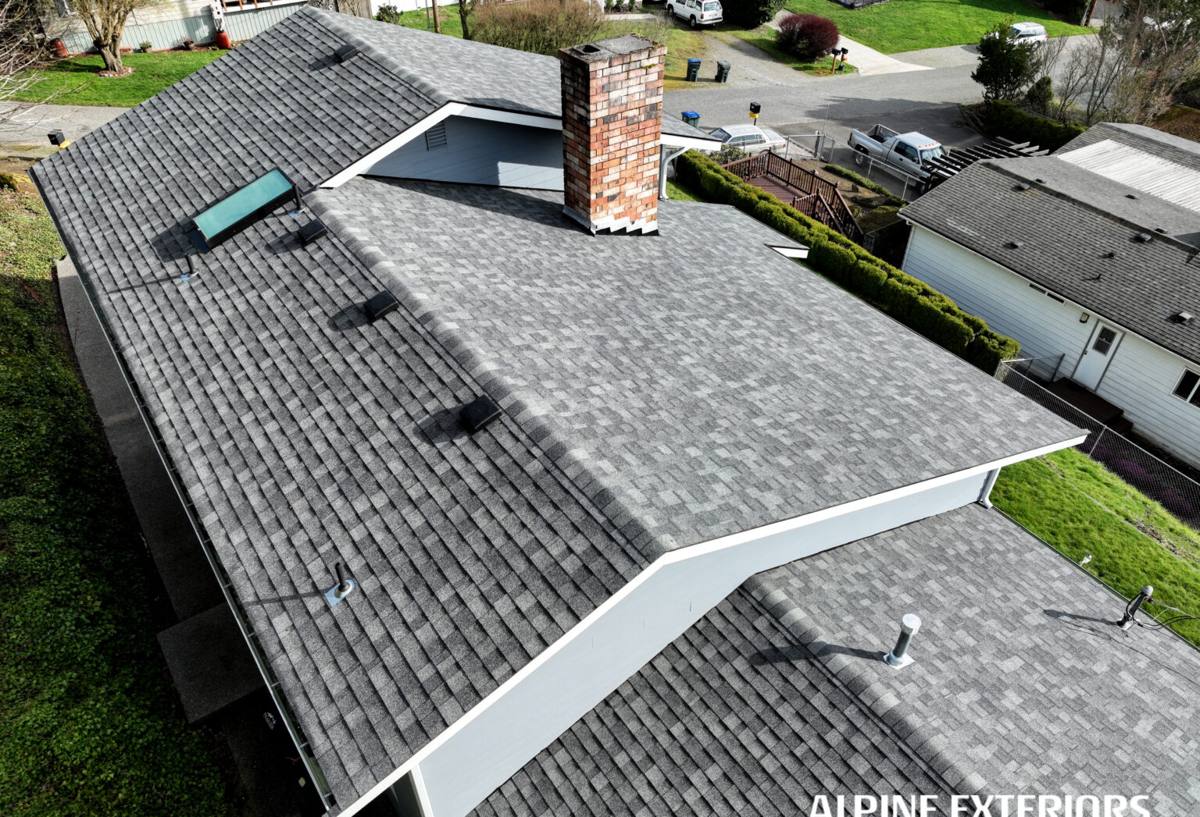
Chimneys, vent pipes, skylights, and wall step-flashing are where most roof leaks actually originate — not the open field of shingles. We replace flashing rather than reuse old pieces, and we detail each one to shed water correctly rather than relying on sealant to do a metal detail's job.
Ventilation
Balanced intake and exhaust ventilation keeps the attic dry and temperature-regulated, which reduces moisture buildup that would otherwise feed moss and mildew from underneath the decking. We check existing ventilation during the estimate and correct it as part of the replacement when it's inadequate — a new roof over a poorly ventilated attic just moves the moisture problem, it doesn't solve it.
Our Roof Replacement Process
- On-site inspection and estimate. We walk the roof (weather permitting) and the attic, note decking condition, ventilation, flashing points, and slope-specific issues like moss or shade exposure, and give you a written estimate with material options.
- Material selection. We walk through the trade-offs in plain terms — cost, lifespan, moss resistance, appearance — so you're choosing based on your priorities, not a sales pitch.
- Scheduling around weather. Whatcom County's wet season means we plan install windows carefully and keep the roof dried-in at every stage of tear-off, so an unexpected shower doesn't become a problem inside your home.
- Tear-off and decking repair. Old roofing comes off, decking gets inspected and repaired as needed, and any surprises are discussed with you before we move forward.
- Underlayment, flashing, and shingle installation. Installed in the sequence and to the detail described above — ice and water shield first, then underlayment, then flashing, then the roofing material itself.
- Final inspection and cleanup. We check every penetration, ridge, and edge, do a magnetic sweep and yard cleanup for debris and nails, and walk the finished roof with you.
Cost Factors for a Sunnyland Roof Replacement
Every roof is different, so we won't quote a number without seeing yours — but these are the variables that actually move the price:
| Factor | Why It Matters |
|---|---|
| Roof size and pitch | Steeper roofs take longer to work safely and use more material for the same footprint |
| Number of existing layers | Multiple old layers mean more tear-off labor and disposal before the deck is even visible |
| Decking condition | Rot or delamination found during tear-off adds material and labor to replace it properly |
| Material choice | Architectural shingle, metal, and cedar carry different material and labor costs, as shown above |
| Roof complexity | Valleys, dormers, chimneys, and skylights each add flashing work and time |
| Access and site conditions | Tight lots, mature trees, or limited staging space can affect labor time and disposal logistics |
We'd rather walk your roof and give you real numbers than throw out a broad range that doesn't mean much either way.
Why a Crew That Already Works Sunnyland Matters
Roofing crews that work all over Western Washington aren't necessarily wrong for the job, but there's real value in a crew that already knows this specific area's conditions. We know which slopes in Sunnyland's tree cover tend to hold moss longest, how salt air behaves on fasteners and flashing near the bay, and how to sequence a tear-off around Whatcom County's rain patterns instead of getting caught mid-project by a system rolling in off the Sound. We're also familiar with Bellingham's permitting process and inspection expectations, which keeps a replacement moving instead of stalling on paperwork.
Just as important: we're going to be here after the job is done. If a flashing detail needs a look five years from now, or a warranty question comes up, you're calling a local crew that installed the roof — not chasing down a company that did one job in the neighborhood and moved on.
What to Ask Before You Hire a Roofer in Whatcom County
- Are you licensed and insured in Washington State, and can you provide proof?
- Will you tear off down to the decking, or is a re-cover being proposed?
- What underlayment and ice-and-water shield are included, and where specifically will they be used?
- How will you handle ventilation if the current setup is inadequate?
- What's the manufacturer's warranty on materials, and what's your workmanship warranty separately?
- Do you have local references or completed work in this area we can look at?
- How do you handle weather delays mid-project so the roof stays protected?
A contractor who answers these clearly and specifically, without dodging into vague reassurance, is one worth trusting with a job this size.
Get a Straight Answer on Your Roof
If your Sunnyland roof is showing its age — moss that keeps coming back, granule loss, or a few too many past repairs — we're happy to take a look and give you an honest read on whether it's time to replace or if a repair still has life in it. The estimate is free, there's no pressure attached to it, and you'll get a real answer based on what we actually see on your roof, not a generic sales pitch. Use the form below to get started.