 Fairhaven Siding
 Silver Beach Asks More of Siding Than Most Neighborhoods
Homes in Silver Beach sit inside the same marine climate that defines all of Whatcom County: damp air for most of the year, driving rain that comes in sideways during fall and winter storms, and long stretches of overcast, low-airflow weather that let moss and algae get established on anything shaded or north-facing. Siding here isn't just a cosmetic layer — it's the first line of defense against moisture that never fully lets up, season after season.
The combination matters more than any single factor on its own. Salt-laden air near the water accelerates corrosion on fasteners and trim. Driving rain finds every gap, seam, and unflashed penetration. And a moss season that can run from early fall through late spring keeps siding surfaces damp longer than they'd stay in a drier climate, which is exactly the condition organic growth needs. A siding product and installation that would hold up fine in a drier inland climate can fail years early here if it isn't matched to what Silver Beach actually throws at it.
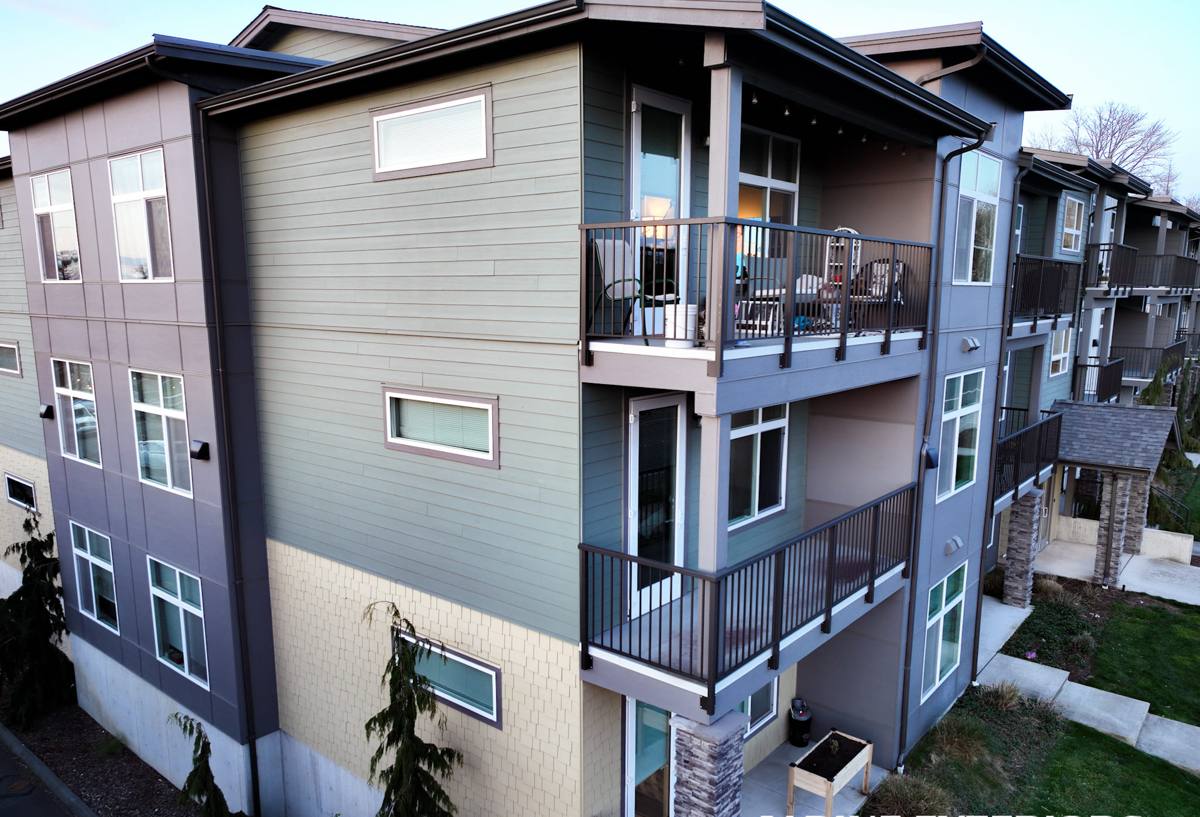
Why Fiber Cement Is the Right Material for This Location
Fiber cement is cement, sand, and cellulose fiber pressed into a dense, stable board. It doesn't absorb and swell with moisture the way wood-based products can, it won't rot, and it doesn't feed the organic growth that thrives in a damp, shaded climate the way some wood-fiber sidings can if their edges are compromised. We install James Hardie fiber cement exclusively, and part of why is that Hardie engineers specific product lines for specific climates through its HardieZone system — the planks and panels rated for high-moisture, marine regions like ours are formulated and tested differently than the versions sold in dry, low-humidity states. That's not marketing; it's a real difference in how the product is engineered to perform where humidity and rainfall are constants rather than occasional events.
Fiber cement also holds a factory-applied finish — ColorPlus technology — better than field-applied paint holds up on wood or engineered wood siding in a climate this wet. A factory finish cures under controlled conditions and is backed by its own finish warranty, which matters in a place where a field-painted surface has to fight moisture and mildew from day one of the paint job.
What a Correct Installation Involves
Fiber cement siding is only as good as the installation behind it. On a Silver Beach home, that means getting the details right that don't show up in a walk-by but determine whether the siding lasts 30-plus years or starts showing problems in five:
Drainage and clearance
Siding needs a proper weather-resistive barrier behind it, correctly lapped and taped, with a drainage plane that lets any moisture that gets behind the boards find its way back out instead of sitting against the sheathing. Bottom clearance from grade, decks, patios, and roof lines has to meet manufacturer minimums — skip this and you're inviting the exact wicking and rot at the base of the wall that fiber cement is supposed to prevent.
Flashing at every penetration
Windows, doors, hose bibs, light fixtures, vents — every penetration through the siding plane is a potential entry point for driving rain. Correct step flashing, head flashing, and kick-out flashing at roof-to-wall intersections are non-negotiable in a climate where wind-driven rain is a regular event, not a rare storm.
Fastening and joints
Fasteners have to be corrosion-resistant and driven correctly — not overdriven, not underdriven, spaced and placed per the manufacturer's published fastening schedule. Butt joints get treated as a system: manufacturer-approved joint flashing or gapping, not just a bead of caulk expected to do all the work for the next three decades.
Finish integrity
Because we use factory-finished ColorPlus boards, field touch-up is limited to cut edges and minor repairs using the manufacturer's matched touch-up products — not a full repaint that would void the factory finish warranty.
How Fiber Cement Compares to the Alternatives
Homeowners in Silver Beach usually ask us to compare fiber cement against a few other common siding options. Here's an honest look at how they stack up for a coastal, high-moisture climate like this one:
| Factor | James Hardie Fiber Cement | Vinyl | Engineered Wood (LP SmartSide) | Cedar |
|---|---|---|---|---|
| Moisture/rot resistance | Cement-based, doesn't rot | Doesn't rot, but seams can trap moisture behind panels | Wood-based core; edges need protection from moisture intrusion | Natural wood; rots without diligent maintenance |
| Fire resistance | Non-combustible | Combustible, can melt/deform in heat | Combustible | Combustible |
| Maintenance in a moss-prone climate | Low; factory finish resists growth better than field paint | Low, but can look chalky/faded over time | Moderate; requires diligent caulking and repainting | High; regular sealing/staining required |
| Color/finish durability | Factory-baked ColorPlus finish, separate warranty | Color molded in, can fade | Field-applied or factory paint, shorter repaint cycle | Requires ongoing refinishing |
| Typical product warranty | Long-term, transferable | Varies widely by manufacturer | Manufacturer-dependent | None from a manufacturer; wood is wood |
Every one of these products has a legitimate place in the market. We simply made a standard: we install James Hardie fiber cement because, for a climate like Silver Beach's, it's the option we're willing to warranty our workmanship against and stand behind for the long haul.
Our Process for a Silver Beach Siding Project
- On-site assessment: We look at your current siding, sheathing condition, moisture history, and any trouble spots — north-facing walls, shaded areas, low-clearance zones — that tend to be the first to show wear in this climate.
- Tear-off and sheathing check: Once the old siding is off, we inspect the sheathing and framing underneath for hidden moisture damage before anything new goes on. Problems found here get addressed, not covered up.
- Weather barrier and flashing: A new weather-resistive barrier is installed and properly lapped, with flashing detailed at every window, door, and penetration.
- Hardie installation to manufacturer spec: Boards are installed with correct clearances, fastening schedules, and joint treatment — not shortcuts that happen to look fine from the curb.
- Trim, caulking, and touch-up: Cut edges are sealed and touched up with matched ColorPlus products; caulking is applied only where the manufacturer's system calls for it.
- Final walk-through: We go over the finished job with you before calling it done.
What Drives Cost on a Fiber Cement Job in This Area
| Cost factor | Why it matters here |
|---|---|
| Home size and story count | More square footage and second-story work both add labor and material |
| Existing siding removal and sheathing repair | Homes with hidden moisture damage from prior siding need repairs before new siding goes on |
| Trim and detail complexity | Corners, soffits, and architectural detail add labor beyond flat wall coverage |
| Profile and color selection | Lap width, panel style, and ColorPlus color affect material cost |
| Site access | Tight lots, slopes, and limited staging area near the water can add setup time |
We give straightforward, itemized estimates so you can see what you're paying for rather than a single lump number.
Living With a Long Moss Season: What Actually Needs Upkeep
Fiber cement is low-maintenance compared to wood or engineered wood siding, but "low-maintenance" doesn't mean "no maintenance," especially in a climate that stays damp as long as this one does. A short list of what's actually worth doing:
- Keep gutters and downspouts clear so water isn't sheeting down the siding face during heavy rain
- Trim back shrubs and trees close to the house to let shaded walls dry out between storms
- Rinse siding annually, especially on north-facing and shaded walls where moss and algae take hold first
- Inspect caulking at trim, windows, and penetrations for cracking or separation once a year
- Check flashing above windows and at roof-to-wall intersections for signs of water tracking
- Watch the base of the walls near grade, decks, and patios for any buildup of soil, mulch, or debris against the siding
Why the Installing Crew Matters as Much as the Siding
James Hardie's product warranty and finish warranty are only as good as the installation behind them — manufacturer specs on clearance, fastening, and flashing exist because skipping them is exactly what causes early failures, and an installer who doesn't follow them can put that warranty coverage at risk regardless of how good the material is. A crew that already works in and around Fairhaven and Silver Beach has seen how wind-driven rain actually behaves against a wall here, where moss tends to establish first, and which details can't be shortcut in this climate. That local pattern recognition is worth as much as the material spec sheet.
If you're weighing a siding replacement in Silver Beach, we're glad to walk your home, point out what we see, and put together a straightforward, no-pressure estimate — use the form below to get started.