 Fairhaven Siding
 Why Sudden Valley Homes Put Windows Through More Than Most
Homes around Sudden Valley deal with a specific combination of conditions that most window sales reps outside Whatcom County never have to think about. Salt-tinged air moving in off the water, driving rain that comes in sideways during winter storms, and a moss season that can stretch from October through May all put steady stress on window frames, seals, and glazing. None of that is dramatic on its own, but it adds up year after year. A window that would last two decades in a drier inland climate can start failing in half that time here if it wasn't built or installed with this environment in mind.
Energy efficiency and durability aren't separate issues in this climate — they're the same issue. A window that's leaking air is very often also a window that's letting in moisture, and moisture is what eventually rots a frame, fogs a sealed glass unit, or feeds the mildew and moss that creeps onto north-facing walls. When we talk about "energy-efficient windows" for a Sudden Valley home, we're really talking about windows that shed water, resist wind-driven rain, and hold their seal for the long haul — with lower energy bills as one of the results, not the only goal.
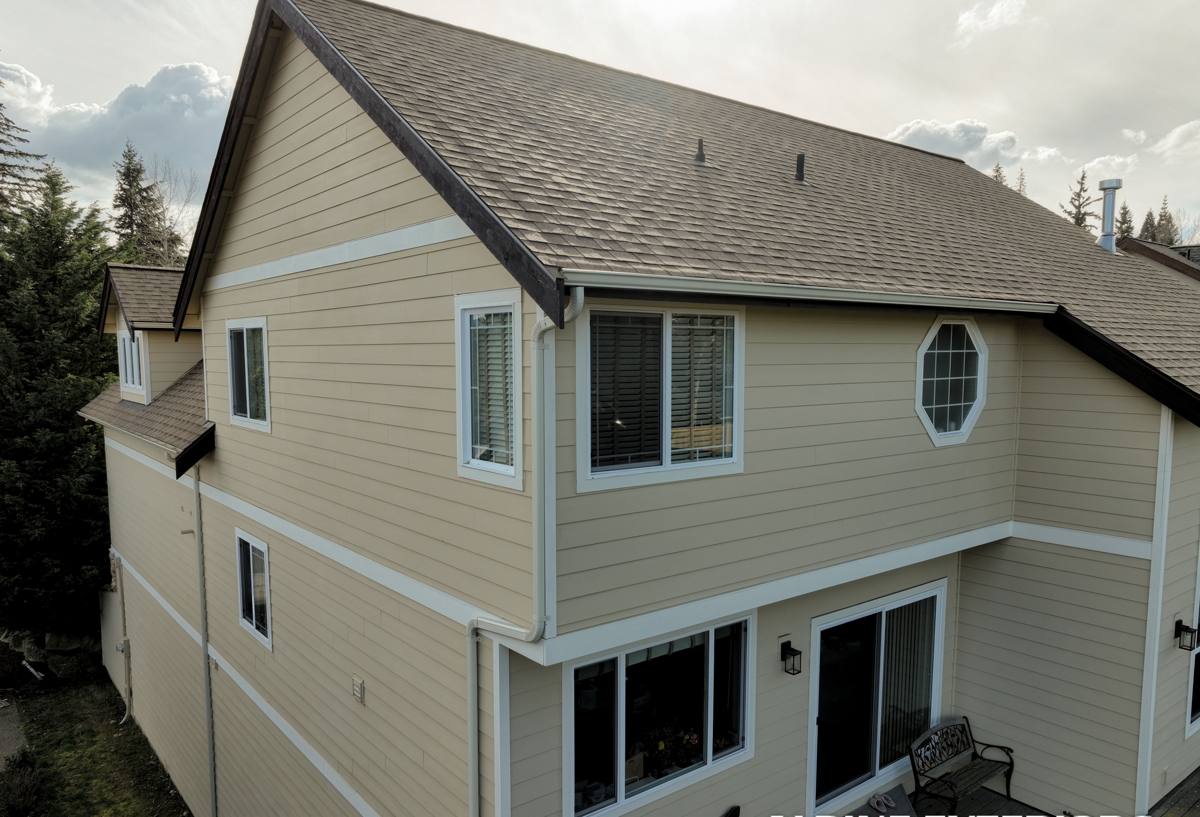
What Actually Goes Wrong With Windows Out Here
Wind-Driven Rain Finding Weak Points
Standard installation practices assume rain falls mostly straight down. In storms that push rain sideways against a wall, water gets forced into gaps that would never see moisture in a calmer climate. If the flashing, sill pan, or sealant detailing wasn't built for that reality, water finds its way behind the window trim and into the wall framing — often years before anyone notices a stain.
Condensation From Temperature Swings
Whatcom County's damp, moderate-but-changeable weather means indoor and outdoor temperature and humidity differ enough, often enough, to cause condensation on older or poorly rated glass. Persistent condensation on the interior side of a window is usually a sign the glass package or frame is no longer doing its job — and it's a slow path to wood rot, mold, and peeling paint on surrounding trim.
Salt Air and Metal Fatigue
Salt-laden air corrodes exposed metal components faster than it does further inland — hinges, weep-hole screens, and lower-grade hardware are the first things to show wear. Over time this can affect how tightly a window closes and seals, which quietly undermines its energy performance even if the glass itself is fine.
Moss and Organic Growth
A long moss season means organic growth doesn't just show up on roofs — it collects in window tracks, sills, and anywhere water sits instead of draining. Beyond being unsightly, trapped moisture from moss buildup accelerates frame degradation, especially on wood and lower-grade composite products.
Frame Materials: What Holds Up Here and What Doesn't
There's no single "best" window material for every home, but some perform more predictably than others in a wet, salt-influenced climate. Here's how the common options generally compare for Sudden Valley conditions:
| Material | Moisture Resistance | Maintenance | Typical Trade-Offs |
|---|---|---|---|
| Vinyl | Very good — won't rot, low permeability | Low | Can expand/contract with temperature; quality varies a lot by manufacturer |
| Fiberglass | Excellent — dimensionally stable, resists moisture and salt corrosion | Low | Higher upfront cost than vinyl |
| Wood (unclad) | Poor to fair without diligent upkeep | High | Needs regular refinishing to resist this climate's moisture load |
| Wood, aluminum- or fiberglass-clad | Good — exterior clad protects the wood core | Moderate | Cladding must be properly sealed at joints or moisture gets trapped inside |
| Aluminum | Fair — durable but conducts heat/cold and can corrode near salt air over time | Low | Generally the weakest energy performer of this group unless thermally broken |
Our standard for Sudden Valley homes leans toward vinyl or fiberglass for most projects, because both resist the moisture and salt exposure this area sees without the ongoing maintenance burden of bare wood. Where a homeowner wants a wood interior look, a properly clad wood window is a reasonable choice — but only when the cladding and flashing details are done right, since a poorly sealed clad window can trap moisture against the wood core and cause hidden rot faster than an unclad window would.
Glass and Ratings That Actually Matter in This Climate
Sales literature throws a lot of numbers at homeowners. In practice, three ratings matter most for this region:
- U-factor: measures how well the window resists heat loss. Lower is better, and it matters more here than in milder inland climates because of the Pacific Northwest's long heating season.
- Low-E coatings: a microscopically thin coating that reflects heat while still letting light through. The right Low-E package for this region balances winter heat retention with keeping summer afternoon sun from overheating west-facing rooms.
- Air infiltration rating: tells you how much air leaks through the window assembly itself, not just the glass. This is directly tied to how well wind-driven rain gets kept out too — a tight window and a dry window usually go together.
Double-pane windows with argon gas fill and a Low-E coating are the practical baseline for this climate. Triple-pane can make sense for homes with a lot of west- or north-facing glass exposed to weather, but it's not automatically worth the added cost on every elevation of every house — that's a case-by-case call, not a blanket upgrade.
Signs It's Time to Replace, Not Just Repair
Not every window problem means a full replacement. But some signs are reliable indicators that repair is just delaying the inevitable:
- Fog or moisture trapped between panes of a double- or triple-pane unit — the seal has failed and can't be restored
- Soft or spongy wood at the sill or bottom corners of the frame
- Visible daylight or a noticeable draft at the frame edges when the window is fully latched
- Difficulty opening, closing, or latching that isn't fixed by cleaning the tracks
- Paint that keeps peeling or bubbling around the frame despite repainting
- Moss or dark staining building up in the tracks or sill even after cleaning
- A noticeable jump in heating costs with no other explanation
How the Job Actually Gets Done Right
Assessment First
We start by looking at each window in the context of the wall it's in — not just the glass. That means checking existing flashing, siding condition around the opening, and whether there's any sign of past water intrusion. A window replaced without addressing a bad flashing detail underneath just repeats the same failure with new glass.
Sill Pan and Flashing Integration
This is the step that separates a durable installation from one that fails quietly over a few winters. A properly sloped sill pan, correctly lapped flashing tape, and integration with the home's water-resistive barrier are what actually keep wind-driven rain out — more than the window product itself does. This is also where window work and siding work overlap directly, since the flashing has to tie into the surrounding wall assembly correctly.
Air Sealing, Not Just Caulk
Gaps around the window frame need continuous, appropriate insulation and air sealing — not just a bead of caulk at the trim. Done poorly, this is one of the most common sources of the drafts and energy loss homeowners notice within a year of a "new window" job.
Finish and Cleanup
Interior and exterior trim gets reset and sealed, debris is cleared, and every window is tested for smooth operation and a tight seal before we call the job done.
What This Kind of Project Costs
Exact pricing depends on window size, material, glass package, and how much of the surrounding trim or siding needs attention — but broadly, homeowners in this area should expect the following ranges per window, installed:
| Window Type | Typical Range (Installed) | What Drives the Cost |
|---|---|---|
| Standard vinyl, double-pane | Moderate, lower end of the range | Size, number of operable panels, basic Low-E glass |
| Fiberglass, double-pane | Moderate to upper-moderate | Material cost, better long-term moisture performance |
| Wood-clad, double-pane | Upper-moderate to higher | Interior wood finish, cladding detail, custom sizing |
| Triple-pane upgrade (any material) | Add to base window cost | Extra pane, gas fill, heavier glass unit and hardware |
| Flashing/siding repair around openings | Varies by extent of damage found | Whether water intrusion has already reached the framing |
We'll always give a straightforward, itemized number after seeing the actual openings — not a one-size estimate over the phone.
Why Local Experience With This Specific Area Matters
A lot of window crews can install a window competently on a dry, calm day. Fewer have spent years dealing with the specific failure patterns that show up in Whatcom County's marine-influenced climate — the wind direction that tends to drive rain into certain wall orientations, how quickly moss reestablishes itself in shaded areas, and which flashing details actually hold up through a full winter of sideways rain rather than just looking right on installation day. That's the difference between a window that performs for one season and one that performs for its full warranty life.
We also treat window work as connected to the rest of the building envelope. Because we work in siding as our core trade, we're not looking at a window in isolation — we're looking at how it ties into the wall, the trim, and the water-management system around it. That matters more here than in a lot of other climates, because a window that's perfectly installed but sitting behind failing siding or bad flashing will still let water in eventually.
A Simple Checklist Before You Commit to Any Window Project
- Ask what U-factor and air infiltration rating the proposed windows carry, and whether that's appropriate for your home's exposure
- Ask how sill flashing and pan flashing will be handled — not just whether the window itself is good
- Confirm whether surrounding siding or trim will be inspected and repaired as part of the job, not patched around
- Get a written, itemized estimate rather than a single lump-sum number
- Ask about the manufacturer's warranty terms and what voids them — installation errors often do
- Ask whether the crew has done window work specifically in this climate, not just in general
If your windows are drafty, fogged, hard to operate, or you're just planning ahead for a home in Sudden Valley, we're happy to take a look and walk you through what your options actually are — no pressure, no inflated quote to start negotiations from. Fill out the form below for a free estimate.