 Fairhaven Siding
 Why Bellingham Roofs Wear Differently Than Roofs Inland
A roof in Bellingham lives a harder life than the same roof forty miles inland. Between the marine air rolling off Bellingham Bay, the long stretch of wet months, and the shade cover that keeps parts of nearly every roof damp for days at a time, asphalt shingles here are working against conditions most manufacturers didn't design their warranties around. We install and repair asphalt shingle roofs on Bellingham homes regularly, and the failure patterns we see are consistent enough that we plan for them before the first shingle goes down, not after a problem shows up.
Three things drive almost everything that goes wrong with a shingle roof in this part of Whatcom County: salt-laden air that accelerates corrosion on fasteners and metal flashing, driving rain that gets pushed sideways under normal weather patterns and finds any gap in the underlayment or flashing detail, and moss and algae growth that thrives in the shaded, moisture-heavy microclimates common on tree-lined Bellingham lots. None of these alone are exotic problems. Together, over years, they're what separates a roof that makes it to 25 years from one that needs attention at 12.
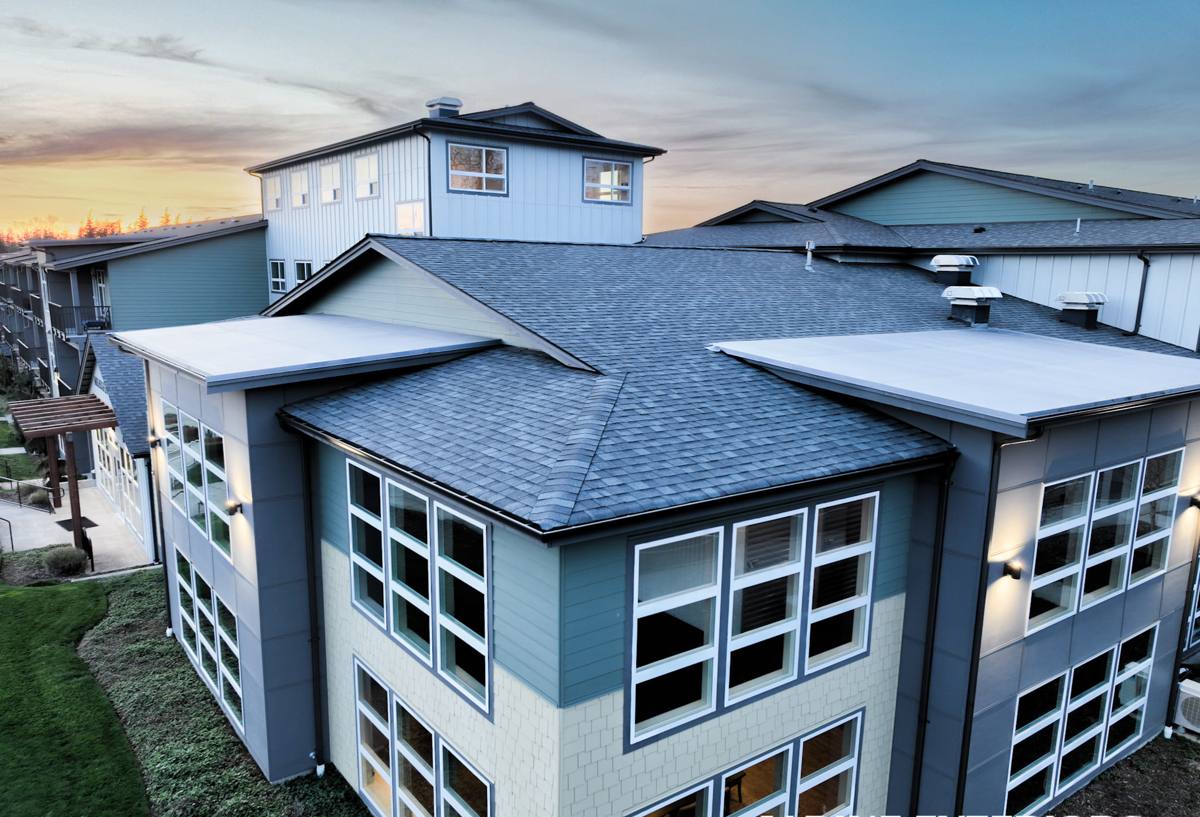
What Salt Air Actually Does to a Shingle Roof
Proximity to the bay means airborne salt settles on every exterior surface, including the roof. It doesn't damage the asphalt shingle mat itself in any dramatic way, but it accelerates corrosion on the metal components a roof depends on: nail heads, drip edge, flashing around chimneys and vents, and any exposed fastener. Corroded fasteners lose holding power over time, and corroded flashing develops pinholes long before it looks obviously bad from the ground.
The practical response isn't complicated — it's using corrosion-resistant fasteners and flashing rated for coastal exposure rather than the cheapest standard-grade materials, and paying closer attention during inspections to the metal details rather than assuming the shingles themselves are the only thing that ages.
Driving Rain and Wind-Driven Water Intrusion
Bellingham doesn't just get a lot of rain — it gets rain pushed by wind off the water, which behaves differently than straight-down rainfall. Wind-driven rain can work its way under shingle tabs, around step flashing, and through valleys that weren't detailed with enough overlap. A roof that would perform fine in a calmer climate can leak here if the underlayment, valley protection, and flashing laps weren't built with sideways water in mind.
This is why we treat underlayment and flashing as the parts of the job that actually keep water out — the shingles are the visible, weather-facing layer, but the waterproofing system underneath is what determines whether wind-driven rain ever reaches the roof deck.
Where Leaks Actually Start
- Valleys where two roof planes meet and water concentrates
- Step flashing along chimneys, dormers, and sidewalls
- Around roof penetrations — vent pipes, exhaust fans, skylights
- Along eaves, where ice and heavy rain can back up under shingles
- Nail placement — too high or too low in the shingle course
Moss, Algae, and Bellingham's Shade Cover
Whatcom County's tree canopy is part of what makes the area appealing, and it's also what keeps roof sections in shade long after a storm passes. Shaded, north-facing, or tree-covered sections of a roof stay damp far longer than sun-exposed slopes, and that sustained moisture is exactly what moss and algae need to establish. Once moss takes hold, it doesn't just look bad — it holds water against the shingle surface, works its way under tab edges, and can lift shingles enough to let water underneath.
A roof with heavy moss cover is aging faster than the same roof kept clean, even if the shingles themselves are the same age and quality. Moss control is a maintenance issue as much as an installation issue, and it's one of the few roof problems a homeowner can actually stay ahead of between full inspections.
What a Correctly Installed Shingle Roof Needs Here
A shingle roof built for this climate isn't a different product than a shingle roof built anywhere else — it's the same asphalt shingle system installed with more attention to the details that matter in a wet, salt-air, moss-prone environment.
The Non-Negotiables for This Climate
- Ice-and-water shield at eaves, valleys, and around penetrations — not just where code minimums require it
- Synthetic underlayment across the full deck, which handles sustained moisture exposure better than older felt products
- Corrosion-resistant flashing and fasteners given the salt air exposure this close to the bay
- Balanced attic ventilation so moisture from inside the house doesn't condense against the roof deck from underneath
- Algae-resistant shingle granules where the roof has shaded or tree-covered exposure
- Proper starter strip and drip edge detailing at eaves and rakes to stop wind-driven rain at the edge
Choosing the Right Asphalt Shingle for a Bellingham Roof
Not every asphalt shingle product performs the same way in this climate. We steer most Bellingham homeowners toward architectural (dimensional) shingles over basic three-tab shingles, mostly because of how each handles wind and water rather than for appearance alone.
| Factor | 3-Tab Shingles | Architectural Shingles |
|---|---|---|
| Wind resistance | Lower rated, more prone to lifting in gusty coastal wind | Higher wind ratings, better tab adhesion |
| Algae resistance options | Available but less common | Widely available, standard on most product lines |
| Typical lifespan in this climate | 15–20 years with regular maintenance | 25–30+ years with regular maintenance |
| Upfront cost | Lower | Moderate premium over 3-tab |
| Appearance | Flat, uniform | Dimensional, heavier shadow lines |
The cost difference between the two isn't large enough, in our experience, to justify the shorter service life and lower wind rating of 3-tab shingles on a roof that's going to face regular coastal storms. We'll walk through the specific product lines and warranty terms available for a given home, but the underlying recommendation for most Bellingham roofs is architectural shingles with algae-resistant granules as standard, not an upgrade.
Our Installation Process
A shingle roof is only as good as what happens before the shingles are visible. Here's how we approach a replacement:
- Full tear-off and deck inspection — we remove the existing roofing down to the deck and check for soft spots, rot, or damage that needs repair before anything new goes down
- Deck repair as needed — any compromised sheathing gets replaced, not covered over
- Ice-and-water shield and underlayment — installed across the full deck with extra coverage at eaves, valleys, and penetrations
- Flashing — new drip edge, step flashing, and valley metal, matched to the home's specific roof geometry
- Ventilation check — intake and exhaust balanced so the attic can breathe properly year-round
- Shingle installation — starter strips, field shingles, and ridge cap installed to manufacturer spec, with attention to nail placement and exposure
- Final walkthrough — cleanup and a review of the finished roof with the homeowner
Maintenance That Actually Extends a Bellingham Roof's Life
Between the driving rain, the salt air, and the shaded lots common through Whatcom County, an asphalt shingle roof here benefits from more regular attention than the same roof would need in a drier, sunnier climate. None of this is complicated, but skipping it is how a well-installed roof still ends up needing early repairs.
- Keep gutters clear so water isn't backing up under the eaves
- Have moss and debris removed from shaded roof sections before it builds up
- Trim back overhanging branches to reduce shade and debris buildup
- Schedule a roof inspection after major windstorms, not just on a fixed calendar
- Address small flashing or granule-loss issues before they become leaks
Repair or Replace? What We Actually Look At
Homeowners often ask whether a leak or a patch of missing shingles means the whole roof needs to go. Usually not. We look at the age of the roof, how widespread the wear is versus how localized, whether the deck underneath is sound, and how much of the roof's remaining shingles still have healthy granule coverage. A roof with isolated flashing failure or storm damage on an otherwise sound, mid-life roof is a repair. A roof with widespread granule loss, curling shingles across multiple slopes, or recurring leaks in different spots each season is usually past the point where repairs make sense long-term.
Why Hire a Crew That Already Works Bellingham Roofs
A roofing crew that mostly works drier, inland climates can install a technically correct roof and still miss the details that matter specifically here — the extra flashing attention salt air demands, the underlayment coverage that handles wind-driven rain, and the shingle products that hold up under sustained shade and moisture. We work on homes throughout Fairhaven and the Bellingham area regularly, which means we're not guessing at how a given product or detail performs in this climate — we've seen it hold up, or seen it fail, on roofs like the one on your house.
If you're weighing a repair, a replacement, or just want an honest read on where your current roof stands, we're glad to take a look. Reach out through the form below for a free, no-pressure estimate.