 Fairhaven Siding
 Windows in Edgemoor Face a Different Kind of Weather
Edgemoor sits close enough to the water that homes here take a steady dose of salt-laden air off the bay, mixed with the driving, sideways rain that rolls through Whatcom County for much of the year. Add the tree cover that gives the neighborhood its character — mature firs and cedars that keep siding and trim shaded and damp for long stretches — and you get a climate that's genuinely hard on window frames, sealant, and glazing. This isn't a place where a window just has to look good. It has to shed water on the first try, resist salt corrosion on hardware, and hold its seal through a moss season that can run from October into May.
We see the same failure patterns over and over in this area: swollen wood sashes that won't latch, corroded aluminum cranks and hinges, black mildew streaking below sills, and fogged double-pane glass where the seal finally gave out. None of that is a knock on the homeowners — it's what happens when standard products and standard installs meet a marine microclimate over ten or fifteen years.
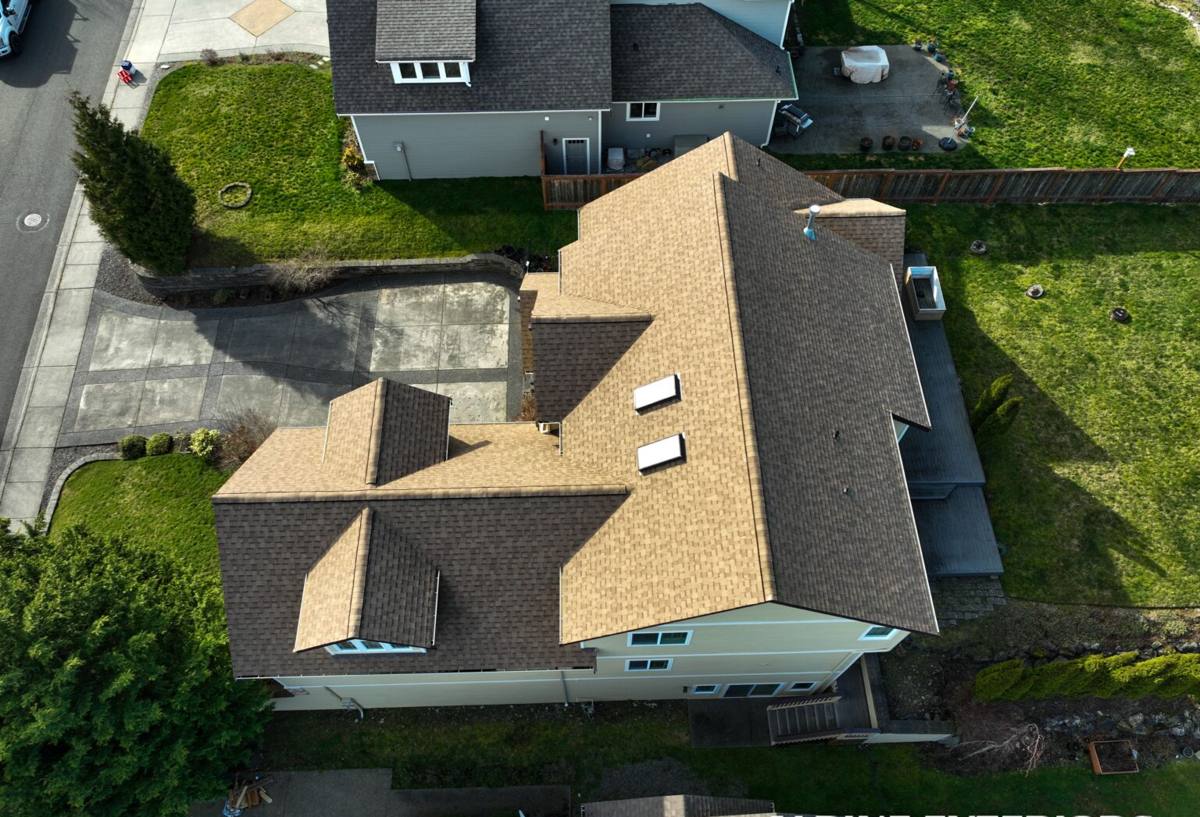
What "Custom" Actually Means for This Neighborhood
Custom doesn't just mean an unusual size. In Edgemoor, it usually means one of three things: matching an original opening in an older home where nothing off-the-shelf fits cleanly, replacing large view-oriented windows that were built into the house to take advantage of the water and tree line, or working around trim, siding, and roof details that a stock replacement would butcher if forced into place.
Common situations we run into
- Older homes with original wood-frame openings that have settled slightly out of square over the decades
- Larger picture or bay windows oriented toward views, where sightlines and sash proportions matter as much as function
- Custom shapes — arched tops, transoms, odd-sized openings — that were built for the house rather than pulled from a catalog
- Homes where the exterior trim profile is specific enough that a mismatched replacement window would stand out immediately
In all of these cases, "custom" means we measure and order to the actual opening and the actual house, not the nearest standard size.
Material Choices That Hold Up Near the Water
The frame material matters more here than it would inland. Salt air accelerates corrosion on hardware and fasteners, and constant moisture punishes anything that can absorb water or trap it against wood. Here's how the common options actually perform in a Fairhaven-area coastal setting:
| Material | How it handles salt air & rain | Maintenance | Typical cost position |
|---|---|---|---|
| Vinyl | Good — won't corrode or rot, seams are the weak point if not installed tight | Low; occasional cleaning | Lower |
| Fiberglass | Very good — dimensionally stable, resists moisture and salt corrosion well | Low | Mid to upper |
| Wood-clad | Good on the exterior face if the cladding is intact; interior wood still needs protection from condensation | Moderate; watch cladding seams and interior finish | Upper |
| Bare aluminum | Poor to fair — prone to corrosion and thermal issues in this climate unless it's a marine-grade, thermally broken product | Higher; hardware needs regular attention | Varies widely |
We don't push one material on every job. A view-facing wood-clad window can be the right call on a home where appearance and history matter, as long as the owner understands the maintenance commitment. For most Edgemoor replacements, we lean toward vinyl or fiberglass for the workhorse windows and reserve wood-clad for situations where matching original character is the priority.
Why the Installation Matters More Than the Window Itself
A well-built window installed badly will fail faster than a mid-grade window installed correctly. This is the part of the job that's invisible once trim goes back on, and it's also where most of the callbacks we see from other installs trace back to.
What a correct installation actually involves
- Removing the old window and inspecting the rough opening for rot, soft framing, or prior water intrusion before anything new goes in
- Repairing or replacing any damaged framing — never installing a new window over a compromised opening
- Installing flashing in the correct shingle-lap sequence so water is directed out and down, not trapped behind the siding
- Applying a continuous, compatible sealant bead at the right points — sealing everything, including the bottom, traps water rather than shedding it
- Shimming and fastening the unit square and plumb so sashes operate correctly and weatherstripping compresses evenly
- Insulating the gap between the frame and rough opening without overpacking it, which can bow the frame
- Finishing interior and exterior trim to shed water away from the new seams
In a neighborhood that gets this much driving rain, step three and four are where the job is won or lost. A window that's caulked around all four sides but not flashed properly will look fine for a season or two, then start leaking into the wall cavity where nobody sees it until there's rot or a moisture problem inside.
How We Approach an Edgemoor Window Job
1. On-site assessment
We walk the house, look at existing window condition, check for signs of past water intrusion around openings, and talk through what's actually bothering the homeowner — drafts, fogging, difficulty operating, appearance, or all of the above.
2. Measurement and product selection
Every opening gets measured individually; we don't assume uniformity even on newer homes, and we don't assume it at all on older ones. We go over material, glass, and grille options based on the home's exposure — a window on the water-facing side of the house gets a different conversation than one tucked under an eave on the leeward side.
3. Installation
Old units come out, openings get inspected and repaired as needed, and new windows go in following the sequence above — flashing first, sealant in the right places, square and properly fastened.
4. Finish and cleanup
Interior and exterior trim gets finished to shed water correctly, debris is hauled off, and we walk the homeowner through operation and any care specifics for the material chosen.
Signs Your Current Windows Are Already Failing
Most window problems in this climate don't show up as a sudden leak — they show up gradually, and homeowners often live with them longer than they need to. Worth checking for:
- Fogging or a hazy film between the panes of a double-pane window (the seal has failed)
- Soft or spongy wood at the sill or lower frame corners
- Visible moss or dark green growth building up on horizontal frame surfaces
- A noticeable draft near the frame even when the window is fully latched
- Sashes that are hard to open, close, or lock — often from swelling or corroded hardware
- Black or gray staining on interior trim or drywall below or beside the window
- Paint or finish that's bubbling or peeling specifically around the window opening, not the wall generally
Any one of these on its own might just mean a tune-up. Two or three together, especially the staining or soft wood, usually means water has already gotten past the seal and it's worth having someone look at the opening itself, not just the sash.
What Drives the Cost of a Custom Window Job
There's no single price that applies to every house, but the same handful of factors move the number up or down on nearly every Edgemoor job we quote:
| Factor | Why it matters |
|---|---|
| Opening size and shape | Custom or oversized openings cost more to manufacture and install than stock sizes |
| Frame material | Vinyl runs lower, fiberglass and wood-clad run higher; see the material table above |
| Glass package | Upgraded low-E coatings or laminated glass for sound or storm resistance add cost but pay off in comfort here |
| Number of openings | Doing several windows in one visit is more efficient per-unit than one-offs |
| Access and height | Second-story or hard-to-reach windows take longer and need more setup |
| Trim and siding repair | If the opening has hidden rot or damaged siding, that repair is separate from the window itself |
As a rough starting point, a straightforward vinyl replacement in a standard opening tends to sit at the lower end of the market, while custom shapes, larger view windows, or wood-clad units run meaningfully higher. We give exact numbers after we've actually measured and looked at the opening — anything quoted sight unseen is a guess.
Why Local Experience in This Area Actually Matters
A crew that mostly works inland doesn't spend much time thinking about salt exposure, moss growth patterns, or how driving rain off the bay hits a west-facing wall differently than it hits an east-facing one. Working in and around Fairhaven and Whatcom County regularly means we're not guessing at how a given material or install detail holds up here — we're seeing the results on other homes in the same conditions year after year. That shows up in small decisions: which sealant we trust in this humidity, how much clearance we leave for a fiberglass frame that expands and contracts differently than vinyl, and where we spend extra time flashing because we've seen what happens when that step gets rushed on a water-facing wall.
Living With Windows in a Marine Climate
Even a correctly installed, well-chosen window benefits from a little seasonal attention in this environment. A few habits go a long way:
- Rinse salt residue off exterior frames and glass periodically, especially after windy weather off the water
- Keep an eye on horizontal surfaces and tracks for moss or algae buildup and clean it before it holds moisture against the frame
- Check that weep holes on vinyl and fiberglass frames stay clear so water can drain out rather than pool
- Have wood-clad or wood-sash windows inspected for finish wear before small cracks turn into water paths
- Test locks and cranks each season — corrosion on hardware is often the first sign of a bigger moisture issue nearby
None of this is complicated, but it's the difference between a window that looks and performs well for decades and one that starts causing problems after just a few wet seasons.
If your Edgemoor home has windows that are drafty, fogged, hard to operate, or just don't match the house the way they should, we're glad to take a look. Reach out for a free, no-pressure estimate — we'll walk the openings with you, tell you honestly what we see, and lay out real options before any work begins.