 Fairhaven Siding
 Why Bellingham Decks Wear Out Faster Than People Expect
A deck in Bellingham doesn't fail the way a deck in a dry inland climate fails. Out here, the damage is slower and less obvious — it happens underneath, between boards, and around fasteners long before the surface looks bad. By the time a deck looks worn from the top, the framing underneath has usually been dealing with moisture for years.
Salt Air and Bay Moisture
Bellingham's proximity to the water means a steady, low-grade dose of salt-laden air moving through the area. Salt air accelerates corrosion in fasteners, brackets, and any exposed metal hardware. A deck built with standard interior-grade screws or under-spec'd connectors will show rust streaks and loosening joints years before a deck built with marine-rated or hot-dip galvanized hardware.
A Long, Wet Moss Season
Whatcom County's wet season runs long, and shaded or north-facing decks stay damp for months at a stretch. Moss and algae take hold in the gaps between boards and on any surface that doesn't drain or dry quickly. That trapped moisture is the single biggest driver of rot in older wood decks, and it also makes boards dangerously slick underfoot.
Freeze-Thaw and Driving Rain
Bellingham doesn't get brutal winters, but it gets enough freeze-thaw cycling combined with driving, wind-blown rain to force water into every joint, screw hole, and end-cut that isn't properly sealed or flashed. Water that gets in and then freezes expands wood fibers and widens cracks a little more each season.
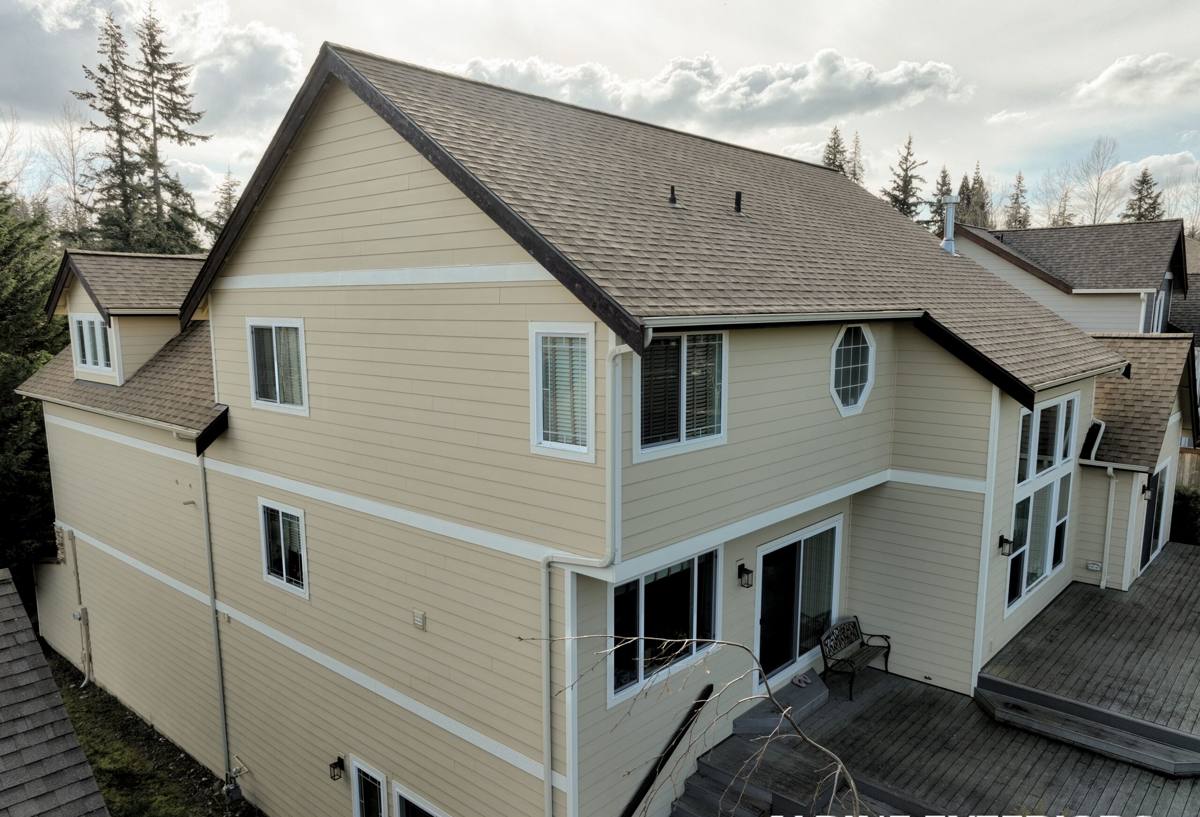
Signs Your Deck Needs Replacement, Not Just Repair
Not every tired-looking deck needs a full teardown — but plenty of decks that "just need a few boards" actually have structural problems hiding underneath. Here's what tells us a repair won't be enough:
- Soft, spongy, or spring-back spots when you walk across the deck
- Rot or discoloration at the ledger board (where the deck attaches to the house)
- Rusted, loose, or missing joist hangers and fasteners
- Posts that wobble or show rot at the base near grade
- Persistent moss or black staining that comes back within weeks of cleaning
- Railings that flex or feel loose when leaned on
- A deck more than 20–25 years old that's never had the framing inspected
- Gaps, cupping, or splintering across most of the decking surface, not just a few boards
If the framing and ledger connection are sound and it's just the decking surface that's tired, a resurfacing may be a reasonable option. If the problems are structural, patching individual boards just delays a bigger, more expensive failure later.
What a Correct Deck Replacement Actually Involves
Tear-Out Done Right
A full replacement starts with removing the old decking, railings, and — where needed — the framing down to sound structure. This is also when we find out what's really going on underneath: hidden rot, undersized joists, or a ledger board that was never flashed correctly in the first place. Any of those get addressed before a single new board goes down.
Framing, Footings, and Ledger Flashing
This is the part of a deck nobody sees once it's finished, and it's also the part that determines whether the deck lasts 10 years or 30. Footings need to be sized and set correctly for the load and soil conditions. The ledger board — the piece that ties the deck to your house — needs proper flashing so water is directed away from your home's wall assembly instead of into it. A poorly flashed ledger is one of the most common causes of hidden rot damage to the house itself, not just the deck.
Fasteners and Hardware Rated for the Coast
Given the salt air common to Bellingham and the rest of the Whatcom County coastline, we use fasteners and structural connectors rated for coastal or marine exposure rather than standard interior-grade hardware. It costs a little more up front and saves years of premature corrosion and loosening joints later.
Choosing Decking Material for Local Conditions
There's no single "best" decking material — there's a best fit for your budget, your maintenance appetite, and how much sun or shade your deck gets. Here's how the common options hold up under Bellingham's rain, moss, and salt air:
| Material | Moisture & Moss Resistance | Maintenance | Typical Lifespan |
|---|---|---|---|
| Pressure-treated wood | Moderate — needs sealing to perform well | Annual cleaning and re-sealing recommended | 10–15 years with upkeep |
| Cedar | Good natural resistance, but surface still needs care | Regular cleaning, periodic oiling or staining | 15–20 years with upkeep |
| Composite decking | Very good — resists moisture absorption and rot | Periodic washing; no sealing or staining | 25–30 years |
| PVC / capped composite | Excellent — least susceptible to moisture and mold staining | Occasional washing | 25–30+ years |
In our experience, shaded or partially shaded decks — common on lots with mature trees, which is a lot of Bellingham — do best with composite or capped composite boards, simply because they don't feed moss and algae the way untreated wood fiber does. Wood is still a fine choice on a sunny, well-drained deck if you're committed to yearly maintenance.
Railings, Stairs, and Code Basics
Most jurisdictions, including here in Whatcom County, require a guardrail once a deck surface sits above a certain height off grade, along with baluster spacing tight enough that a small child can't pass through. Stair stringers and landings have their own structural requirements, especially on sloped lots, which are common around Fairhaven and Bellingham Bay. A deck replacement is also typically the point where a permit gets pulled — replacing framing and structure isn't usually treated the same as a cosmetic resurface. We handle the permit and inspection process as part of the job so you're not stuck untangling that yourself.
Our Deck Replacement Process
- On-site assessment — we look at the existing structure, ledger connection, footings, and drainage before quoting anything
- Honest scope and material walkthrough — what needs full replacement versus what's salvageable, and which decking material fits your site and budget
- Permitting — we pull the necessary permits and schedule required inspections
- Tear-out and structural correction — old material removed, framing and footings brought up to spec
- Decking, railing, and stair installation — built to the material manufacturer's fastening specs, not shortcuts
- Final walkthrough — we check the deck with you before calling the job done
Why a Crew That Already Works Bellingham Matters
Deck work here isn't the same as deck work in a dry climate, and it isn't identical to deck work forty miles inland either. A crew that regularly works Bellingham and Fairhaven already knows which fastener specs hold up against the salt air off the bay, which lots need extra attention to drainage and footing depth, and what the local permitting process actually looks like — instead of learning it for the first time on your project. That local familiarity translates into fewer surprises mid-job and a deck that's actually built for where it sits, not a generic spec built for somewhere else.
Cost Factors to Understand Before You Get a Quote
Deck replacement pricing varies a lot based on size, material, and how much structural work is needed — we won't guess a number here without seeing the site. What we can tell you is what moves the price up or down:
| Factor | Effect on Cost |
|---|---|
| Deck size and shape (multi-level, curves, wraparounds) | Larger and more complex footprints increase cost |
| Decking material (wood vs. composite vs. PVC) | Composite and PVC cost more upfront, less over the deck's life |
| Structural/framing repair needed | Rotted footings or joists found during tear-out add cost, but skipping this is how decks fail early |
| Railing style and stair count | Custom railings and multiple stair runs add labor and material |
| Height above grade | Taller decks need deeper footings and more robust guardrail bracing |
| Site access | Difficult access for material and equipment can add labor time |
Keeping a New Deck Ahead of Moss Season
Whatever material you choose, a few habits go a long way in this climate:
- Sweep debris and leaves off the deck regularly, especially in fall — trapped organic matter feeds moss
- Rinse or wash the surface a couple of times a year to interrupt moss and algae before they take hold
- Keep gutters and downspouts clear so runoff isn't dumping extra water onto or near the deck
- Trim back overhanging branches to let more light and airflow reach shaded sections
- Check railing connections and fastener heads once a year for early signs of rust or loosening
A deck built with the right framing, flashing, and hardware for this climate needs a lot less babying than one that wasn't — but no material is entirely maintenance-free here.
If your deck is showing its age or you're just not sure whether it needs repair or full replacement, we're happy to take a look and give you a straight answer. Reach out for a free, no-pressure estimate using the form below.