 Fairhaven Siding
 Edgemoor's Coastline Is Hard on Siding — Here's Why
Edgemoor sits close enough to the water that salt air is a daily fact of life, not an occasional nuisance. Combine that with the driving, wind-blown rain that rolls in off Bellingham Bay and a moss season that can stretch from fall clear through spring, and you've got one of the tougher siding environments in Whatcom County. Homes here don't fail because owners neglect them — they fail because the siding installed on them was never engineered for this combination of salt, moisture, and shade.
Salt air accelerates corrosion on fasteners and trim metal, and it works its way into any seam or scratch in a coating. Driving rain doesn't just fall straight down — it gets pushed sideways under laps, around trim, and into any gap left by a rushed installation. And moss doesn't just sit on a roof; it colonizes north-facing walls, fence lines, and siding in the shaded, tree-covered lots common around Edgemoor, holding moisture against the wall surface for months at a stretch. Any siding installation in this neighborhood has to be built to shed water aggressively, resist organic growth, and hold up to salt exposure for decades — not just look good on install day.
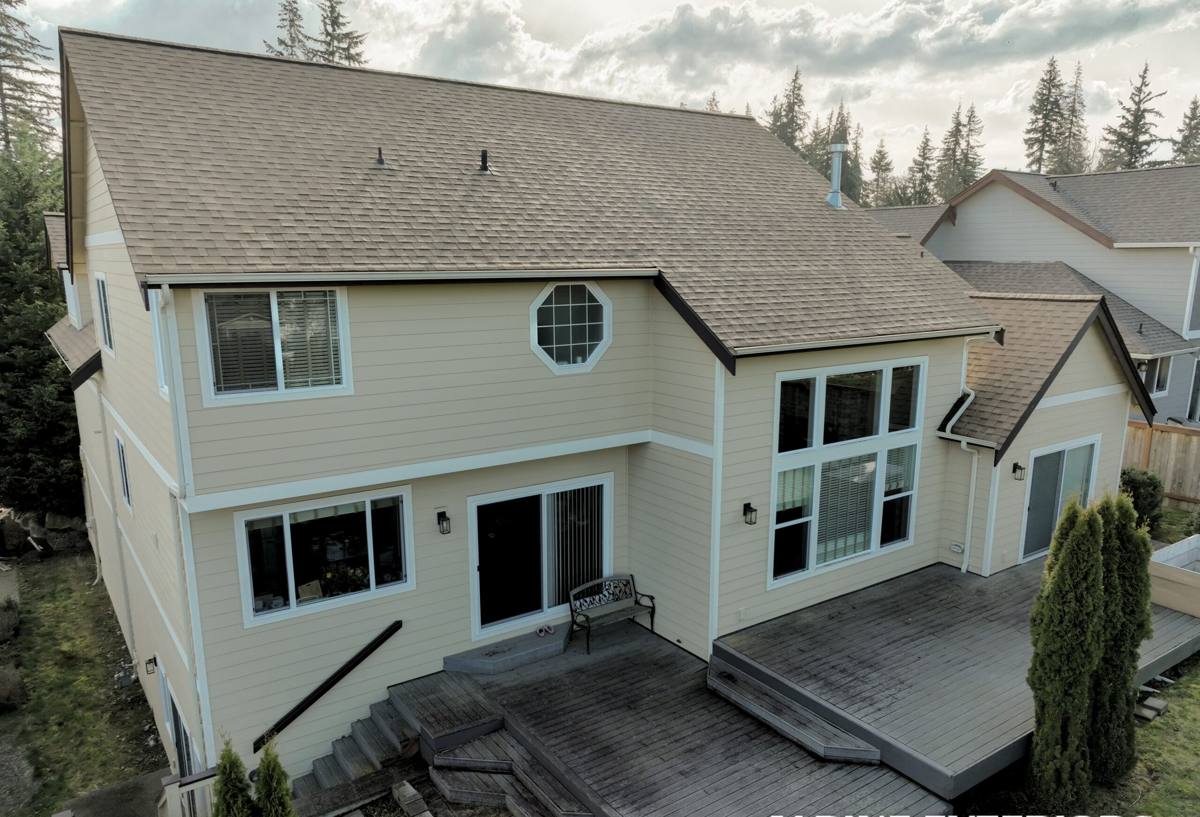
What "Correct" Siding Installation Actually Means Here
A lot of siding problems we get called out to inspect in Fairhaven aren't material failures — they're installation shortcuts that only show up once the coastal climate gets to work on them. Getting it right on an Edgemoor home means:
- A continuous weather-resistive barrier behind the siding, lapped correctly so water sheds down and out, never inward
- Properly flashed windows, doors, and any wall penetrations, with kick-out flashing at roof-wall intersections so runoff can't track behind the cladding
- Correct fastener type and spacing driven to manufacturer spec — not just "close enough" — since under-driven or over-driven fasteners are a top cause of premature siding failure
- Proper clearance between the bottom of the siding and grade, decks, roofs, and hardscaping, so splash-back and standing moisture don't sit against the plank
- Factory-primed or factory-finished cut edges sealed in the field, since a bare cut edge is the fastest way for moisture to enter fiber cement or any other siding material
None of this is exotic. It's disciplined, by-the-book installation — but it's exactly the layer of care that determines whether a home in a salt-air, high-rain neighborhood gets fifteen years out of its siding or fifty.
Why We Only Install James Hardie Fiber Cement
We made a decision a long time ago to install one siding system and install it well, rather than offer a menu of products and hope each one gets the attention it needs. That system is James Hardie fiber cement. It's non-combustible, dimensionally stable in wet climates, and available in HZ product lines specifically engineered for regions with heavy moisture exposure — which describes Edgemoor about as well as any neighborhood in the county.
We don't install vinyl, LP SmartSide, Cemplank, Allura, or unfinished wood siding like primed spruce or cedar. That's not a knock on every homeowner who has one of those products on their home already — it's a statement about what we're willing to put our name behind on a job we install ourselves. Fiber cement handles salt air and driving rain without the expansion, warping, or coating breakdown that can show up on other materials over time, and Hardie's factory-applied ColorPlus finish is baked on under controlled conditions rather than field-painted, which matters a great deal in a climate that rarely gives you a long dry stretch to work with.
Choosing the Right Hardie Line for Edgemoor's Exposure
Not every Hardie product is used the same way. For most Edgemoor homes we're specifying:
- HardiePlank lap siding for the primary wall field — the workhorse product, available in smooth or cedar-textured finishes
- HardiePanel vertical siding for accent walls, gable ends, or a modern look where it fits the home's design
- HardieTrim boards at corners, window and door casings, and fascia, so the trim ages at the same rate as the field siding
The HZ5 product line, engineered for wetter, harsher climates, is the right call for most homes in this part of Washington. It's a small spec difference on paper, but it's exactly the kind of decision that matters more in Edgemoor than it would somewhere drier.
Our Installation Process
| Stage | What We Do |
|---|---|
| Site & substrate assessment | Inspect existing sheathing and framing for rot or moisture damage before any new material goes up — a common finding on older Fairhaven homes with failed original siding |
| Weather barrier installation | Install a continuous drainage plane, correctly lapped, with all seams and penetrations sealed |
| Flashing | Install window, door, and roof-wall flashing before siding starts — this is the step that gets rushed on cut-rate jobs and is the one we won't rush |
| Hardie installation | Install planks or panels to manufacturer fastening spec, with correct clearances at grade, decks, and roofs |
| Trim and detail work | Corners, casings, and joints finished and caulked with products rated for coastal exposure |
| Final walkthrough | Site walk with the homeowner before we call the job done |
Comparing Siding Options for a Salt Air, High-Moss Climate
Homeowners in Edgemoor sometimes ask us to bid against a vinyl or LP quote, so it's worth laying out honestly how the materials stack up in this specific climate rather than in general.
| Factor | James Hardie Fiber Cement | Vinyl | LP SmartSide / Wood-Based |
|---|---|---|---|
| Moisture behavior | Dimensionally stable, resists warping in constant damp conditions | Can warp or distort with heat and cold cycling; seams can allow water intrusion | Engineered wood core is vulnerable if moisture reaches an exposed edge or damaged coating |
| Salt air resistance | Non-combustible cement composite; factory finish resists coastal corrosion at cut/exposed areas when properly sealed | Generally holds up to salt but can chalk and fade faster | Wood-based core is more sensitive to prolonged salt-laden moisture exposure |
| Moss and organic growth | Hard, dense surface resists moss colonization better than soft-textured materials | Smooth surface resists moss but can trap moisture behind panels if not vented properly | Textured wood-grain surface can hold moisture and organic growth more readily |
| Finish/color | Factory-baked ColorPlus finish, consistent and long-lasting | Color molded through, but limited to certain style profiles | Requires field priming/painting and repainting over its life |
| Warranty | Strong transferable manufacturer warranty on the product | Varies by manufacturer and often prorated | Varies; coating warranty is often separate and shorter than substrate warranty |
Signs Your Current Siding Is Already Failing
If your home is in Edgemoor and the siding is more than 15-20 years old, or was installed as a lower-cost product to begin with, it's worth a look before small issues become structural ones. Watch for:
- Soft or spongy spots when you press on the siding, especially near the bottom courses or under windows
- Persistent moss or dark staining that keeps coming back within weeks of cleaning
- Visible warping, bowing, or gaps opening up between boards or panels
- Paint or coating that's chalking, peeling, or bubbling, particularly on north- or west-facing walls
- Rust streaking from fasteners, a sign salt air has already reached the fastener heads
- Interior signs — musty smell, peeling interior trim paint, or damp drywall near exterior walls
Any one of these on its own might be minor. Several together, especially on a home that's taken the full brunt of Edgemoor's exposure for a couple decades, usually means it's time for a real assessment rather than another round of caulk and paint.
Why a Crew That Already Works This Neighborhood Matters
Siding installation isn't just a product decision — it's a site-specific one. A crew that has already worked homes in Edgemoor knows how far the salt air reaches inland on this stretch of coastline, which lots hold moisture longest under tree cover, and where driving rain tends to concentrate against a wall during a typical Whatcom County winter storm. That knowledge shapes small decisions — where to add extra flashing, which elevation needs the most attention to fastening and sealant, how much clearance to leave at grade — that don't show up in a generic spec sheet but matter enormously to how the siding performs ten and twenty years down the road.
It also means fewer surprises during the bid process. We're not guessing at what an Edgemoor home needs based on a climate zone map — we've seen what happens to siding here when it's installed right, and what happens when it isn't.
Living With a Long Moss Season
Even the right siding, correctly installed, benefits from a bit of homeowner attention in a climate like this. A yearly rinse-down before moss gets a real foothold, trimming back vegetation that shades and dampens a wall, and keeping gutters clear so overflow doesn't run down the siding face all go a long way. Hardie's factory finish and dense composite make this kind of upkeep dramatically easier than it is on a softer or more porous material, but "low-maintenance" was never meant to mean "no-maintenance" — especially not on Bellingham Bay.
If your Edgemoor home needs new siding, or you're not sure whether what's on the walls now is still doing its job, we're happy to take a look and talk through it honestly. Reach out for a free, no-pressure estimate using the form below.