 Fairhaven Siding
 Windows Built for Happy Valley's Marine Climate
Happy Valley sits close enough to Bellingham Bay and the Salish Sea that homes here deal with a specific combination of stresses most window manufacturers design for in general terms, not specific ones: salt-laden air moving in off the water, long stretches of driving rain pushed sideways by wind, and a moss season that can run eight months or more out of the year. None of that is dramatic on its own. It's the accumulation that wears windows down — seals that dry out and crack a season or two early, aluminum hardware that pits and corrodes, wood sashes that hold moisture against the frame long enough for rot to start behind the paint line.
An energy-efficient window in this part of Whatcom County has to do two jobs at once. It has to keep conditioned air inside and control the home's heating and cooling load, and it has to survive the coastal environment well enough that the efficiency it's rated for on day one is still there ten or fifteen years later. A window that loses its seal integrity to moisture and salt exposure stops being efficient long before it stops looking fine from the street.
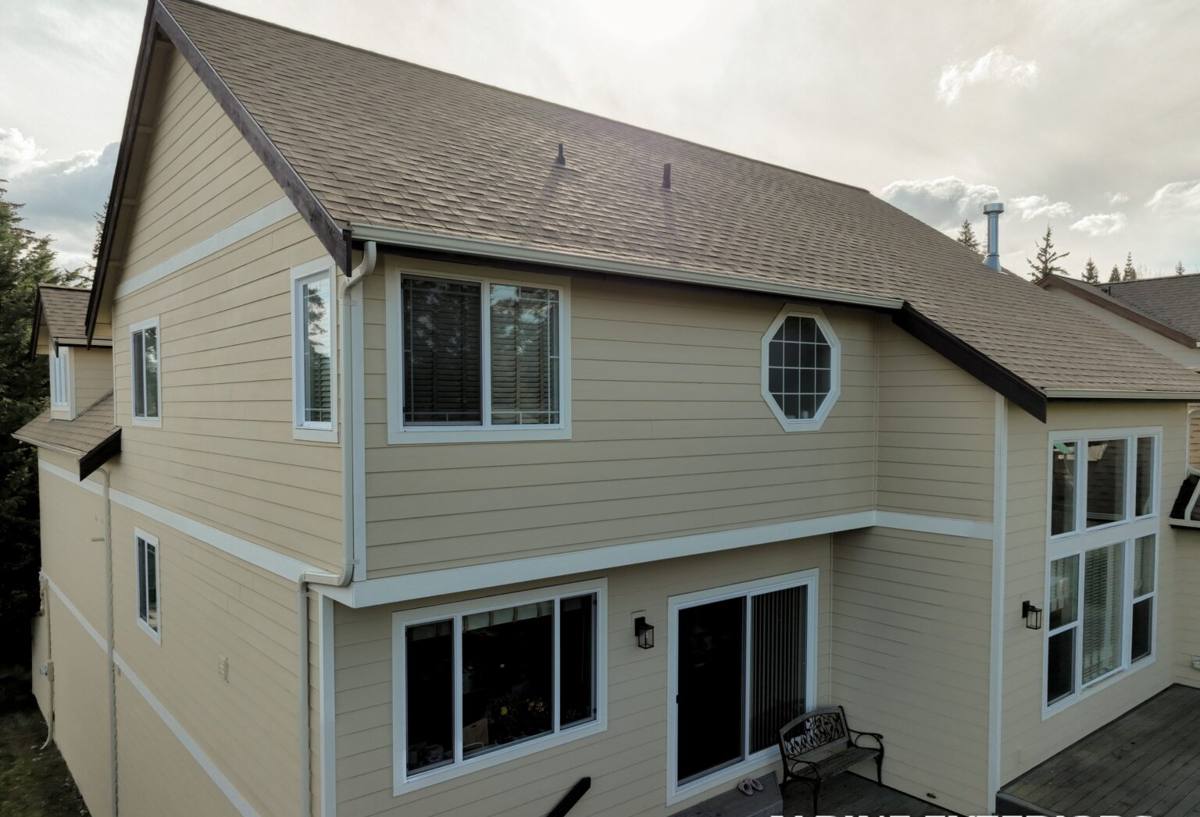
What "Energy-Efficient" Should Mean Here
Efficiency ratings on a spec sheet are a starting point, not the whole answer. Two windows can carry similar U-factor numbers and perform very differently in a Fairhaven winter depending on how well they resist air infiltration under wind-driven rain and how their frame material handles years of damp exposure.
The Ratings Worth Paying Attention To
- U-factor — how well the window resists heat transfer. Lower is better for our heating-dominated climate.
- SHGC (Solar Heat Gain Coefficient) — how much solar heat passes through. Less critical here than in sunnier regions, but still worth balancing on south- and west-facing walls.
- Air infiltration rating — often overlooked, but arguably the most important number for a home exposed to sustained wind-driven rain. A low air infiltration rating means fewer drafts and less chance of moisture being forced past the seal during a storm.
- Condensation resistance — relevant for interior comfort and for keeping moisture from collecting on glass and sash edges in our damp, mild winters.
For most Happy Valley homes, we steer the conversation toward air infiltration and condensation resistance alongside U-factor, because those two numbers correlate directly with how the window will actually behave during the kind of weather this area gets most of the year.
Frame Material: The Decision That Matters Most Long-Term
The glass package gets most of the attention in window sales conversations, but frame material is what determines whether a window holds its performance in a marine climate. Salt air accelerates corrosion on unprotected metal components and hardware. Sustained moisture exposure is unforgiving on any material that isn't dimensionally stable or properly sealed.
| Frame Material | Coastal Climate Performance | Our Take |
|---|---|---|
| Vinyl | Doesn't corrode, low maintenance, good thermal performance | Our default recommendation for most Happy Valley homes — solid value and durability against salt and moisture |
| Fiberglass | Excellent dimensional stability, very durable, higher upfront cost | Worth it on exposed elevations or for owners planning to stay long-term |
| Aluminum | Conducts heat and cold, prone to pitting and corrosion near salt air over time | We generally steer clients away from it here unless it's a specific architectural match |
| Wood (unclad) | Attractive but demands consistent maintenance in high-moisture environments | We recommend clad-wood or composite alternatives instead, to avoid the ongoing upkeep burden |
We're not telling clients any of these materials are junk — aluminum and unclad wood both have legitimate uses in the right setting. Our standard for Happy Valley installs simply reflects what holds up with the least maintenance against salt exposure and sustained rain, year after year, without the homeowner having to think about it.
Where Efficiency Is Actually Won or Lost: Installation
A high-performance window installed poorly will underperform a mid-range window installed correctly. This is true everywhere, but it matters more in a climate that throws sustained wind-driven rain at a house for months at a time. Most window failures we see in this area aren't glass or frame failures — they're installation failures that let moisture behind the window opening, where it does damage slowly and invisibly.
What a Correct Installation Includes
- Removing old windows carefully enough to inspect the rough opening for hidden rot or water damage before anything new goes in
- Proper flashing sequence — sill pan flashing, side flashing, and head flashing installed in the correct shingle-lap order so water sheds outward, never inward
- Correct, continuous sealant application at all sides — not just a bead around the trim
- Shimming and squaring the unit so the sash operates correctly and seals compress evenly for the life of the window
- Insulating the gap between the frame and rough opening without over-packing, which can bow the frame and compromise the seal
- Interior and exterior trim work that sheds water away from the opening rather than channeling it toward it
Skipping or rushing any one of these steps is how a homeowner ends up with a window that's rated well on paper but drafts, fogs, or develops rot around the frame within a few years. In a driving-rain climate, flashing sequence in particular is not optional — it's the difference between a window that sheds water and one that slowly feeds it into the wall cavity.
Our Process for Happy Valley Window Replacements
- On-site assessment. We look at existing window condition, sill and sheathing condition where accessible, sun exposure by elevation, and any specific trouble spots — condensation, drafts, visible frame damage.
- Product selection based on exposure. Windows facing prevailing wind and rain may warrant a different frame material or glass package than more sheltered elevations of the same house.
- Written estimate with clear scope. What's being replaced, what flashing and moisture-barrier work is included, and what the timeline looks like.
- Installation with moisture management as the priority, not an afterthought — proper flashing, sealant, and trim detailing on every unit.
- Final walkthrough to confirm operation, sealing, and finish work meet the standard we set at the estimate stage.
Signs Your Current Windows Are Working Against You
Homeowners often live with underperforming windows longer than necessary because the signs are gradual. Watch for:
- Condensation forming between panes (a sign the seal on a double- or triple-pane unit has failed)
- Visible fogging or a milky appearance in the glass
- Drafts near the frame during windy, rainy weather
- Difficulty opening, closing, or locking — often a sign the frame has swollen, warped, or shifted
- Soft or discolored trim or sill material, which can point to moisture intrusion behind the window
- Visible corrosion or pitting on metal hardware or aluminum frames
- A noticeable jump in heating costs without a clear explanation
Any one of these on its own isn't necessarily urgent. Several of them together, especially on the sides of the house that catch the most wind and rain, usually means it's time for a real assessment rather than a patch job.
Maintenance Expectations After Replacement
Even a well-installed, efficient window benefits from a bit of seasonal attention in this climate. Moss and organic growth accumulate on horizontal surfaces and in corners where debris collects, and salt residue can build up on glass and hardware near the coast. We recommend rinsing frames and tracks periodically, keeping weep holes clear so water can drain as designed, and checking exterior sealant lines every year or two for cracking or gaps. None of this is heavy maintenance — it's the kind of basic upkeep that lets a properly installed window actually reach its expected service life instead of falling short of it.
What Affects the Cost of a Window Project Here
| Factor | Why It Matters Locally |
|---|---|
| Frame material | Vinyl is typically the most cost-effective; fiberglass costs more upfront but holds up longest against salt and moisture exposure |
| Number and size of openings | Larger or custom-sized units cost more to manufacture and install than standard sizes |
| Condition of the rough opening | Hidden rot or water damage found during removal adds repair work before a new window can go in correctly |
| Exposure and elevation | Elevations facing prevailing wind and rain may call for higher-performance glass or additional flashing detail |
| Trim and finish work | Matching existing interior or exterior trim profiles adds labor beyond the window unit itself |
We don't publish flat per-window pricing because these variables genuinely change the scope from one house to the next — a straightforward swap into a sound opening is a very different job than one where the sheathing needs repair first. An on-site estimate is the only honest way to price it.
Why Local Experience in Happy Valley Matters
A crew that regularly works this specific pocket of Fairhaven understands which elevations tend to take the worst weather, what kind of moisture damage shows up behind older windows in homes of this area's typical age and construction, and how to sequence flashing correctly for a climate that gets sustained wind-driven rain rather than occasional storms. That's knowledge that comes from doing the work here repeatedly, not from a general product catalog. It shows up in fewer callbacks, fewer surprises once old windows come out, and a finished job that's built to actually perform through a Whatcom County winter — not just look good on installation day.
If you're weighing whether your windows need attention, or you already know they do, we're happy to take a look and give you a straightforward, no-pressure estimate. Fill out the form below and we'll set up a time to assess your home's windows in person.