 Fairhaven Siding
 Why Happy Valley Roofs Wear Differently Than Roofs Inland
Happy Valley sits close enough to the water and the tree cover around Fairhaven that its roofs deal with a combination most inland Whatcom County homes never see: salt-laden air off Bellingham Bay, long stretches of driving rain, and shade patterns that keep certain roof planes damp for days after a storm passes. None of these on their own is unusual for Western Washington. Together, over years, they change what "correct" roof installation actually means for this neighborhood.
Salt air accelerates corrosion on exposed metal — nail heads, flashing, vent caps, gutter hangers. Driving rain, especially when it comes in at an angle off the water, finds weaknesses at valleys, step flashing, and low-slope transitions that a straight-down rain would never expose. And the long moss season here, often eight or nine months of the year depending on sun exposure, means anything installed without moss resistance built in in the first place is fighting an uphill battle from day one.
A new roof installation done right in Happy Valley isn't just "put shingles on a house." It's choosing materials and details that are already suited to salt exposure, wind-driven rain, and moss pressure — not retrofitting fixes after the first winter.
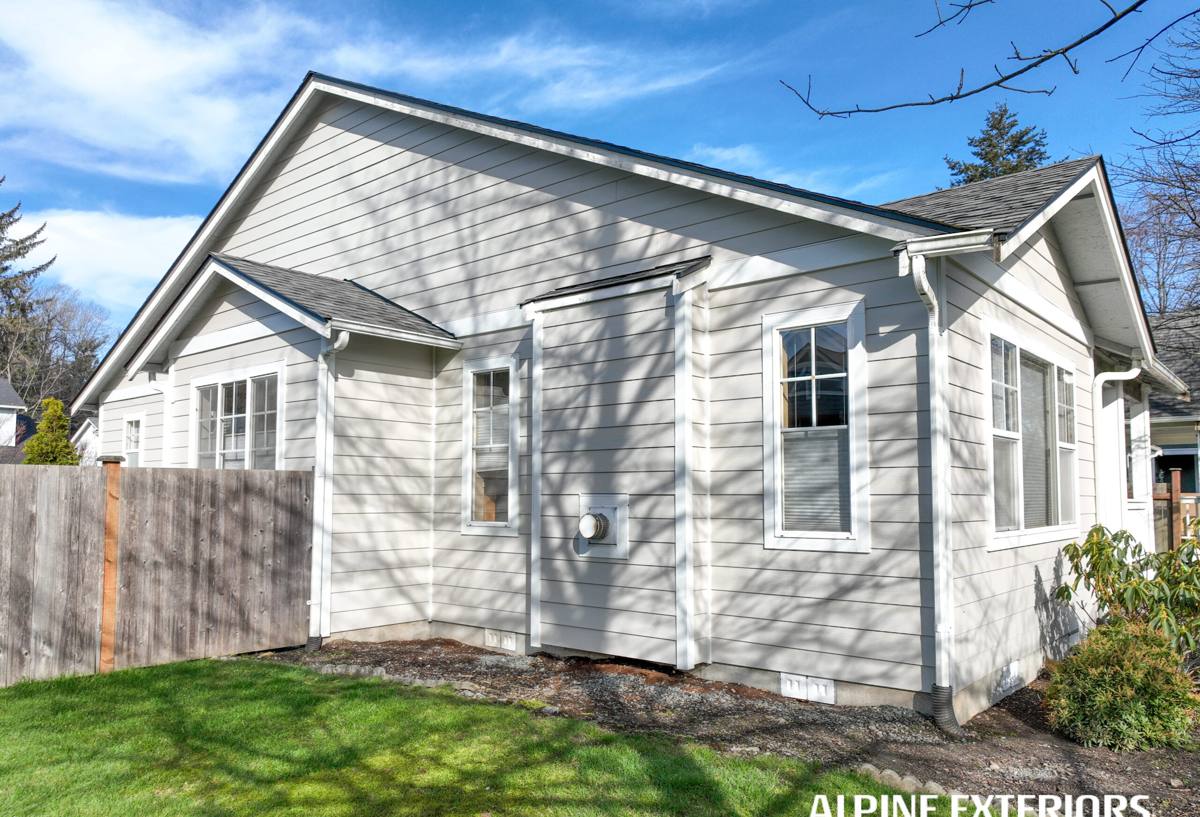
What a Correct New Roof Installation Includes
A full roof replacement is a system, not a single product. Skipping or downgrading any one layer shows up as a leak, a mold spot, or premature shingle failure within a few years — often well before the shingle itself would have worn out. For a Happy Valley home, we treat every layer as climate-specific, not generic.
The layers that matter most here
- Deck inspection and repair: Any soft, delaminated, or water-stained sheathing gets replaced before anything else goes down — covering rot with new shingles just hides it longer.
- Ice-and-water shield at vulnerable points: Valleys, eaves, and roof-to-wall transitions get self-adhering membrane, not just felt, because these are exactly the spots driving rain and wind-blown water find first.
- Synthetic underlayment across the field: More tear-resistant and more consistently waterproof than old-style felt, and it holds up better to the wet-then-dry cycling common near the coast.
- Corrosion-resistant flashing and fasteners: Given the salt content in the air this close to the bay, standard fasteners and flashing can pit and stain years before they should. We spec metals rated for that exposure.
- Balanced ventilation: Intake at the eaves, exhaust at the ridge, sized to the attic — this is what keeps moisture from condensing under the deck in our wet winters.
- A moss-resistant roofing surface: Either an algae/moss-resistant shingle line or, on the right roof, a metal or composite surface that simply doesn't give moss anything to grow on.
Material Choices for Happy Valley's Climate
There's no single "best" roofing material — there's a best material for a given roof's slope, sun exposure, shade cover, and budget. Here's how the common options actually perform under Fairhaven's specific mix of salt air, rain, and moss pressure.
| Material | Moss Resistance | Salt Air / Corrosion | Typical Lifespan (Local) | Relative Cost |
|---|---|---|---|---|
| Standard architectural asphalt shingle | Moderate — needs treated variant or regular cleaning | Fasteners/flashing need corrosion-rated hardware | 20–25 years with maintenance | $ |
| Algae/moss-resistant asphalt shingle | Good — copper or zinc granules discourage growth | Same hardware considerations as standard shingle | 25–30 years | $$ |
| Standing seam metal | Excellent — smooth surface, moss struggles to establish | Requires marine-grade coatings/fasteners near the bay | 40–50+ years | $$$ |
| Synthetic/composite shake or slate | Good to excellent depending on product | Non-corroding material body; hardware still matters | 30–50 years | $$–$$$ |
For most Happy Valley homes we're recommending either a treated architectural shingle or standing seam metal, depending on roof pitch, how shaded the lot is, and how long the homeowner plans to stay in the house. Steeper, sunnier roofs do fine with a good shingle. Shaded, low-slope, or valley-heavy roofs benefit from metal's smooth, moss-resistant surface.
A Note on Product Choices We Don't Make Lightly
We're selective about certain low-cost underlayments and fastener packages that get bundled into cut-rate roofing bids. It's not that they're incapable of holding a roof together — it's that in a wet, salt-influenced climate like this one, the margin for error is smaller, and cheaper components tend to show their limits in year three or four rather than year twenty. We'd rather spec the right layer once than have a homeowner pay for two roofs in a decade.
How Moss and Moisture Actually Damage a Roof
Moss doesn't just look bad — it's a moisture trap. Once it establishes on shaded or north-facing slopes, it holds water against the roofing surface long after the rest of the roof has dried out. That constant dampness works shingle granules loose, lifts shingle edges, and over time works moisture under the surface and into the deck. On older or poorly ventilated roofs in this area, we regularly find soft decking directly under thick moss mats — damage that was avoidable with the right surface and airflow from the start.
Wind-driven rain causes a different kind of damage: it pushes water sideways and upward under shingle edges and flashing laps that would be perfectly fine in a straight-down rain. This is why valley and flashing detailing matters more here than in drier, calmer climates — it's not overbuilding, it's matching the install to what actually happens during a real Whatcom County storm.
Our Process for a Happy Valley Roof Replacement
- On-site inspection and estimate: We walk the roof (or the attic and exterior, if walking it isn't safe or necessary), check the deck condition where visible, evaluate ventilation, and note shade patterns and moss history specific to the lot.
- Material recommendation: Based on slope, sun/shade exposure, and budget, we recommend a system — not just a shingle color — that fits the roof's actual conditions.
- Tear-off and deck inspection: Old roofing comes off down to the deck so we can see and address any rot or soft spots before new materials go down.
- Underlayment and flashing installation: Ice-and-water membrane at vulnerable points, synthetic underlayment across the field, and corrosion-rated flashing and fasteners throughout.
- Ventilation correction: If intake or exhaust airflow is undersized or blocked, we address it as part of the job, not as an afterthought.
- Roofing surface installation: Installed to manufacturer specifications with attention to the exposure and fastening patterns that matter most in wind-driven rain.
- Cleanup and final walkthrough: Magnetic sweep for stray fasteners, gutter check, and a walkthrough so you know what was done and why.
What to Expect During the Job
A typical full tear-off and replacement on a single-family home in this area runs a few days to about a week, weather permitting — Fairhaven's rain windows mean we plan around forecasts rather than fighting through them, since roofing in the wrong conditions is how corners get cut. Expect noise and some yard disruption during tear-off, a dumpster or trailer on-site for old material, and daily cleanup so the property isn't left exposed overnight during an active tear-off.
We'll flag anything unexpected — deck rot, prior repair issues, undersized ventilation — before we proceed, not after the fact. A roof estimate that doesn't account for the possibility of deck repair isn't a complete estimate; it's a placeholder that changes once the old roofing comes off.
Why a Crew That Already Works in Happy Valley Matters
Roofing code and permitting requirements are consistent across Whatcom County, but the practical judgment calls — how much ventilation a particular lot needs given its tree cover, which valleys need extra attention because of how rain moves off the bay, how aggressive the moss pressure is on a shaded north slope — come from having actually worked on roofs in this specific pocket of Fairhaven. A crew that's replaced roofs in Happy Valley before isn't guessing at how the salt air and rain patterns here behave; they've already seen what fails and what holds up.
That local pattern recognition shows up in small decisions that add up: which fastener spec to use given the proximity to the water, where to add extra membrane even if it's not strictly required by code, and which roof surfaces are worth the upcharge on a shaded lot versus a sunny one.
After Installation: Keeping a New Roof Performing
Even the right system benefits from basic upkeep, especially through a Fairhaven winter. A little attention keeps a well-installed roof performing for its full expected lifespan instead of degrading early.
- Keep gutters and downspouts clear — clogged gutters back water up under the roof edge, especially during heavy rain events.
- Have moss growth addressed early, before it mats and holds moisture against the surface — a light annual treatment is far cheaper than a moss-related repair.
- Keep overhanging branches trimmed back where practical — less shade and debris means less moss pressure and less standing organic matter on the surface.
- Check the attic once a year for signs of condensation or blocked vents, since ventilation problems show up as moisture issues long before they show up as visible roof damage.
- Have the roof looked at after any major windstorm — wind-driven rain events are when lifted shingles or flashing issues are most likely to start.
If you're weighing a roof replacement for a Happy Valley home, we're happy to take a look, walk you through what your specific roof needs, and give you a straightforward estimate — no pressure, no upsell on materials your roof doesn't call for. The form below is the fastest way to get that conversation started.