 Fairhaven Siding
 Why Happy Valley's Marine Climate Is Hard on Windows
Happy Valley sits close enough to the water that homes here deal with a different set of stresses than houses further inland. Salt air works on aluminum hardware, screen frames, and exposed fasteners year-round, not just during storms. Driving rain off Bellingham Bay pushes water sideways into gaps that would stay dry in a calmer climate, which is why window failures here so often start at the corners and sills rather than the middle of the glass. And Whatcom County's long, damp moss season means anything shaded or slow to dry — window sills, bottom rails, the wood trim around older wood or wood-clad units — stays wet longer than it should, which is exactly the condition mold, rot, and moss favor.
None of this means windows in Happy Valley fail faster than windows anywhere else. It means the details that get skipped on a rushed install — flashing, sealant choice, drainage — matter more here, and they show up as problems sooner when they're wrong.
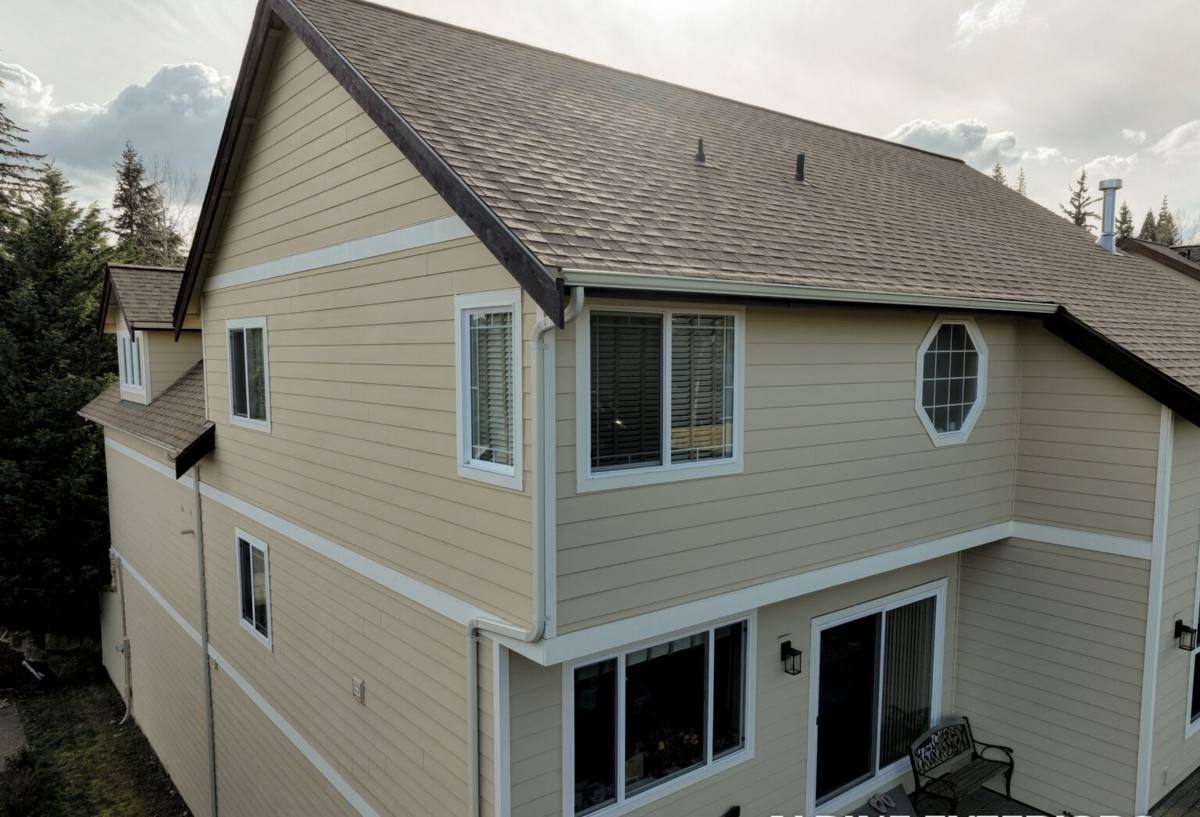
Signs Your Windows Need Replacing, Not Just Repair
Not every window problem calls for full replacement. But there's a point where patching stops making sense — either because the fix won't hold in this climate, or because the cost of repeated repairs starts to rival the cost of doing it right once. Common signs we look for on Happy Valley homes:
- Fogging or a hazy film between the panes of a double-pane window — the seal has failed and the insulating gas is gone; this can't be repaired, only replaced
- Soft, spongy, or visibly rotted wood at the sill or bottom corners
- Persistent drafts you can feel even with the window latched
- Windows that are hard to open, close, or lock — often swelling from moisture intrusion, not just old paint
- Water staining or dark streaks below the window on interior or exterior trim
- A noticeable jump in heating costs with no other explanation
If you're only seeing one of these and the frame is otherwise sound, a repair or re-seal may buy you real time. If you're seeing two or three together, that's usually a sign the window's ability to shed water has already broken down.
What a Correct Window Replacement Job Actually Involves
Tear-Out and a Structural Check
Pulling the old window is also the one chance to see what's been happening behind it. We check the framing and sheathing around the opening for soft spots, staining, or rot before anything new goes in. In a climate that gets as much driving rain as this one, it's not unusual to find some degree of hidden moisture damage around older units, especially on walls that face the weather. Any of that gets repaired before the new window is set — installing a new window into a compromised opening just hides the problem for a few more years.
Flashing and Weatherproofing
This is the part that separates a window that lasts from one that leaks again in five years. Proper installation means a sloped sill pan to direct any water that gets past the window back outside, head flashing above the unit, and correct integration with the house's weather-resistive barrier so water sheds down and over each layer — never behind it. Given how much wind-driven rain this area sees, we don't treat flashing as optional trim work; it's the actual waterproofing system, and the window itself is secondary to it.
Sealing, Insulation, and Finish
Gaps around the window frame get filled with low-expansion foam or backer rod rather than packed solid, which lets the assembly move slightly without cracking the seal. Exterior caulking goes in at the joints designed to be sealed — and only those joints, since sealing the wrong gap can trap moisture instead of keeping it out. Interior and exterior trim is finished to match the home, and hardware is checked for smooth operation before we call the job done.
Choosing Window Materials and Glass for Salt Air and Driving Rain
Material choice matters more here than in a dry inland climate, mainly because of how each option handles constant moisture exposure and salt-laden air over time.
| Material | Moisture & Salt-Air Resistance | Maintenance | Typical Lifespan |
|---|---|---|---|
| Vinyl | Very good — won't corrode or rot; seams are the main thing to watch | Low — occasional cleaning | 20–30 years |
| Fiberglass | Excellent — dimensionally stable, doesn't expand/contract much with moisture or temperature swings | Low | 30–40+ years |
| Wood or wood-clad | Fair — the clad exterior resists weather well, but any breach exposes wood to rot risk | Higher — periodic finish/seal checks | 20–30 years with upkeep |
| Aluminum | Poor to fair near salt air — prone to pitting and corrosion over time unless marine-grade | Moderate | 15–25 years in coastal exposure |
We're generally cautious about standard aluminum-frame windows this close to salt air — not because aluminum is a bad material everywhere, but because ordinary aluminum hardware and frames corrode faster in this specific environment, and that's a maintenance burden we'd rather steer a homeowner away from up front. Vinyl and fiberglass tend to be the more forgiving, lower-maintenance choices for most Happy Valley homes.
Glass and Hardware Details Worth Asking About
Low-E coated, argon-filled double-pane glass is the standard for energy performance in this climate, and it's worth confirming on any quote rather than assuming it's included. Stainless or corrosion-resistant hardware — hinges, cranks, locks — is a small upgrade that pays off in salt air where standard-grade hardware can start showing rust or stiffness within a few years. Weep holes (the small drainage openings at the base of the frame) should be clear and correctly sized; on a driving-rain coast, a clogged weep hole is one of the more common causes of water pooling inside a window track.
What Drives the Cost of Window Replacement in Happy Valley
Every quote should reflect the specific window, the opening condition, and the install complexity — not a flat per-window number. The main factors we walk homeowners through:
- Window size and type — a standard double-hung costs less than a large picture window or a custom shape
- Material — vinyl is typically the most budget-friendly; fiberglass and wood-clad cost more upfront but can offer longer service life
- Number of windows — doing a whole elevation or the whole house at once usually costs less per window than one-off replacements over time
- Condition behind the old window — hidden rot or framing damage adds repair time that's hard to price until the old unit is out
- Access and height — second-story or hard-to-reach windows take more setup time
- Trim and finish work — matching existing interior or exterior trim profiles adds labor over a bare install
Because so much depends on what we find once the old window is out, we'd rather give you a realistic range up front and firm numbers after a walkthrough than a low estimate that grows once work starts.
Our Window Replacement Process, Start to Finish
The process is straightforward, but the order matters:
- Walkthrough and assessment — we look at each window in question, check for signs of hidden moisture or framing issues, and talk through what you actually need versus what you might be able to defer
- Written estimate — material options, timeline, and pricing, with the reasoning behind each recommendation
- Precise measurement and ordering — windows are ordered to the actual opening, not a catalog assumption
- Removal and structural check — old unit comes out, framing gets inspected and repaired if needed
- Installation with proper flashing and sealing — the weatherproofing detail described above
- Finish work and walkthrough — trim completed, hardware tested, site cleaned up, and a final check with you before we consider the job done
Most single-window replacements take well under a day once the crew is on site; whole-house projects are scheduled around weather windows, since installing into an open wall opening during a heavy rain event is exactly the situation we want to avoid.
Why Hiring a Crew That Already Works in Happy Valley Matters
A window installer who works Fairhaven and the surrounding Whatcom County neighborhoods regularly has already seen how different products and details hold up locally over years, not just on paper. That shows up in small decisions — which flashing details actually shed water in sustained driving rain, which hardware grades are worth the upgrade in salt air, where moss and standing moisture tend to collect on a given home orientation. It also means fewer surprises with permitting and inspection expectations, since local requirements and typical construction in this area are already familiar territory rather than something to figure out mid-project.
None of that replaces a careful, individual assessment of your home — every house is different. But it does mean the starting assumptions are grounded in what actually works here, not in generic advice built for a drier or calmer climate.
Keeping New Windows Performing in This Climate
New windows are a real upgrade, but a little seasonal attention keeps them performing the way they should for the long haul in a salt-air, moss-prone environment:
- Rinse exterior frames periodically to clear salt film, especially on the sides facing the water
- Keep weep holes clear of dirt, pollen, and debris so water can drain properly
- Check exterior caulking once a year for cracking or gaps, particularly after the first winter
- Keep moss and vegetation trimmed back from window sills and surrounding trim
- Operate hardware (locks, cranks, latches) a few times a season so moving parts don't seize up
- Wipe down interior sills after heavy rain if you notice any condensation pooling
These are five-minute tasks, but skipping them is one of the more common reasons a perfectly good window installation starts showing problems earlier than it should.
Ready to Talk About Your Windows?
If you're dealing with drafts, fogged glass, or windows that just aren't keeping up with what a Whatcom County winter throws at them, we're happy to take a look. We offer free, no-pressure estimates for Happy Valley homeowners — just fill out the form below and we'll get in touch to schedule a walkthrough.