 Fairhaven Siding
 Why Decks in Marietta Wear Out Differently Than Decks Inland
Marietta sits close enough to Bellingham Bay that the air itself is part of the maintenance problem. Salt-laden air moves in off the water and settles on every exposed surface, which means fasteners, hardware, and connectors corrode faster here than they would twenty miles inland. Add in Whatcom County's long stretch of driving rain each fall and winter, and you have moisture getting pushed sideways into seams, end grain, and ledger connections that a dry-climate deck would never see.
Then there's moss season, which in this part of Washington isn't really a season at all — it's most of the year. Any horizontal wood or composite surface that doesn't drain and dry quickly becomes a growing medium. Moss and algae hold moisture against the decking, which accelerates rot in wood and can make composite surfaces slick and stained. None of this is unique to Marietta, but the combination of salt exposure, sustained rain, and shaded, damp conditions is more aggressive here than most manufacturers' warranty language assumes.
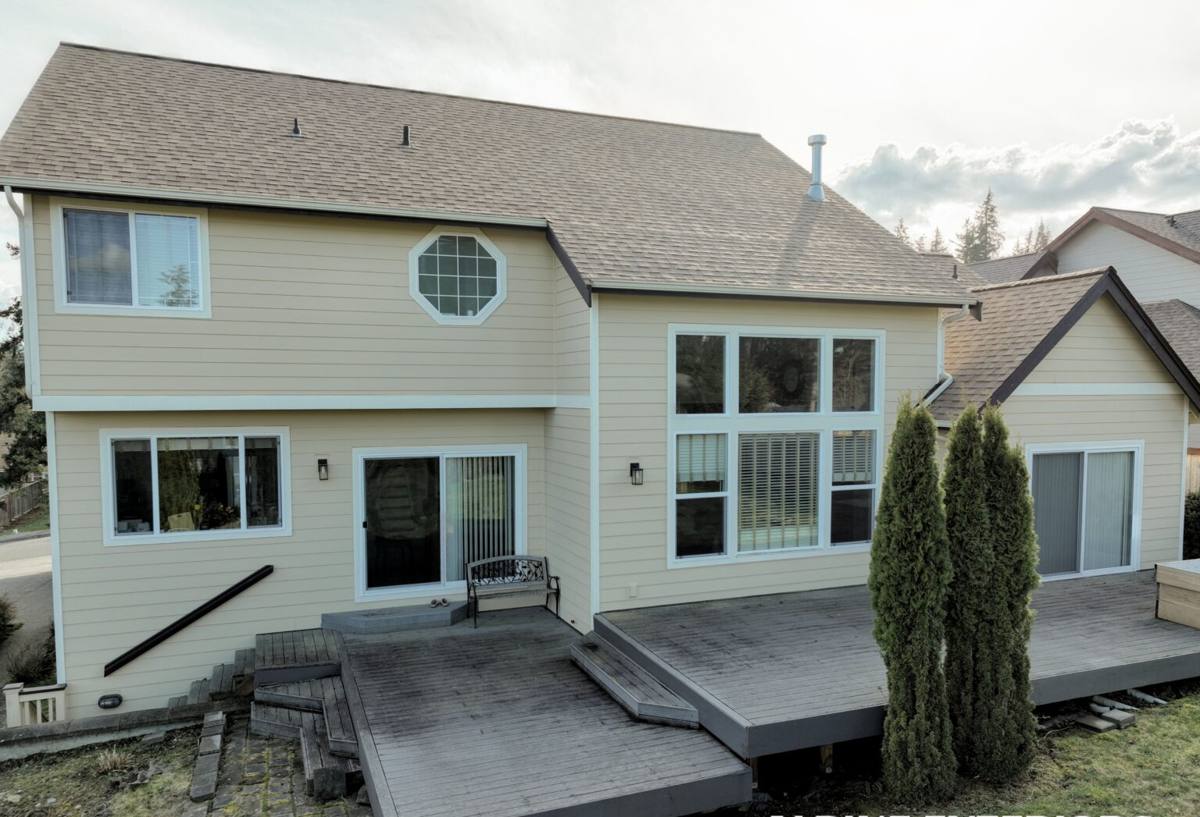
Signs Your Deck Needs Replacement, Not Just Repair
A lot of decks get patched for years past the point where patching makes sense. Replacing boards without addressing what's underneath just delays the real problem. Here's what tells us a deck is past the repair stage:
- Soft, spongy decking or visible rot at board ends, especially where boards meet the house
- Rust streaking or corrosion around joist hangers, bolts, or the ledger board connection
- A ledger board that's pulling away from the house, or flashing that's missing or failing behind it
- Posts or footings that have shifted, settled, or show rot at the base
- Persistent moss or black staining that comes back within weeks of cleaning
- Railings that flex or feel loose when leaned on — a structural, not cosmetic, issue
- A deck older than 20-25 years with pressure-treated framing that's never been inspected underneath
If it's just surface graying or a handful of cupped boards on an otherwise sound frame, repair or resurfacing can be the honest answer. We'll tell you that if it's true. Replacement makes sense when the framing, ledger connection, or footings are compromised — patching decking on top of a bad structure just hides the problem for another season.
What a Correct Deck Replacement Actually Involves
Tear-Out and Structural Assessment
We pull the old decking and railing first, then inspect the framing underneath before deciding on anything else. This is the step that gets skipped by crews trying to move fast — and it's the step that matters most in a climate like this, because hidden rot at the ledger or posts doesn't show up until the surface is gone.
The Ledger Connection
Where the deck attaches to the house is the single most common failure point we see on older decks near the water. Proper flashing — installed so it sheds water away from the house sheathing rather than trapping it against the ledger board — is non-negotiable on a replacement. We also confirm the ledger is through-bolted with corrosion-resistant hardware, not just lag-screwed, which was common practice years ago and doesn't hold up structurally over time.
Footings and Framing
Footings need to sit below frost depth and bear on undisturbed, well-draining soil — settling posts are usually a footing problem, not a wood problem. We use joist tape or an equivalent moisture barrier on top of framing lumber to keep water from wicking into end grain, and we specify stainless or heavy hot-dip galvanized fasteners and hangers throughout, given the salt air. Standard electro-galvanized hardware corrodes faster here than it does in a drier inland climate, and replacing it later means tearing the deck apart again.
Decking, Railing, and Stairs
Once the frame is sound, decking goes down with attention to gapping for drainage and expansion, railing is set to code height and baluster spacing, and stairs are built with proper stringer support and non-slip tread consideration — worth thinking about given how often surfaces stay damp here.
Choosing a Decking Material for Marietta's Climate
There's no single right answer — it depends on your budget, how much upkeep you want to do, and how much sun exposure the deck gets. Here's how the common options actually compare in a marine, high-moisture climate:
| Material | Upfront Cost | Maintenance | Moss/Moisture Behavior | Realistic Lifespan Here |
|---|---|---|---|---|
| Pressure-treated wood | Lowest | Annual cleaning + refinishing recommended | Prone to moss if not cleaned; can rot at fasteners over time | 15-20 years with upkeep |
| Cedar | Moderate | Periodic sealing to hold color and resist checking | Naturally more rot-resistant than treated pine, but still needs cleaning | 15-20 years with upkeep |
| Composite (capped) | Higher | Occasional washing, no staining/sealing | Resists rot; can still get slick with algae if shaded, but doesn't decay | 25-30+ years, manufacturer-dependent |
| PVC | Highest | Lowest — washing only | Fully moisture-resistant; best option for constant shade/dampness | 25-30+ years, manufacturer-dependent |
We don't push one product over another. Composite and PVC cost more upfront but make sense for homeowners tired of the annual maintenance cycle that wood demands in this climate. Wood costs less to install and can look great, but only if you're willing to clean and reseal it on a schedule — skip that a couple years running here and moss gets ahead of you fast.
Permits and Code Basics for a Deck Replacement
Most attached decks in Whatcom County require a permit, and for good reason — the ledger connection and guardrail requirements are exactly the things that fail when a deck is built or rebuilt without inspection. As a general rule you can expect: guardrails required above a certain walking-surface height, baluster spacing tight enough that a small child couldn't pass through, and stair railings graspable and continuous. Exact thresholds and requirements can vary by jurisdiction and by your specific site, which is why we handle the permit application and coordinate inspections as part of the job rather than leaving that step to the homeowner.
Skipping the permit doesn't just create legal risk — it also removes the third-party check that catches a bad ledger connection or undersized footing before it becomes your problem two winters from now.
Our Deck Replacement Process, Start to Finish
- On-site assessment. We look at the existing deck, the framing, the ledger connection, and drainage around the footings, and talk through what you actually need from the space.
- Written estimate and material selection. You get a clear scope — what's being replaced, what materials, what it costs — with no vague allowances.
- Permit pulled. We handle the paperwork with the local building department before work starts.
- Tear-out. Old decking, railing, and any compromised framing come out; debris is hauled off.
- Structural rebuild. Ledger flashing, footings, framing, and hardware get addressed to current standards, not just matched to what was there before.
- Decking, railing, and stairs installed. Built to the material manufacturer's spacing and fastening specs.
- Inspection and walkthrough. Final inspection where required, then we walk the deck with you before calling it done.
What Drives the Cost of a Deck Replacement
Every deck is different, so we don't quote sight-unseen, but these are the factors that move the price up or down:
| Factor | Why It Matters |
|---|---|
| Size (square footage) | More material and labor, straightforward scaling |
| Decking material chosen | Pressure-treated wood costs far less upfront than composite or PVC |
| Height off grade / need for stairs | Taller decks need more substantial framing, footings, and guardrail structure |
| Condition of existing framing | Reusable sound framing lowers cost; rotted joists or posts add rebuild work |
| Railing style | Basic wood or metal balusters cost less than cable or glass-panel systems |
| Ledger and flashing condition | Correcting a failed or missing flashing detail adds labor but is not optional |
| Demo and haul-away complexity | Multi-level decks or tight access sites take longer to clear |
| Permit fees | Set by the jurisdiction, passed through at cost |
Broadly speaking, a straightforward pressure-treated replacement on sound framing sits at the lower end of the range, while a full tear-out with composite or PVC decking, new footings, and upgraded railing sits at the higher end. We'll walk you through exactly where your project falls once we've seen it.
A Practical Pre-Estimate Checklist
Before we come out, it helps to know:
- Roughly how old the current deck is, if known
- Whether you've noticed soft spots, rot, or rust anywhere
- Whether you want to keep the current footprint or change the size/shape
- Any material preference — wood, composite, or open to recommendations
- Whether stairs, lighting, or a cover are part of the plan
Why Hiring a Crew That Already Works Marietta and Fairhaven Matters
A contractor who works this specific stretch of Whatcom County knows what to check for before they even climb under the deck — corroded hardware on homes with bay exposure, ledger flashing that was never installed correctly on older builds, and how much shade and moisture a given lot actually holds through the winter. That's not something you get from a crew that mostly works drier, inland jobs and treats every deck the same way.
It also matters for the permit and inspection side. A crew that's pulled permits with the local building department before knows what inspectors here actually look for on ledger connections, footing depth, and guardrail compliance — which means fewer surprises and fewer callbacks mid-project.
Living With Your New Deck Through the Wet Season
Even a well-built deck needs some seasonal attention in this climate. Keep gutters and downspouts clear so runoff isn't dumping onto or near the deck. Sweep leaves and debris off the surface before they trap moisture and feed moss growth. If you went with wood, plan on an annual wash and a reseal every couple of years depending on sun exposure. If you went with composite or PVC, an occasional wash with a soft brush handles the algae film that can build up in shaded, damp corners. Trimming back vegetation that overhangs or shades the deck also goes a long way toward keeping moss from taking hold in the first place.
If you're in Marietta or elsewhere around Fairhaven and your deck is showing its age, we're happy to take a look and give you an honest read on repair versus replacement — no pressure, no hard sell, just a straight answer and a free estimate.