 Fairhaven Siding
 Siding Installation Built for Sunnyland's Weather, Not Just Its Curb Appeal
Sunnyland sits close enough to Bellingham Bay and the Fairhaven waterfront that homes here take a different kind of beating than siding sees further inland. It's not one dramatic storm that does the damage — it's the daily grind of salt-laden air off the water, driving rain that comes in sideways during winter fronts, and a moss and algae season that can run eight months or longer under the tree cover common in this part of Whatcom County. Siding installation here has to account for all three at once, and a lot of the siding failures we get called out to inspect trace back to a product or an install that was designed for a drier, milder climate than this one.
This page is specifically about siding installation for Sunnyland homes — what the local conditions demand, what a correct install actually involves, and how our process is built around the realities of this neighborhood rather than a generic national spec sheet.
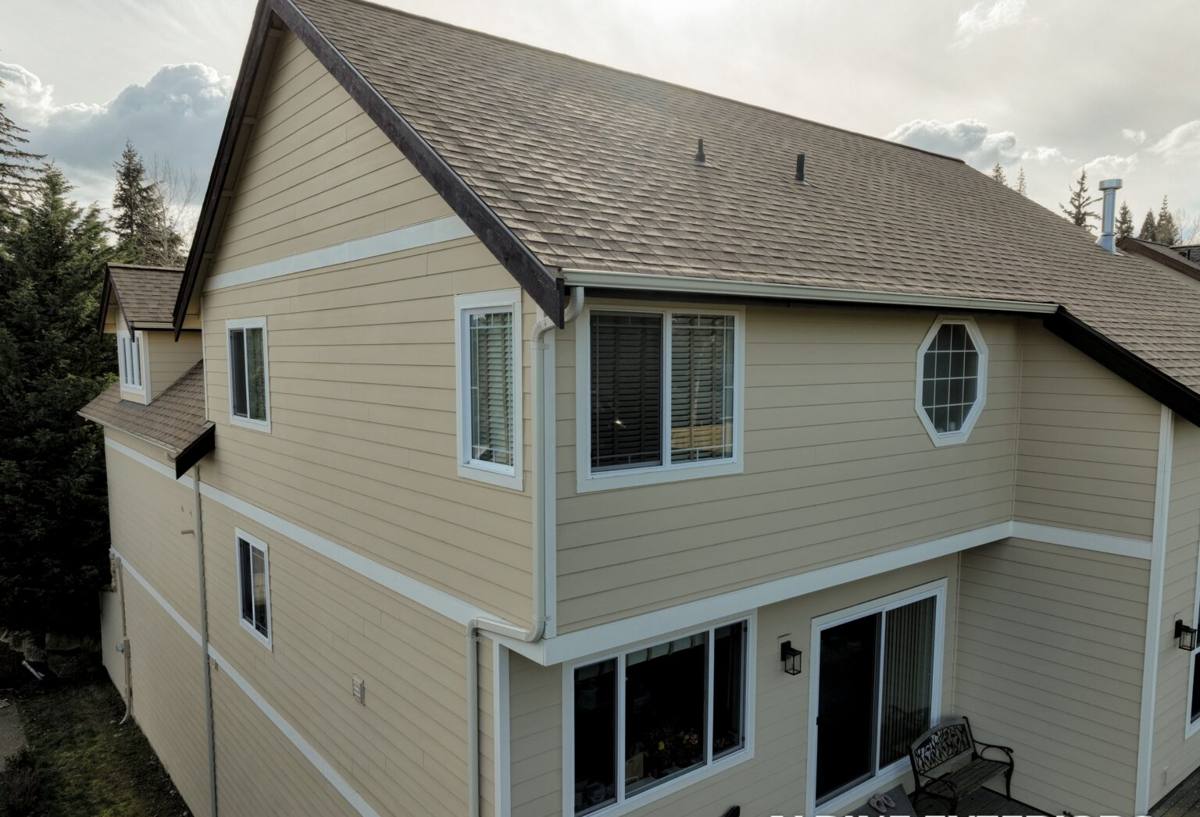
What Sunnyland's Climate Actually Does to Siding
Salt Air and Corrosion
Proximity to Bellingham Bay means airborne salt is a constant, low-grade factor even a mile or two inland. Salt air accelerates corrosion on fasteners, flashing, and any exposed metal trim. It also degrades cheaper paint and coating systems faster than manufacturers' published fade and chalk ratings usually assume, because those ratings are typically tested in inland, non-marine environments.
Driving Rain and Wind-Driven Moisture
Whatcom County storms frequently push rain sideways rather than straight down, which means siding isn't just shedding water off a flat vertical surface — it's fighting moisture that's actively being forced up and under laps, around window trim, and into any gap in the weather-resistive barrier. A siding system that isn't detailed for wind-driven rain will eventually let water behind the cladding, and once that happens the problem is hidden until sheathing rot or interior staining shows up.
Moss and Algae Season
Shaded north- and east-facing walls in Sunnyland, especially under mature tree canopy, can stay damp for most of the year. That constant moisture is exactly what moss and algae need to establish, and once organic growth takes hold on a wall it holds even more moisture against the siding surface, compounding the problem. Products and finishes vary widely in how well they resist this, and it's one of the biggest visible differences between a siding job that still looks clean after ten years and one that's streaked and mossy after three.
Why We Install James Hardie Fiber Cement — And Nothing Else
We standardized on James Hardie fiber cement siding for every project we take on, including Sunnyland homes, and we don't install vinyl, LP SmartSide, or other fiber cement alternatives. That's a deliberate professional standard, not a sales pitch. Fiber cement is non-combustible, dimensionally stable in wet-dry cycling, and doesn't feed moss and algae the way some wood-based and engineered-wood products can once their factory coating wears. James Hardie's ColorPlus finish is baked on at the factory under controlled conditions, which gives it better fade and chip resistance in a marine climate than field-applied paint typically achieves, and it comes with a real transferable warranty backing both the substrate and the finish.
We're not going to pretend every other product on the market is unusable — vinyl and engineered wood both have legitimate use cases elsewhere. But for the specific combination of salt air, wind-driven rain, and heavy moss pressure that Sunnyland homes deal with, we've found Hardie's fiber cement system holds up with less maintenance and fewer callbacks, and that's the standard we're willing to put our name on.
HZ5 Engineering for This Climate
James Hardie manufactures its siding in climate-specific formulations called HZ (HardieZone) products. The HZ5 formulation is engineered for wetter, colder regions like the Pacific Northwest, with a moisture and freeze-thaw performance profile suited to exactly the conditions Sunnyland sees. Using the correct HZ product for this region — rather than a generic national spec — is one of the details that separates a properly installed Hardie job from one that just used the same materials as everywhere else in the country.
What a Correct Installation Actually Involves
Fiber cement siding is only as good as the assembly it's installed into. The board itself resists moisture and fire well, but the system around it — the weather-resistive barrier, flashing, fastening, and clearances — is what actually keeps a home dry over decades. In a climate like this one, skipping or rushing any of these steps shows up faster than it would in a milder region.
- A continuous, properly lapped weather-resistive barrier installed shingle-style so water sheds outward at every seam
- Correctly flashed windows, doors, and penetrations, with flashing tucked behind the barrier above and lapped over it below
- Rainscreen or furring strategy where wall orientation and shading call for it, to let trapped moisture and vapor drain and dry rather than sit against the sheathing
- Fasteners driven to Hardie's specified pattern and depth — overdriven or underdriven nails are one of the most common causes of premature siding failure
- Proper clearance at the foundation, roofline, and any horizontal trim so water and debris don't wick up into the bottom edge of the boards
- Caulked and back-primed cut ends at every butt joint, since exposed cut fiber cement edges are the most vulnerable part of the whole system
- Corrosion-resistant, code-compliant fasteners and trim hardware suited to a marine-air environment
Our Process for a Sunnyland Siding Installation
1. On-Site Assessment
We walk the home and look specifically at exposure: which walls take the most wind-driven rain, which stay shaded and damp longest, and where existing moisture or rot damage has already started. This shapes decisions on rainscreen use, trim details, and where extra attention to flashing is warranted.
2. Tear-Off and Sheathing Check
Old siding comes off and the sheathing underneath gets inspected before anything new goes on. In a climate this wet, hidden rot behind old siding isn't rare — catching and repairing it now is far cheaper than discovering it after the new siding is up.
3. Weather Barrier and Flashing
This is the step that determines whether the wall actually stays dry, and it's the one that's easiest to shortcut and hardest to inspect after the fact. We install and flash it to hold up specifically against wind-driven rain, not just a straight-down drizzle.
4. Hardie Board Installation
Boards are installed to Hardie's fastening and clearance specifications, with cut ends sealed and joints staggered. We use the HZ5 product line appropriate for this region rather than a one-size-fits-all national spec.
5. Trim, Caulking, and Final Detail
Trim boards, corners, and penetrations get finished and sealed. This is where the small details — the ones that don't show up in a driveway inspection but matter in a January storm — get closed out.
6. Walkthrough
We walk the finished job with the homeowner, explain what was done and why, and cover basic upkeep specific to this climate before we consider the job finished.
Correct Install vs. Common Shortcuts
| Detail | Done Correctly | Common Shortcut We See |
|---|---|---|
| Weather barrier laps | Shingle-lapped, taped seams, continuous coverage | Barrier stapled up quickly with gaps at seams |
| Window/door flashing | Flashing integrated with barrier, tucked and lapped correctly | Trim caulked over the barrier instead of properly flashed |
| Fastener depth | Driven flush per Hardie spec | Overdriven, cracking the board's fiber matrix |
| Cut ends | Sealed and back-primed at every joint | Left raw, absorbing moisture over time |
| Bottom clearance | Gap maintained above grade, deck, and roofline | Siding run tight to grade or hardscape |
| Product region-fit | HZ5 formulation for wet, marine climates | Generic national-spec board used regardless of region |
Living With Fiber Cement Siding in a Moss-Prone Neighborhood
No siding material is completely maintenance-free in a climate like Whatcom County's, but Hardie fiber cement with a factory ColorPlus finish resists moss and algae staining better than bare-primed wood-based products, and it doesn't require the periodic re-caulking and repainting that field-finished siding does. On heavily shaded Sunnyland walls, we still recommend an occasional soft wash to keep organic growth from establishing, and keeping gutters clear and vegetation trimmed back from the walls goes a long way toward reducing how much moisture the siding has to shed in the first place. None of this is difficult, but it matters more here than it would in a drier region, simply because the moss season is longer.
Why Local Experience in Sunnyland Matters
A siding crew that only occasionally works in a marine, high-rainfall environment tends to default to whatever detailing works fine in a drier climate — and that's exactly the gap that shows up as moisture problems five or ten years later. Working Fairhaven and the surrounding Bellingham neighborhoods regularly means we see how specific walls, orientations, and tree cover in this area actually perform over time, and we build that into every flashing and barrier decision rather than treating every job the same regardless of where it sits.
A Homeowner's Checklist for Vetting a Siding Installer Here
- Ask what weather-resistive barrier and flashing sequence they use, and why — a confident, specific answer is a good sign
- Confirm they're using the HZ5 (or region-appropriate) James Hardie product line, not a generic national spec
- Ask how they handle cut ends and butt joints, since that's a common weak point
- Ask whether they'll inspect and repair sheathing before new siding goes up
- Check that fastener type and trim hardware are rated for a marine-air environment
- Get a clear explanation of what the manufacturer warranty covers versus what the installer warranties separately
If your Sunnyland home's siding is showing moss streaking, soft spots, or cracked boards, or you're planning ahead for a replacement, we're happy to take a look and walk you through what your walls actually need. Reach out for a free, no-pressure estimate using the form below.