 Fairhaven Siding
 What Bellingham's Climate Actually Does to Siding
Bellingham sits where Bellingham Bay meets the foothills, and that location cuts both ways for a home's exterior. Homes closer to the water take on salt-laden air that accelerates corrosion of fasteners and finishes. Homes tucked under tree cover deal with a long, wet moss season that keeps north-facing walls damp for weeks at a time. And nearly every home in the area gets hit with driving, wind-pushed rain off the Strait of Georgia and Puget Sound during fall and winter storms — rain that doesn't just fall straight down, it drives sideways into seams, laps, and trim joints that were never designed to handle it.
None of this is unique to one street or one subdivision. It's the baseline condition for siding anywhere in Whatcom County, and it's why so many homes here show siding failure years before the material's rated lifespan. The siding itself often isn't the problem — the installation is. Wood-based and vinyl products that perform fine in drier climates start absorbing moisture, warping, or growing mold within a handful of Bellingham winters when the assembly behind them wasn't built for this much sustained wet weather.
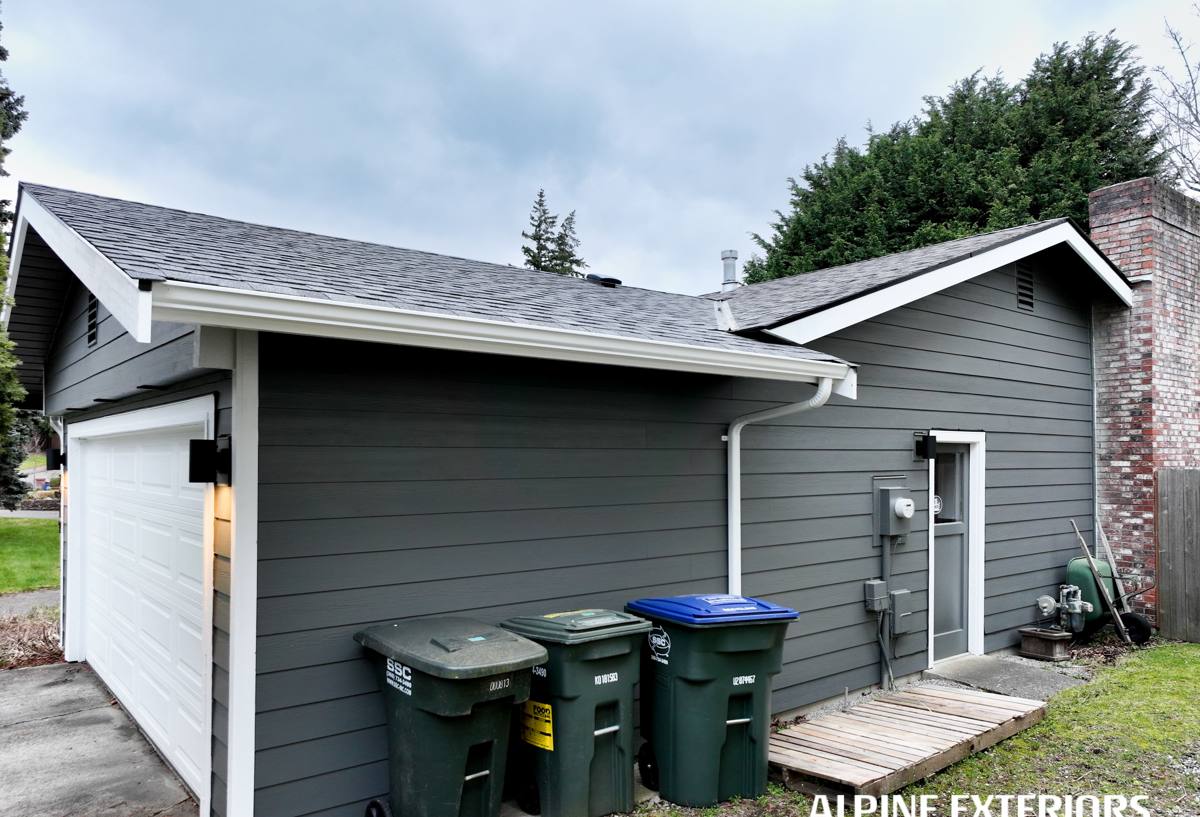
Signs a Bellingham Home Needs Replacement, Not Repair
Homeowners often call us to patch a section of siding, and sometimes that's genuinely all that's needed. But there's a point where patching is throwing good money after bad. Look for:
- Soft or spongy spots when you press on the siding, especially near the bottom courses and around window trim
- Persistent moss or algae growth that returns within weeks of cleaning, particularly on shaded or north-facing walls
- Paint that's bubbling, peeling, or won't hold for more than a couple of years between coats
- Visible gaps, warping, or buckling at panel seams and corners
- Rising utility bills alongside drafts near exterior walls, which often points to a compromised weather barrier behind the siding
- Interior signs — musty smells, staining, or soft drywall near exterior walls — that suggest moisture has already gotten past the siding
If more than one or two of these show up in the same area, especially anywhere that catches wind-driven rain, a full replacement of that section (or the whole exterior) is usually the more honest recommendation than another round of caulk and patch.
What a Correct Siding Replacement Actually Involves
It Starts Underneath the Siding, Not With It
The siding material gets all the attention, but the assembly behind it is what actually keeps water out. A correct replacement in this climate includes a continuous weather-resistive barrier, properly lapped and taped seams, correctly flashed windows and doors, and a drainage gap that lets any moisture that does get behind the siding find its way back out instead of sitting against the wall sheathing. Skip any one of these steps and you can install the best siding on the market and still get rot within a few years.
Fastening Matters More Here Than People Realize
Salt air and constant moisture are hard on fasteners. Nails or screws that aren't corrosion-resistant will streak, weaken, and eventually let siding panels work loose — usually starting on the walls that face prevailing weather. Fastener spec, spacing, and penetration depth all need to match both the siding manufacturer's requirements and the realities of the local climate, not just the minimum building code.
Trim, Caulking, and Termination Details
Most siding failures we're called out to inspect in Bellingham don't start in the middle of a wall — they start at a termination point: where siding meets trim, where trim meets the foundation, around penetrations for hose bibs or vents. These are the details that get rushed on a fast, cheap install and are the first places driving rain finds a way in.
Why We Install Only James Hardie Fiber Cement
We made a deliberate decision years ago to install one siding system: James Hardie fiber cement. That's not a marketing preference — it's a standard we hold because of what we've seen happen to other materials in exactly this climate.
Vinyl siding is affordable and low-maintenance in mild, dry climates, but it can warp and distort with the temperature swings and moisture cycling common here, and it doesn't stand up to wind-driven debris the way a rigid fiber cement panel does. Wood-based products like primed spruce or cedar look great on day one but need vigilant, ongoing maintenance to survive a wet Pacific Northwest exterior — repainting, recaulking, and moisture monitoring that most homeowners don't have time for. Engineered wood siding has closed the gap on performance in many climates, but it still relies on its factory coating and field-applied caulking to stay watertight, and any breach in that coating opens the door to the kind of moisture damage that's hard to catch early.
James Hardie fiber cement is non-combustible, dimensionally stable, and doesn't absorb water the way wood-based products do, which matters enormously in a climate with a moss season this long. Hardie's ColorPlus factory finish is baked on under controlled conditions rather than field-applied, which gives it better adhesion and UV resistance than most job-site paint jobs — meaning fewer repaint cycles over the life of the siding. Hardie also engineers specific product lines (HZ5) for climate zones like ours, accounting for moisture exposure rather than using a one-size-fits-all formulation. Combined with a strong transferable warranty, it's the system we're comfortable standing behind on every home we side.
Our Bellingham Siding Replacement Process
| Stage | What Happens | Why It Matters Here |
|---|---|---|
| Inspection & Estimate | We walk the exterior, check problem areas, and give a written scope and estimate | Identifies hidden moisture damage before it's covered by new siding |
| Tear-Off | Old siding and damaged trim removed, sheathing inspected | Confirms the wall structure is sound before anything new goes on |
| Repair & Barrier Install | Any rotted sheathing replaced; weather-resistive barrier and flashing installed and taped | This is the layer that actually stops driving rain — it has to be done right |
| Hardie Installation | Panels installed to manufacturer spec, including fastener type, spacing, and clearances | Correct spec keeps the warranty valid and the assembly performing for decades |
| Trim & Finish Details | Corners, terminations, and caulking completed and inspected | Where most failures start if rushed — we don't rush these |
| Final Walkthrough | We review the finished work with you before calling the job done | You should understand what's on your home and how to maintain it |
What Affects the Cost of a Siding Replacement
| Factor | Why It Changes the Price |
|---|---|
| Extent of hidden damage | Rotted sheathing or framing found during tear-off requires repair before new siding goes on |
| Home size and wall complexity | More corners, dormers, and trim details mean more labor per square foot |
| Siding profile and accessories | Lap width, trim style, and factory-finish color options carry different material costs |
| Access and site conditions | Steep lots, mature landscaping, or limited staging area affect labor time |
| Scope: full replacement vs. partial | Whole-house jobs have different per-square-foot economics than targeted section replacement |
We don't quote a job over the phone. An accurate number requires an on-site look at the current siding, the wall assembly underneath, and the layout of the home.
A Homeowner's Checklist Before Hiring for Siding Replacement
- Ask what's included in the tear-off scope — does it cover inspecting and repairing sheathing, or just removing and replacing siding panels?
- Confirm the weather-resistive barrier and flashing details are part of the written scope, not assumed
- Verify the crew is a licensed, bonded, and insured Washington contractor
- Ask which siding products the contractor installs and why — and be wary of anyone who installs "whatever you want" without a stated standard
- Get the fastener and installation spec in writing, matched to the manufacturer's requirements for our climate zone
- Ask how the warranty works if something goes wrong five or ten years down the road
Why Local Experience in Bellingham Matters
A siding crew that works this area regularly already knows which walls take the worst of the wind-driven rain, how long moss season really runs here, and how salt air behaves on homes closer to the water versus those further inland. That's not something you can fully account for from a generic install checklist written for a different climate. It shows up in small decisions — extra attention to a north wall's drainage gap, a slightly different flashing detail at a window that faces prevailing weather — that add years to how long the siding actually performs, not just how long the warranty says it should.
It also matters for accountability. A contractor based in and working around Bellingham has a reputation in the community to protect, and is going to be reachable if a question comes up on a job two or five years later.
Ready to Talk About Your Siding?
If your Bellingham home is showing signs of aging siding, or you're just planning ahead, we're happy to take a look and give you a straight assessment — no pressure, no sales pitch. Fill out the form below for a free estimate on James Hardie siding replacement built for what this climate actually does to a home.