 Fairhaven Siding
 Deck Replacement Built for How Sudden Valley Actually Lives
Sudden Valley sits on wooded, sloped lots near Lake Whatcom, and that setting shapes what a deck has to survive out here. Between the tree canopy shading half the yard, the humidity that rolls off the lake, and the driving rain that comes through Whatcom County most of the year, a deck in this neighborhood works harder than one on an open, sunny lot. We replace decks for homeowners across the Fairhaven and greater Bellingham area, and Sudden Valley is one of the neighborhoods where we see the clearest pattern: decks that were built to a generic spec, without accounting for shade, moisture, and moss, wear out faster than they should.
This page is about one job, done right, in one place: full deck replacement for Sudden Valley homes. Not a patch, not a re-stain, not a board-by-board swap that leaves a weak frame underneath. If your deck is soft, gray, spongy, or just tired, here's what actually goes into replacing it correctly out here, and why the crew you hire for it matters as much as the materials.
What the Local Climate Does to a Deck Over Time
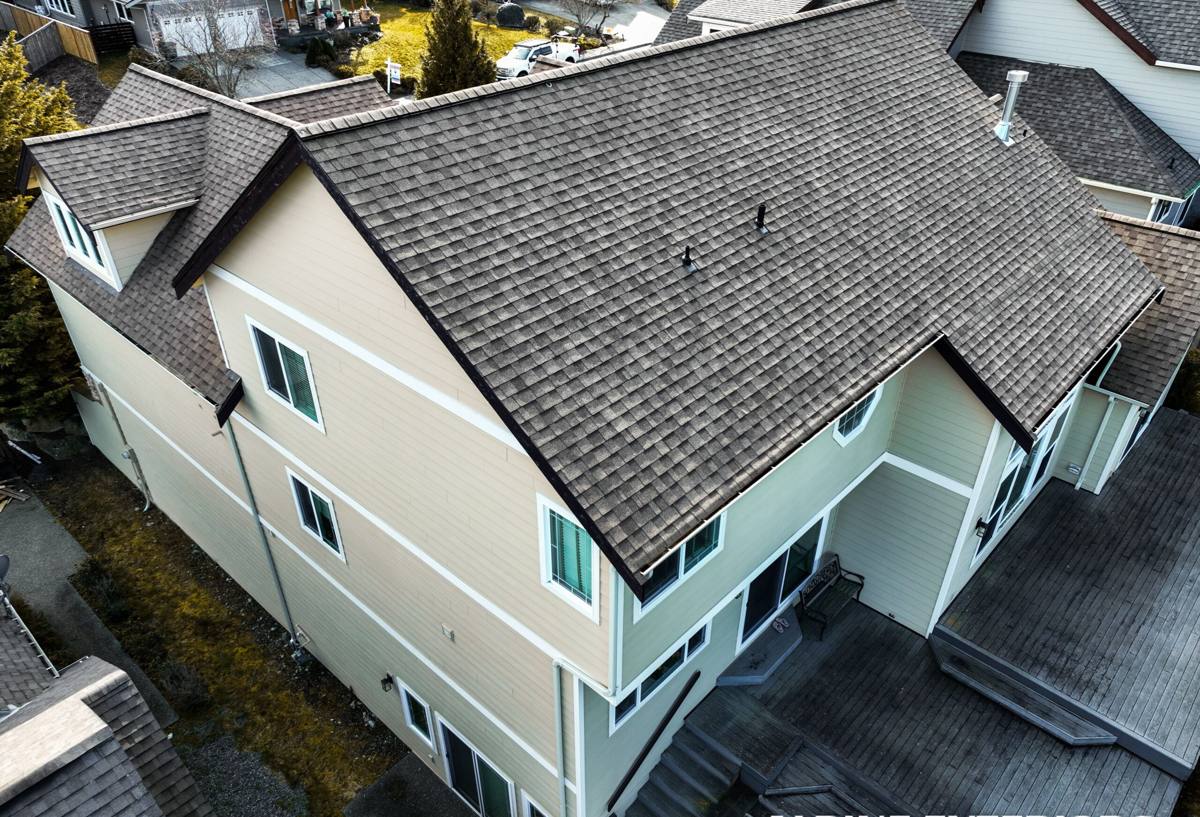
Whatcom County's marine climate brings moisture-laden air off the Salish Sea, long stretches of steady rain, and short, low-angle winter sun that never fully dries shaded surfaces. Sudden Valley adds its own layer on top of that regional pattern: mature tree cover and proximity to the lake mean many decks here stay damp longer than decks in more open parts of the county, and they collect falling needles, leaves, and pollen that hold moisture against the boards.
Over years, that combination shows up in predictable ways:
- Moss and algae growth on shaded boards and stair treads, which holds moisture against the wood and creates a genuine slip hazard, especially on stairs and low-traffic corners.
- Fastener corrosion — nails and screws that weren't rated for wet, coastal-influenced conditions rust, streak the decking, and eventually lose their grip.
- Ledger board and framing rot where the deck meets the house, often hidden under decking that still looks fine from above.
- Cupping and splitting in wood decking as boards repeatedly swell with rain and shrink in dry spells.
- Slick, black-green buildup on the underside of railings and joists where airflow is blocked by nearby trees or dense landscaping.
None of this means Sudden Valley is a bad place to have a wood or composite deck — it just means the deck has to be built and detailed for these specific conditions, not for a dry-climate spec sheet.
Signs a Deck Needs Replacing, Not Just Repairing
Not every tired-looking deck needs full replacement. But there's a point where patching individual boards is throwing money at a structure that's already failed underneath. Before we recommend replacement over repair, we look for these signs:
- Joists or the ledger board feel soft or spongy when probed with a screwdriver
- Multiple deck boards are cupping, splitting, or delaminating across more than a small section
- Railing posts wobble or have visible rot at the base
- Persistent moss or dark staining returns within weeks of cleaning, even in the same spots each year
- Fasteners are rusted, backing out, or leaving black streaks around every screw head
- The deck was built without proper flashing at the house connection (a common shortcut on older or budget builds)
- Stairs feel bouncy or treads have visibly thinned
If you're only seeing one or two of these, repair may genuinely be the right call, and we'll say so. If you're seeing several, especially structural softness, replacement is usually the more honest recommendation — repeated patch jobs on a failing frame just delay the real cost.
Why "It Still Looks Fine" Isn't the Right Test
Because Sudden Valley decks are often shaded and screened by trees, surface wear can be hard to spot from a distance. The framing underneath — joists, ledger, posts, and footings — is usually the first thing to fail, and it's invisible until someone gets underneath the deck and checks it directly. That's a standard part of how we evaluate every deck before quoting replacement versus repair.
What a Correct Deck Replacement Actually Involves
Substructure First
The frame — joists, beams, posts, and footings — is what actually holds the deck up and keeps it safe. We evaluate the existing substructure for rot, undersized framing, and footing condition before touching decking material. In many older Sudden Valley decks, the framing was never sized or spaced for the loads or spans now expected under current code, and replacement is the right time to correct that rather than build new decking over an outdated frame.
Ledger Board and Flashing
Where the deck attaches to the house is the single most common failure point we find in this climate. Proper flashing keeps water from tracking behind the ledger board and into the house rim joist. A deck without correct flashing at that connection will eventually cause hidden rot, no matter how good the decking material is.
Fasteners and Hardware
Every fastener, hanger, and connector gets matched to the decking material and rated for exterior, moisture-heavy use. Mismatched metals corrode each other; the wrong coating rusts and streaks the deck within a couple of seasons. This is a small line item that makes a large difference over ten years.
Drainage and Airflow
Where the site allows it, we build in slope and gaps that let water shed off the deck surface and airflow move underneath, rather than pooling against the house or sitting stagnant in shaded corners where moss takes hold fastest.
Permits
Deck replacement, especially when it involves structural changes, height changes, or work near property lines, typically requires a permit through the applicable local building department. We handle that process as part of the job rather than leaving it to the homeowner to sort out.
Decking Material Options for Sudden Valley Conditions
There's no single "best" decking material for every home — it depends on how much shade the deck gets, how much maintenance you want to do, and your budget. Here's how the common options actually perform under Sudden Valley's shaded, moist conditions:
| Material | Moss/Moisture Resistance | Maintenance | Typical Lifespan |
|---|---|---|---|
| Pressure-treated wood | Moderate — needs sealing and regular cleaning to resist moss in shaded areas | Annual cleaning and re-sealing recommended | 10–15 years with upkeep |
| Cedar | Good natural rot resistance, but still needs sealing in shaded, wet spots | Periodic sealing; cleaning to prevent moss buildup | 15–20 years with upkeep |
| Composite decking | Strong — resists rot and moisture absorption; can still grow surface algae if never cleaned | Occasional washing; no sealing or staining | 25–30 years, manufacturer-dependent |
| PVC/capped decking | Very strong — fully moisture-sealed surface, least prone to moss adhesion | Low; occasional washing | 25–30+ years, manufacturer-dependent |
For heavily shaded lots common in Sudden Valley, we lean toward recommending composite or capped decking when budget allows, simply because a sealed surface holds up better against constant moisture and organic debris than any wood, no matter how well it's finished. That said, plenty of homeowners want the look and feel of real wood, and a well-built, well-maintained wood deck can absolutely hold up here — it just asks more of the homeowner in upkeep. We'll walk through the honest trade-offs for your specific site rather than pushing one material by default.
Our Deck Replacement Process
- On-site evaluation: We inspect the existing deck from the ground up, including underneath, checking framing, ledger connection, and footing condition.
- Honest repair-vs-replace recommendation: If repair genuinely makes more sense, we'll tell you. We don't sell replacement jobs that aren't needed.
- Material and layout discussion: We walk through decking material options against your budget, sun/shade exposure, and how much maintenance you want to take on.
- Permitting: We handle the permit application for the scope of work involved.
- Demolition and disposal: Full removal of the old deck, including framing found to be compromised, hauled off site.
- Framing and flashing rebuild: New substructure built to current code, with proper ledger flashing and moisture management detailing.
- Decking, railing, and stair installation: Installed per manufacturer specifications for your chosen material.
- Final walkthrough: We go over the finished deck with you, including basic care guidance suited to your site's sun and shade conditions.
What Deck Replacement Typically Costs
Every deck is different, and the honest answer is that cost depends on size, material, height off grade, and how much of the existing structure needs to be corrected rather than just replaced. That said, these are the main factors that move the price up or down:
| Cost Factor | Why It Matters |
|---|---|
| Deck size and shape | Larger and multi-level decks require more material, framing, and labor |
| Decking material chosen | Pressure-treated wood is typically the lowest upfront cost; composite and PVC cost more upfront but less over time in maintenance |
| Height above grade | Taller decks need more substantial framing, railings, and often stairs, which adds labor and material |
| Existing structural damage | Rotted framing, footings, or ledger connections found during demo may need correction before rebuilding |
| Site access | Sloped, wooded, or tight-access lots — common in Sudden Valley — can affect equipment access and labor time |
| Railing and stair complexity | Custom railing styles, multiple stair runs, or code-driven guard height changes add cost |
| Permit requirements | Scope-dependent permitting and inspection add time and a modest fee to the project |
We won't quote a number without seeing the site — anyone who does is guessing. What we can promise is a clear, itemized estimate that shows you where the cost is actually going, not a vague lump sum.
Why a Crew That Already Works Sudden Valley Matters
Sudden Valley isn't a typical flat-lot subdivision. Sloped, wooded sites mean equipment staging and material delivery take more planning than a standard job. Many properties are part of a homeowners' association with design or exterior guidelines, and a crew that's worked in the neighborhood before knows to ask about that up front rather than finding out mid-project. Familiarity with the terrain, the tree cover, and the moisture patterns specific to lots near the lake also means fewer surprises once demolition starts and the old framing is exposed.
We work throughout the greater Fairhaven and Bellingham area, and Sudden Valley is a neighborhood we return to regularly. That matters less for marketing and more for practical reasons: we've already seen how decks fail here, which details actually hold up under this specific combination of shade, humidity, and rain, and which shortcuts show up as problems five years later.
A Straightforward Way to Start
If your deck is showing its age — soft spots, persistent moss, rusted fasteners, or just a general sense that it's not going to make it through another wet Whatcom County winter — we're glad to come take a look. We'll give you a straight answer on repair versus replacement, walk through material options suited to your site's sun and shade, and put together a clear estimate with no pressure to sign anything on the spot. Use the form below to request a free estimate for your Sudden Valley deck.