 Fairhaven Siding
 Why Sudden Valley Siding Has to Work Harder
Homes around Sudden Valley sit in a demanding pocket of Whatcom County. The tree cover and lake-adjacent humidity keep siding damp longer after every storm than it would stay in a drier, more open neighborhood. Add the region's driving rain off the Salish Sea and the salt-tinged air that reaches inland from Bellingham Bay, and you have a climate that punishes any siding product with weak points at the seams, fasteners, or trim. Then there's moss season, which in this part of Washington isn't really a season at all — it's most of the year. Shaded, north-facing walls and anything tucked under overhanging firs can stay green and damp for months if the siding and the install don't account for it.
None of this means siding is doomed here. It means the material and the workmanship both have to be chosen for these exact conditions, not for a generic "Pacific Northwest" spec sheet. That's the entire reason this page exists — to explain what actually holds up on a Sudden Valley home, and what we do differently because of it.
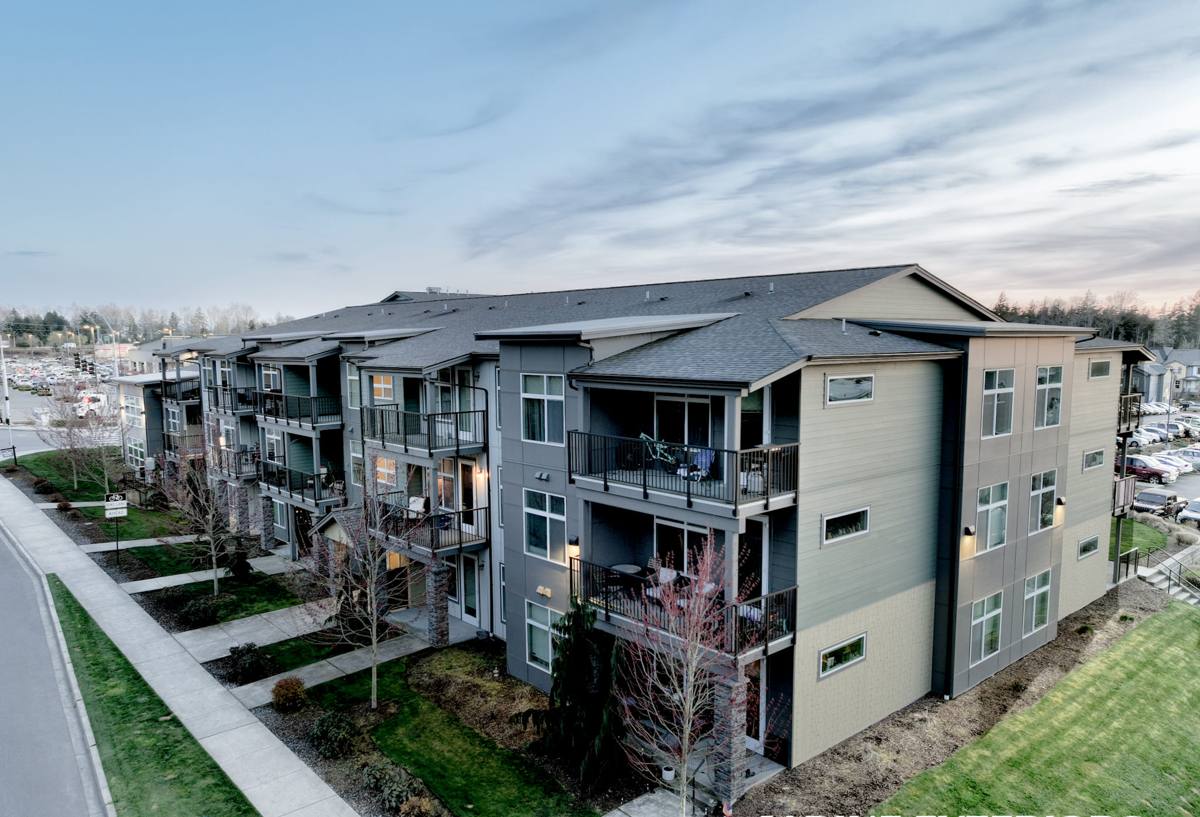
Why We Install Only James Hardie in This Climate
We don't offer LP SmartSide, vinyl, Cemplank, Allura, primed spruce, or cedar. That's a deliberate standard, not a lack of options. Each of those products has real strengths, but each also has a weak point that shows up faster in a climate like Sudden Valley's than it would somewhere dry.
What Moss and Moisture Do to Other Materials
Vinyl doesn't rot, but it flexes and gaps with temperature swings, and those gaps become entry points for wind-driven rain and a place for moss and algae to colonize behind the panel where you can't see it. Wood siding — cedar or primed spruce — needs a maintenance schedule most homeowners underestimate: repainting, caulking, and moss treatment every few years, or moisture finds the end grain and rot follows. Engineered wood products like LP SmartSide resist rot better than raw wood, but they're still a wood-based substrate, meaning any breach in the factory coating or a poorly sealed cut edge lets moisture in, and once it's in, swelling and delamination can follow.
Why James Hardie Fits
James Hardie fiber cement is engineered from cement, sand, and cellulose fiber. It doesn't rot, it doesn't feed moss the way wood-based siding can, and it holds paint and factory finish far longer than wood because it doesn't move with moisture the way wood fibers do. Hardie also builds a specific product line, HZ5, engineered for exactly this climate zone — freeze-thaw cycles, sustained damp, and coastal-influenced weather. That's not marketing language; it's a real difference in the formulation compared to the HZ10 line sold in drier southern climates.
What a Correct Install Actually Involves
Fiber cement siding is only as good as the installation underneath it. This is where most siding failures we get called out to inspect actually originate — not the product, the install. In a climate that stays damp as long as Sudden Valley's does, every one of the details below matters more than it would in a drier region.
Clearance and Moisture Management
- Minimum clearance from grade, decks, patios, and roof lines so splashback and standing moisture never sit against the bottom edge of the siding
- Proper weather-resistive barrier and flashing at every window, door, and penetration, lapped correctly so water sheds outward, not behind the cladding
- Rain screen or drainage gap where the wall assembly calls for it, so any moisture that does get behind the siding can actually dry out instead of sitting trapped against sheathing
- Kick-out flashing at roof-to-wall intersections, a detail that's easy to skip and one of the most common sources of hidden rot we find on older homes in wooded, high-rainfall settings
Fastening and Joint Treatment
Hardie's warranty and performance depend on following the manufacturer's fastening pattern and using the specified nails or screws driven correctly — not overdriven, not underdriven. Butt joints get treated with the correct sealant or covered with H-jamb trim, not just caulked and hoped for. Caulking itself has to be a paintable, flexible exterior-grade product at every joint and penetration, because a caulk failure in a climate this wet turns into a moisture problem fast.
Factory Finish, Protected
Most James Hardie siding we install comes with the ColorPlus factory finish — a baked-on coating that resists fading and holds up to moss and mildew staining far better than field-applied paint. But that finish only performs as advertised if cut edges are primed and sealed and if the crew isn't scuffing or chipping the finish during handling and install. Sloppy handling on site quietly undermines a product that's otherwise built for this exact weather.
Comparing Siding Options for a Sudden Valley Property
| Factor | James Hardie Fiber Cement | Vinyl | Wood / LP SmartSide |
|---|---|---|---|
| Moss and algae resistance | High — cement substrate, factory finish | Moderate — moss grows on surface film and behind gapped panels | Low to moderate — moss holds moisture against wood fibers |
| Performance in driving rain | High when flashed and gapped correctly | Moderate — seams and panel flex are weak points | Moderate — dependent on coating integrity |
| Maintenance burden | Low — occasional wash, no repainting for years | Low, but cracks and fades over time | High — repainting and moss treatment on a recurring schedule |
| Fire resistance | Non-combustible | Combustible | Combustible |
| Typical lifespan when installed to spec | Decades, with strong transferable warranty | Long, but seams and fasteners degrade sooner | Shorter without consistent maintenance |
The pattern that matters most for this neighborhood: fiber cement's advantage widens specifically in wet, shaded, moss-prone conditions. In a drier climate, some of these gaps would be smaller.
Signs Sudden Valley Homeowners Should Watch For
If your current siding is wood, older vinyl, or a fiber cement job that wasn't installed to spec, a few warning signs show up earlier here than they would in a drier part of the state:
- Persistent green or black staining on north-facing or tree-shaded walls that returns quickly after washing
- Soft or spongy spots near the bottom courses, around window trim, or below roof-to-wall junctions
- Visible gaps at butt joints or corners where caulking has shrunk, cracked, or pulled away
- Peeling or bubbling paint, especially on wood or older engineered wood siding
- Panels that flex noticeably or rattle in wind, a sign of loose fastening or thermal movement issues
None of these mean the whole wall needs replacing on the spot, but they're worth a professional look before the next wet season sets in.
Our Process on Sudden Valley Projects
Assessment First
We start by walking the exterior and identifying the wall assembly's actual condition — sheathing, existing moisture barrier, trim, and any rot or hidden damage behind the current cladding. This matters more here than in a dry climate, because damage can be present behind siding that still looks fine from the curb.
Correct Tear-Off and Prep
Old siding comes off cleanly so we can inspect and repair sheathing, and the weather-resistive barrier and flashing get installed or corrected before a single piece of new siding goes up. This step is the one most often shortchanged by crews trying to move fast, and it's the step that determines whether the siding lasts.
Install to Manufacturer Spec
James Hardie's installation manual is specific about clearances, fastening, and flashing for a reason — deviating from it is one of the fastest ways to void a warranty and shorten the siding's real-world life. We install to that spec as the baseline, not as an upsell.
Final Walkthrough
Before we consider a project finished, we walk the completed siding with the homeowner, checking joints, trim, and caulking, and answering any questions about care going forward.
Choosing the Right Hardie Line for This Neighborhood
Most Sudden Valley homes we work on land well with either HardiePlank lap siding for a traditional look or HardieShingle where a more textured, cottage-style elevation fits the property. Both are available in the ColorPlus finish palette, which is worth choosing over field-applied paint here specifically because it resists the staining that shaded, damp walls are prone to. We'll walk through color and profile options as part of the estimate, matched to your home's exposure and the look you're going for — not a one-size answer.
What to Expect From an Estimate
A siding estimate on a Sudden Valley home should include a real look at the current wall assembly, not just a measurement of exterior square footage. Before you commit to any contractor, it's worth confirming a few basics:
- Do they inspect behind the existing siding, or just measure and quote from the outside?
- Do they install to James Hardie's published fastening and clearance specifications?
- Is flashing and moisture barrier work included and explained, or treated as an afterthought?
- Can they explain why they'd use HZ5 product in this climate specifically?
- Is the warranty transferable, and do they stand behind their own labor separately from the manufacturer's material warranty?
If you're weighing a siding replacement or repair on a Sudden Valley home, we're happy to walk the property, look at what's actually happening behind the current siding, and put together a straightforward, no-pressure estimate. There's a form below — reach out and we'll get a look scheduled.