 Fairhaven Siding
 Why Chuckanut Homes Need a Different Approach to Windows
Chuckanut sits in a spot that's beautiful for exactly the reasons that are hard on a house. The homes tucked along the wooded slopes above Chuckanut Bay and Samish Bay get a mix of conditions you don't see the same way even a few miles inland in Fairhaven or Bellingham: salt-laden air coming off the water, wind-driven rain that hits window walls at an angle instead of straight down, and heavy tree cover that keeps north and west-facing surfaces damp and shaded for long stretches of the year. That combination is why we treat window work in this neighborhood as its own job, not a copy-paste version of what we'd do somewhere drier or more open.
Custom windows come up often here because so many Chuckanut homes are older, view-oriented, or built into terrain that doesn't line up with standard modern openings. Whatcom County's building stock along the water skews toward homes designed to take advantage of the view — which usually means larger glass, non-standard shapes, and openings that were framed by hand decades ago rather than pulled from a lumber yard's stock sizing chart.
What "Custom" Actually Means for a Window Job
Non-Standard Openings
Most production windows are built to a set of common width-and-height combinations. Once your rough opening falls outside those, or the opening is out of square from decades of settling, you're into custom territory — either a special-order unit built to the exact dimensions, or an opening that has to be reframed to accept a stock size. Both are legitimate approaches; which one makes sense depends on the home's age, the framing behind the siding, and what you're trying to preserve architecturally.
View Glass
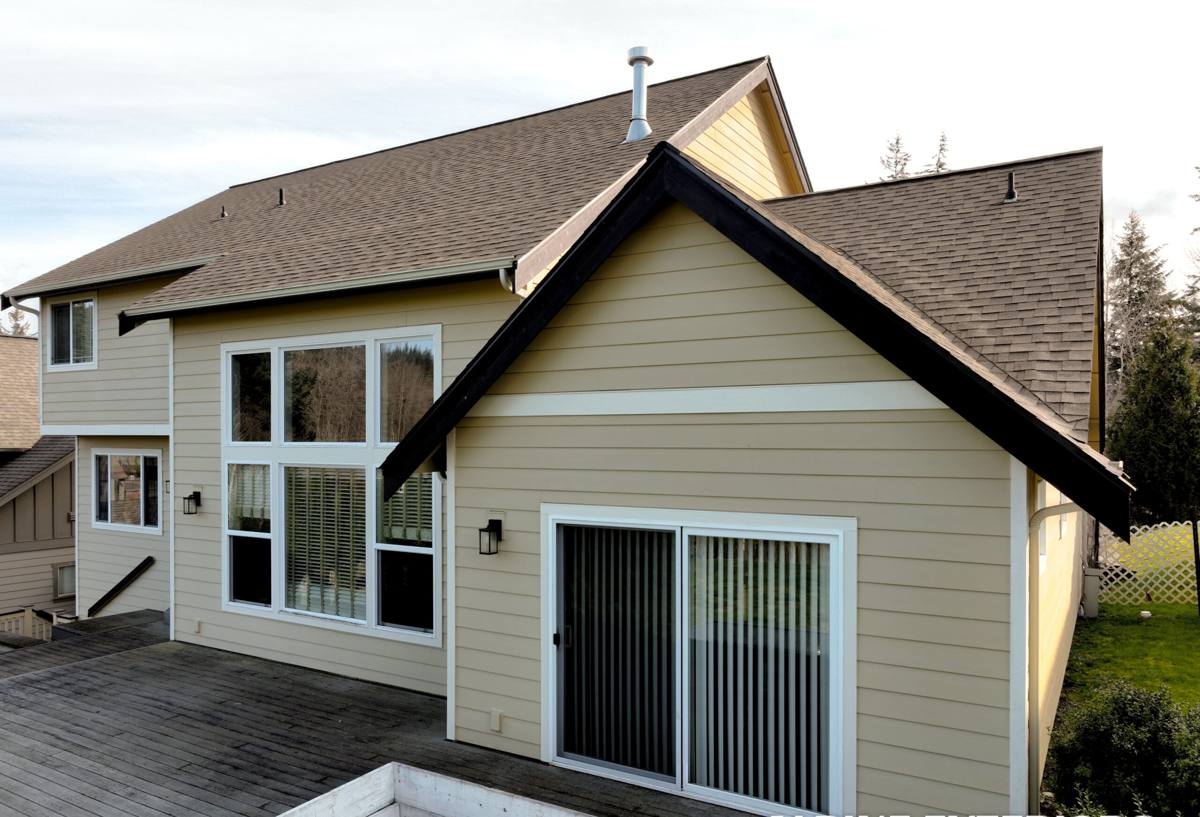
A lot of Chuckanut properties are built around a view of the water or the trees, which means large fixed panes or window walls instead of a few modest double-hungs. Bigger glass means more structural header to size correctly, more perimeter to flash and seal, and more surface area for wind-driven rain to test. Getting this right the first time matters more here than it would on a small, sheltered opening.
Character and Older Homes
Where a home has real architectural character worth keeping, custom windows let us match sightlines, trim profiles, and proportions instead of forcing a stock size that changes how the house reads from the street or the water side.
What Salt Air, Driving Rain, and Moss Actually Do to a Window Over Time
These aren't abstract concerns for a house sitting above Chuckanut Bay — they're the specific reasons windows fail early in this neighborhood when they're installed or maintained without accounting for local conditions.
Salt Air
Airborne salt accelerates corrosion on exposed metal — hinges, balance hardware, screen frames, and especially uncoated or bare aluminum. It also breaks down some sealants and finishes faster than it would inland. This is one of the main reasons frame material and hardware choice matter more here than they would twenty miles from the water.
Driving Rain
Storms off the Salish Sea often push rain sideways instead of down, which means water gets tested against the window's weakest points — the sill, the corners, and wherever flashing ties into the siding — far more aggressively than a light, straight-down rain would. A window that would perform fine in a calmer climate can leak here if the flashing detail wasn't built for wind-driven water.
Moss and Prolonged Dampness
Chuckanut's tree cover keeps shaded walls, sills, and trim damp for extended stretches, especially through the fall and winter. Moss and algae take hold on horizontal surfaces and in corners where water sits, and once established they hold moisture against wood trim and sills far longer than the surface would otherwise stay wet. Over years, that's a slow but steady driver of rot at sills and trim, especially on original wood components that were never meant to stay damp this long.
Frame Materials That Actually Hold Up Here
There's no single "correct" frame material for every home — it depends on budget, exposure, and how the house is built. But in a salt-air, high-moisture environment like Chuckanut, some materials simply require less fighting against the climate than others.
| Material | Salt-Air Durability | Maintenance Load | Relative Cost | Best Fit |
|---|---|---|---|---|
| Vinyl | Good — won't corrode | Low | $ | Budget-conscious replacements, rentals, secondary structures |
| Fiberglass | Very good — stable in temperature swings and salt exposure | Low | $$$ | Full-exposure sides of the house, large view glass |
| Wood-clad | Depends entirely on cladding integrity and detailing | Moderate to high | $$$ | Character homes wanting a wood interior look |
| Bare aluminum | Poor without upgraded coatings — corrodes fastest near salt air | High | $$ | We generally steer clients away from this near the water |
We're not tied to one manufacturer or product line — the right call depends on the specific opening, the home's exposure, and what the homeowner is trying to balance between upfront cost and long-term maintenance. Where we steer people away from a material, it's a maintenance and moisture-performance call for this specific climate, not a claim that the product fails everywhere.
Getting the Installation Right: Flashing, Sealing, and Tie-In to the Siding
A window is only as good as the flashing and sealant details around it, and this is where most leaks actually start — not in the window unit itself. On a home taking wind-driven rain off the water, the details that matter are:
- A properly sloped sill pan that sheds water outward instead of letting it pool at the frame
- Flashing tape or membrane integrated with the weather-resistive barrier behind the siding, not just caulked over the surface
- Head flashing that directs water out and away rather than behind the trim
- Sealant used at the right joints only — over-sealing every seam can trap moisture instead of letting a window's designed drainage path work
- Correct shimming and fastening so the frame isn't racked or bowed, which stresses seals over time
This is also where the connection between windows and siding really matters. If we're already working on a home's siding, tying the window flashing correctly into the new weather barrier is far more reliable than patching around an existing siding job after the fact. Window and siding work done together, in the right order, is one of the more effective ways to cut down on future leak calls.
Our Process for a Chuckanut Custom Window Job
- On-site assessment — we look at the existing openings, framing condition, exposure direction, and any current signs of water intrusion or rot before recommending anything.
- Measuring for custom sizing — older openings are rarely perfectly square, so we measure each one individually rather than assuming they match.
- Material and glass selection — matched to exposure, budget, and whether the priority is view glass, energy performance, or matching existing trim style.
- Removal and opening prep — checking the framing and sheathing behind the old window for hidden moisture damage before anything new goes in.
- Flashing and installation — sill pan, WRB integration, and head flashing installed to shed wind-driven rain, not just block straight-down water.
- Sealing, trim, and finish — interior and exterior trim work finished to match the home, with sealant placed only where it should be.
- Final walkthrough — checking operation, seal, and appearance with the homeowner before we consider the job done.
Signs a Chuckanut Home Needs Window Attention
A lot of window problems here show up gradually, and homeowners often adjust to them without realizing they're a symptom of something worth addressing. Worth checking for:
- Moss or dark green staining building up on sills or bottom trim, especially on shaded or north-facing walls
- Soft or spongy wood at the sill or corners when pressed
- Fogging or condensation between panes on double-glazed units, which means the seal has failed
- Noticeable drafts near the frame on windy days
- Paint or finish that's bubbling or peeling specifically around the window perimeter, not the wider wall
- Difficulty opening or closing, or hardware that's visibly corroded
- Any staining on interior drywall or trim below or beside a window
None of these mean the whole window needs replacing right away, but they're worth a look before the next wet season adds to the damage.
Why Local Experience in Chuckanut Actually Matters
Window work that looks fine on a spec sheet can still fail here if it wasn't built with this specific exposure in mind. A crew that already works in Chuckanut and along the Fairhaven waterfront has usually already seen how a given detail performs through a full Whatcom County winter — which flashing approaches actually shed wind-driven rain off the bay, which materials are holding up on shaded, moss-prone walls, and which older openings in this area tend to be out of square. That's the kind of judgment that's hard to get from a crew that mostly works drier, more sheltered neighborhoods and treats every job the same way.
If you're weighing custom windows for a Chuckanut home — whether it's one problem opening or a full view-side replacement — we're happy to take a look and give you a straightforward assessment. The estimate is free, there's no pressure attached to it, and you can use the form below to get started.