 Fairhaven Siding
 Why Chuckanut Homes Put Siding Through More Than Most
Chuckanut sits in one of the more physically demanding microclimates in Whatcom County. Homes here face a three-part assault that most inland siding never has to survive: salt-laden air off Bellingham Bay, driving wind-driven rain that hits walls at an angle instead of falling straight down, and a long, damp shoulder season that gives moss and algae months to take hold on anything that stays wet. Any one of these is manageable. Together, over years, they expose every weak point in a siding system — the seams, the fasteners, the paint film, the substrate underneath.
Salt air is corrosive to exposed metal trim and fasteners, and it accelerates the breakdown of cheaper paint films faster than a standard weathering chart would predict. Driving rain doesn't just wet a wall — it forces water sideways and upward under laps, gaps, and poorly flashed penetrations that would stay dry in a calmer climate. And moss doesn't need standing water to grow; it just needs shade, moisture, and time, which Chuckanut's tree cover and marine layer supply in abundance for much of the year. Siding that isn't engineered and installed with this specific combination in mind tends to show its age early — cupping, staining, soft spots, and paint failure well before a homeowner expects to think about siding again.
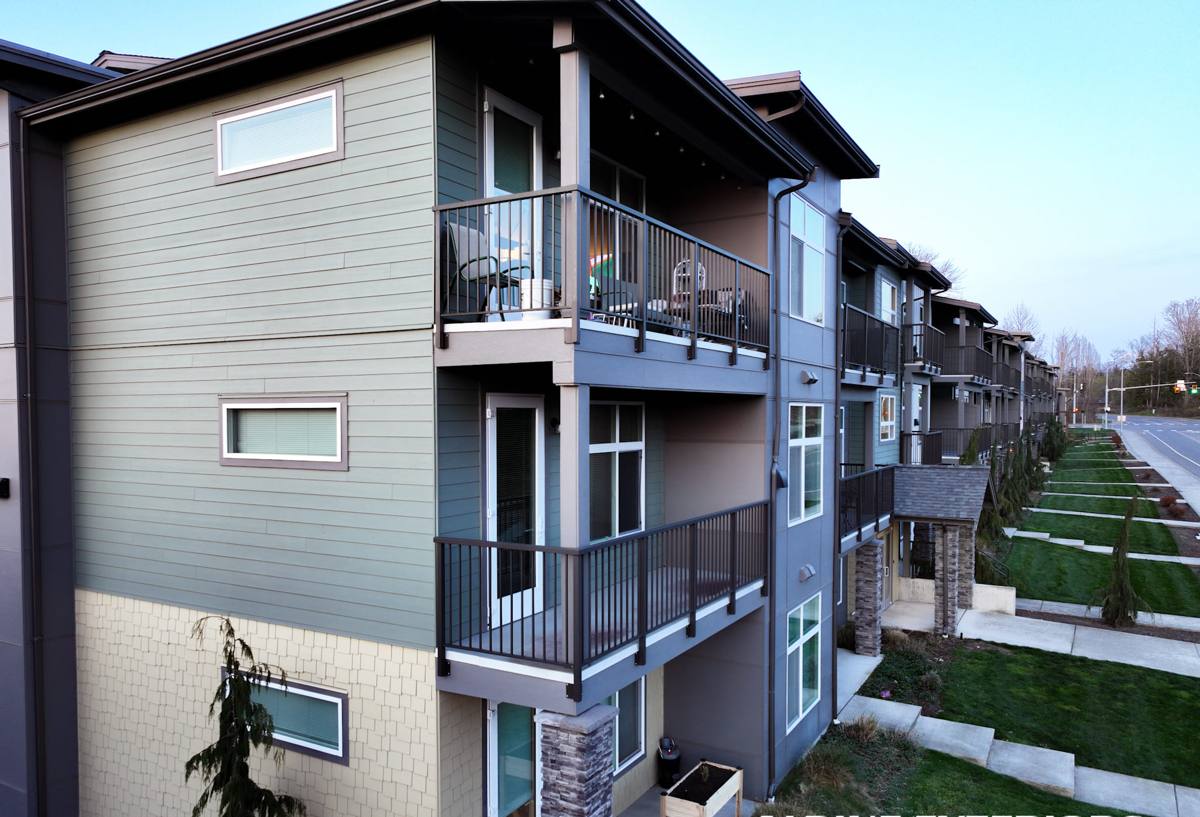
What "Correct" Fiber Cement Installation Actually Means Here
Fiber cement itself is a strong starting point for this climate — it's non-combustible, dimensionally stable, and doesn't absorb water the way wood-based products do. But the material is only half the equation. In a coastal, high-rainfall neighborhood like Chuckanut, the installation details matter as much as the product choice, and they're the details that get skipped when a crew is used to easier, drier jobsites.
The details we treat as non-negotiable
- Correct water-resistive barrier and rainscreen gap so any moisture that gets behind the siding has somewhere to drain and dry out, rather than sitting against the sheathing.
- Manufacturer-specified fastener placement and type — corrosion-resistant fasteners driven at the right depth, not overdriven, which is one of the most common causes of premature cracking near the coast.
- Proper joint flashing and caulking at every seam, window, and penetration, sized for wind-driven rain rather than straight-down rainfall.
- Correct clearance from grade, decks, and roof lines so splashback and debris don't hold moisture against the bottom courses.
- Factory-finished panels and trim wherever possible, since a factory finish resists the coastal UV and salt exposure far better than field-applied paint.
Skipping any one of these doesn't usually show up in year one. It shows up in year five or six, as a stain pattern, a soft corner, or a paint line that's failing faster on one elevation than the others — usually the side that takes the worst of the weather off the water.
Why We Install James Hardie and Nothing Else
We standardized on James Hardie fiber cement across every job we do, including here in Chuckanut, and we don't install vinyl, LP SmartSide, Cemplank, Allura, or bare cedar or primed spruce siding. That's a deliberate professional standard, not a marketing line, and it's worth explaining plainly rather than just asserting it.
Vinyl siding is inexpensive and easy to install, but it moves with temperature and can warp or crack in sustained wind exposure, and it doesn't stand up to salt air discoloration the way a baked-on ColorPlus finish does. Wood-based composite sidings like LP SmartSide use engineered wood strand technology that performs well in many climates, but any wood-based product carries more inherent moisture sensitivity than fiber cement, which matters more in a marine, high-rainfall neighborhood than it would somewhere dry. Bare or primed wood siding — cedar or spruce — looks good on day one, but it requires an ongoing maintenance commitment (recoating, caulking, moisture monitoring) that most homeowners underestimate, and Chuckanut's moss season shortens the window between maintenance cycles considerably. Other fiber cement brands, including Cemplank and Allura, are legitimate fiber cement products, but we've standardized our crews, our installation details, and our warranty conversations around one system so we can guarantee the work end to end rather than juggling multiple manufacturers' specs.
James Hardie's HardieZone system, in particular, is engineered by climate — the HZ5 formulation used in the Pacific Northwest is built specifically for regions with sustained moisture exposure, which is exactly the profile Chuckanut fits. Combined with the factory-applied ColorPlus finish, it gives us a product we can install once, flash correctly, and stand behind — rather than a product we'd have to caveat.
How Fiber Cement Compares for a Coastal Neighborhood
| Factor | Vinyl | Wood-Based Composite | James Hardie Fiber Cement |
|---|---|---|---|
| Salt air / coastal fading | Discolors and can become brittle over time | Moderate, depends on finish maintenance | Factory ColorPlus finish engineered to resist fading |
| Driving rain / moisture behavior | Doesn't absorb, but seams can allow intrusion | More moisture-sensitive at cut edges and seams | Dimensionally stable, low moisture absorption when installed with proper flashing |
| Moss / algae resistance | Can host growth in shaded, damp areas | More vulnerable due to organic wood content | Non-organic core resists moss growth better than wood-based products |
| Fire resistance | Can melt or deform under heat | Combustible | Non-combustible material |
| Typical maintenance cycle | Low, but limited repair options once damaged | Frequent recoating and inspection needed | Long intervals between repaint, factory finish reduces upkeep |
Our Process for a Chuckanut Siding Job
Every project follows the same sequence, whether it's a full re-side or a targeted section replacement, because the sequence is what keeps water out of the wall assembly for the long term.
- On-site assessment. We walk the exterior looking for the specific damage patterns coastal moisture causes — soft trim, staining under windows, moss buildup on north- and shaded-facing walls, and any existing flashing or caulking failures.
- Substrate check. Before any new siding goes on, we confirm the sheathing and water-resistive barrier underneath are sound. Installing new siding over a compromised substrate just hides a problem that will resurface.
- Rainscreen and drainage plane installation. Given how much wind-driven rain this neighborhood sees, we install a proper drainage gap so any incidental moisture has a path to escape rather than accumulating.
- Hardie panel and trim installation to spec. Fastener spacing, panel gaps, and flashing details follow James Hardie's published installation guidelines, which are themselves written with wet climates in mind.
- Sealing and finish work. Seams, corners, and penetrations get sealed with products rated for sustained moisture exposure, not general-purpose caulk that degrades faster under coastal UV and salt.
- Final walk-through. We review the finished job with the homeowner, including what routine maintenance actually looks like for a Hardie system in this climate — which, done right, is minimal.
Living With Moss Season Without Losing Your Siding to It
Moss doesn't damage fiber cement the way it can damage wood, but it does hold moisture against any surface, and left unaddressed for years it can contribute to staining and premature wear on caulk joints and trim. The difference with a correctly installed Hardie system is that the material itself isn't feeding the moisture problem — moss growing on a factory-finished fiber cement panel is a surface issue you can clean off, not a sign the siding is absorbing water and starting to fail underneath.
Homeowners in shaded, tree-lined parts of Chuckanut should expect some moss and algae growth on north-facing and shaded walls regardless of siding material — that's a function of the site, not a defect. What correct installation controls is whether that moisture ever gets a path into the wall assembly. That's the difference between an annual soft-wash and an actual repair.
A homeowner's realistic maintenance checklist
- Rinse or soft-wash siding annually, focusing on shaded and north-facing walls where moss accumulates fastest.
- Inspect caulk joints at trim, windows, and corners every year or two, since UV and salt exposure age sealants faster here than inland.
- Keep gutters clear and downspouts directed away from the foundation — most of the moisture damage we see traces back to water management, not the siding itself.
- Trim back vegetation that keeps a wall shaded and damp longer than necessary.
- Have flashing and trim checked periodically at windows, doors, and roof intersections — these are the highest-risk points for water intrusion in driving rain.
What a Correct Job Costs to Get Right
We don't quote firm numbers without seeing the house, since siding scope, existing damage, trim complexity, and access all move the price. But the factors that actually drive cost on a Chuckanut job are worth understanding before you get a bid.
| Cost Factor | Why It Matters Here |
|---|---|
| Substrate condition | Coastal moisture exposure means more homes need sheathing repair before new siding goes on — this is discovered during tear-off, not before. |
| Rainscreen / drainage detailing | Proper drainage planes add labor and material cost but are what actually protects the wall assembly long term in this climate. |
| Trim and flashing complexity | Homes with more windows, dormers, and roof intersections need more flashing work, which is where driving-rain failures usually originate. |
| Product line and finish | Factory ColorPlus finishes cost more up front than field-primed options but remove a recurring maintenance expense. |
| Site access | Tree cover, slopes, and tight lot lines common in this area can affect staging and labor time. |
The honest way to think about it: paying for correct flashing and drainage details now is cheaper than paying to open up a wall in eight years because water found a way in behind an under-detailed installation.
Why Hiring a Crew That Already Works Chuckanut Matters
Siding installation guidelines are written at a national level, but the judgment calls on any given wall — where to add extra flashing, how much drainage capacity a shaded, moss-prone elevation needs, how to detail a wall that takes rain at an angle most of the year — come from having actually worked this specific stretch of Whatcom County coastline. A crew that mostly installs in drier, calmer climates will follow the manual correctly and still under-detail a house for what Chuckanut's weather actually does to it over a decade.
We also stand behind the work with James Hardie's manufacturer warranty backing the product itself, paired with our own installation workmanship — which matters more here than in a mild climate, since the installation details are exactly what determines whether the product performs the way it's engineered to.
If your siding is showing staining, soft spots, or failing paint, or you're planning ahead for a home in Chuckanut, we're glad to walk the exterior with you and give you a straight assessment — no pressure, no upsell, just what the house actually needs. Reach out for a free estimate using the form below.