 Fairhaven Siding
 Bow's Marine Climate Is Hard on Ordinary Siding
Homes in Bow sit close enough to the water that siding takes a different kind of beating than it does further inland. Salt-laden air, wind-driven rain off the Sound, and a moss season that runs longer than most homeowners expect all work on a house's exterior at the same time, year-round. Siding that's marketed as "low-maintenance" in a catalog often doesn't hold up the same way once it's actually installed a few hundred yards from tidal water in Whatcom County. That gap between what a product promises and what it actually does in this specific environment is the reason we only install James Hardie fiber cement on homes here.
Salt Air and Corrosion
Airborne salt doesn't just sit on the surface of a wall — it works into fasteners, trim joints, and any exposed metal over time. Cheaper or mismatched hardware corrodes faster near the water, and once a fastener starts to fail, it takes the water-tightness of the whole panel with it. Correct material selection for every component, not just the siding itself, matters more in Bow than it does twenty miles inland.
Wind-Driven Rain
Rain in this area rarely falls straight down. Wind off the water pushes it sideways and up under laps, around corners, and into any gap that wasn't sealed or flashed correctly. A siding system can be rated for high exposure and still fail here if the installer didn't respect clearances and drainage planes during the actual install. The material matters, but the workmanship matters just as much.
An Extended Moss and Algae Season
Between the rainfall totals and the tree cover common on Bow lots, surfaces stay damp longer here than in drier parts of the state. Moss and algae get a running start on any siding that holds moisture at the surface, especially on north-facing walls and areas shaded by mature trees. Products that absorb water at the surface give moss something to grow on; products that don't, don't.
Why James Hardie Fits This Environment Specifically
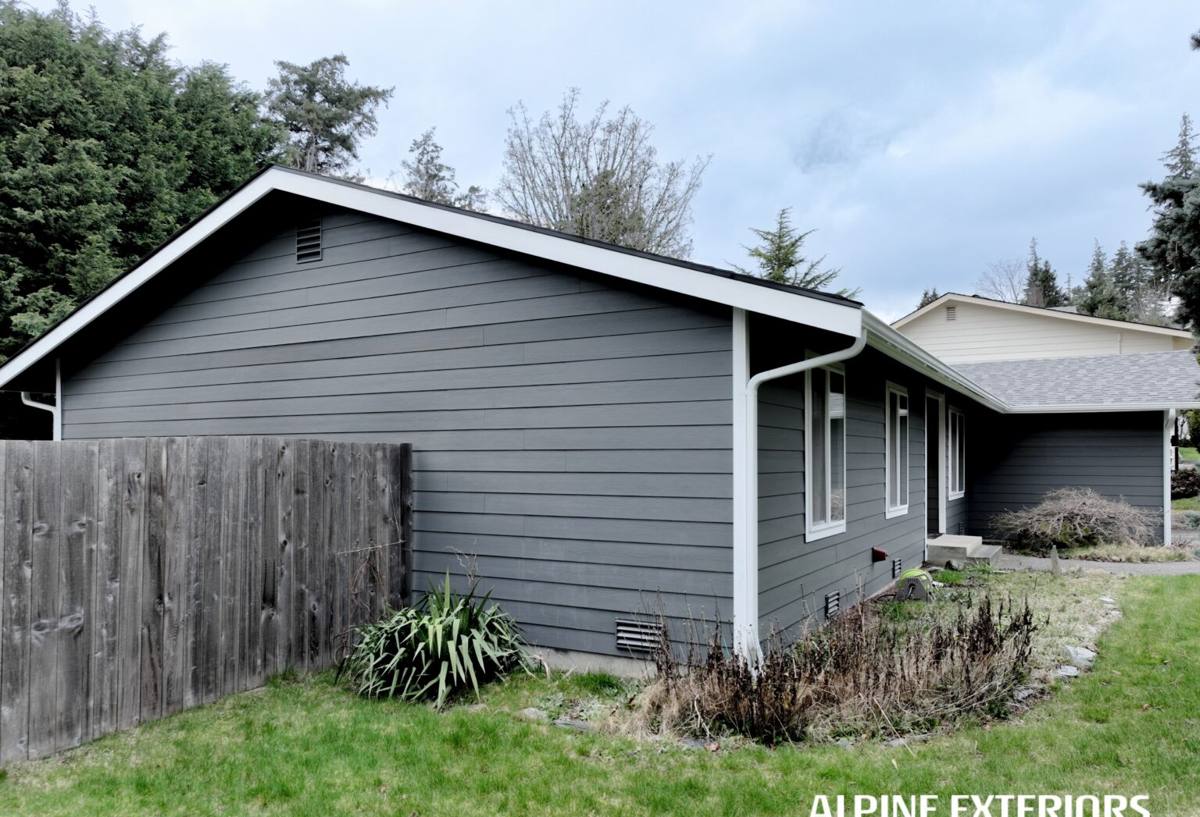
We install James Hardie fiber cement exclusively, and Bow's climate is a good example of why. Fiber cement doesn't rot, it doesn't swell when it takes on moisture the way wood-based products can, and it's non-combustible. For a coastal, wet, moss-prone location, those aren't marketing points — they're the actual list of things that go wrong with lesser materials here.
Engineered for Wetter Climates
James Hardie makes region-specific product lines for exactly this reason. Their HZ10 formulation is engineered for wetter, harsher climates, while HZ5 is built for hotter, drier regions. A siding contractor who doesn't specify the right HZ line for a marine environment like Bow is already starting the job with the wrong product, no matter how well it's installed afterward.
A Factory Finish That Doesn't Rely on Field Painting
Hardie's ColorPlus finish is baked on at the factory under controlled conditions, not brushed or sprayed on-site after installation. In a salt-air environment, a factory-cured finish holds its color and resists fading and chalking far better than a field-applied coat that's fighting damp air and marine salt from day one. That's a meaningful difference for anyone who doesn't want to repaint their house every few years.
What a Correct Installation Actually Involves
Fiber cement siding is only as good as the install underneath it. Most of the failures we get called out to look at aren't material failures — they're installation shortcuts that don't show up as a problem until a few winters of driving rain have found every gap.
Clearances, Flashing, and Drainage
Hardie's install specs call for specific clearances above roof lines, decks, and grade, along with proper flashing at every window, door, and penetration. Skipping these details doesn't usually cause a visible problem on day one — it shows up two or three years later as staining, soft trim, or moisture behind the wall, by which point the fix is a lot more expensive than doing it right the first time.
Fastening and Joint Treatment
Butt joints, corners, and fastener patterns all have to follow the manufacturer's specification to keep the wall watertight and to keep the warranty valid. In a high-exposure location like Bow, we use fasteners and flashing details rated for coastal, high-moisture conditions rather than whatever happens to be cheapest on a given day.
| Installation Detail | Why It Matters in Bow |
|---|---|
| Correct HZ product line (HZ10 vs HZ5) | HZ10 is engineered for wetter, harsher climates like this one; the wrong line ages faster in salt air and rain |
| Proper clearances at grade, roofline, and decks | Prevents the trapped moisture that leads to rot at the framing behind the siding |
| Corrosion-resistant fasteners and flashing | Salt air accelerates corrosion of mismatched or lower-grade hardware |
| Sealed, correctly lapped butt joints | Wind-driven rain finds any gap left by rushed joint work |
| Factory-applied ColorPlus finish | Holds color and resists chalking better than a field-painted finish in salt air |
Our Process for a Bow Siding Project
- On-site assessment — we look at exposure, existing damage, moss patterns, and what's happening behind the current siding, not just its surface condition.
- Tear-off and sheathing check — once the old siding is off, we inspect the sheathing and framing underneath for moisture damage before anything new goes up.
- Weather barrier and flashing — a correctly lapped water-resistive barrier and flashing at every penetration, sized for this area's rain exposure.
- Installation to Hardie's specification — correct HZ product line, clearances, fastening pattern, and joint treatment throughout.
- Trim, caulking, and detail work — the finish details that determine how the house actually performs in wind-driven rain.
- Final walkthrough — we go over the finished job with the homeowner before we consider it done.
Cost Factors for a Bow Siding Project
Every home is different, so we don't publish blanket per-square-foot numbers, but the same handful of factors drive most bids in this area.
| Factor | Why It Affects the Bid |
|---|---|
| Existing siding removal | Multiple layers or damaged sheathing underneath add labor and repair time |
| Home size and wall complexity | Dormers, gables, and multiple stories increase both material and labor |
| Trim and flashing detail | Homes with more windows, doors, and roof intersections need more flashing work |
| Product line and profile | HZ10 vs HZ5, plank width, and panel vs. lap siding all affect material cost |
| Color and finish selection | Standard ColorPlus colors vs. custom finish options price differently |
| Site access | Tree cover, slope, and staging space affect how quickly a crew can work |
Signs Your Current Siding Is Losing the Fight
If you're not sure whether it's time to look at replacement, these are the signs we see most often on homes in this climate:
- Persistent moss or algae growth that comes back within weeks of cleaning
- Soft or spongy spots, especially near the bottom courses or around windows
- Paint that's peeling, bubbling, or chalking faster than it should
- Visible gaps or separation at butt joints and corners
- Staining below window sills or trim that suggests water is tracking behind the siding
- Warping, cupping, or swelling in wood-based or engineered wood siding
Why It Matters to Hire a Crew That Already Works This Area
A contractor who mainly works drier, inland communities can still do competent carpentry and still get a Bow project wrong, simply because the exposure conditions are different from what they're used to. Wind direction relative to the water, how long a wall stays wet after a storm, and which sides of a house grow moss fastest are all things a crew learns by working this specific stretch of Whatcom County repeatedly, not by reading a spec sheet. That local pattern recognition shows up in small decisions — where extra flashing goes, which fastener spacing to tighten up, which walls need a closer look during tear-off — that add up to a siding job that actually performs here.
Maintaining Hardie Siding in a Salt Air, High-Moss Environment
Correctly installed James Hardie siding is genuinely low-maintenance, but "low-maintenance" doesn't mean "no maintenance" in this climate. A yearly rinse-down knocks back salt residue and early moss growth before it gets established. Keeping gutters clear prevents overflow from running down the face of the siding and staining the finish. Trimming back tree limbs that shade a wall for most of the day cuts down on the moisture that moss needs to take hold in the first place. None of this is heavy work, but skipping it is how a well-installed siding job starts looking neglected years before it actually needs to be replaced.
If your siding in Bow is showing wear, or you're planning ahead for a replacement, we're happy to take a look and walk you through what your home actually needs — no pressure, no obligation. Reach out using the form below for a free estimate.