 Fairhaven Siding
 Board & Batten Siding Built for Sudden Valley's Weather, Not Just Its Look
Board and batten is one of the most recognizable siding profiles in Whatcom County — tall vertical panels with narrow strips (battens) covering the seams, giving a home a clean, linear, farmhouse-to-modern look depending on trim and color choice. It's a popular choice on Sudden Valley homes with cabin-style rooflines, gable ends, and mixed-material exteriors where a vertical accent panel sets off stone, board siding, or a different horizontal profile elsewhere on the house.
But board and batten lives or dies on how the water is managed behind those battens. Done right, it's one of the most durable-looking profiles available. Done wrong — batten spacing too tight, no drainage path, caulk doing the work fasteners should be doing — it's one of the fastest profiles to show rot, streaking, and paint failure in a wet marine climate. That's the whole story on this page: what this profile needs from an installer working near Bellingham Bay, and why we only run it in James Hardie fiber cement.
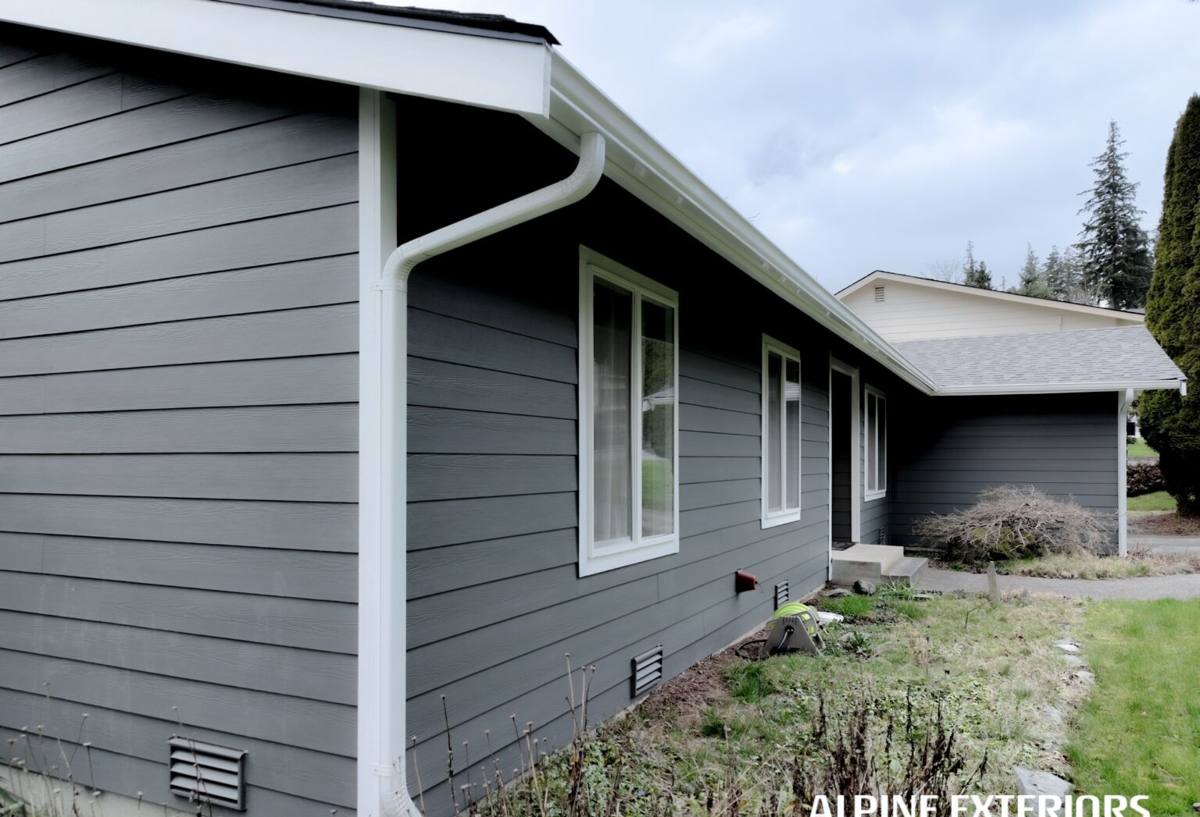
What Sudden Valley's Climate Actually Does to Vertical Siding
Homes in and around Fairhaven and the greater Bellingham Bay area deal with a specific combination of stressors that board and batten siding feels more than most profiles do:
- Salt air off the bay accelerates corrosion on exposed fasteners and metal flashing, and it works into any exposed wood grain over time.
- Driving rain off Pacific storm systems hits gable ends and upper stories at an angle, forcing water sideways into seams and batten joints instead of just running straight down.
- A long moss season — Whatcom County stays damp and shaded for much of the year, which means anything that holds moisture at a seam or fastener line becomes a moss and algae anchor point, and moss holds water against the substrate far longer than bare siding would.
Vertical board and batten has more linear seams per square foot than lap siding, and every one of those seams is a place water can either be shed or trapped. That's why the installation details matter more here than the material choice alone — though the material choice still matters a great deal, which is the next section.
Why We Only Install James Hardie for This Profile
Board and batten can be built from primed wood, engineered wood (LP SmartSide), vinyl panel systems, or fiber cement. We don't install the first three, and it's worth being direct about why, specifically for this profile in this climate.
Primed wood and engineered wood board and batten both rely on an intact paint film and factory seal to keep moisture out of the substrate. In a climate with this much sustained dampness and moss growth, any nick, fastener pop, or seam gap becomes an entry point, and wood-based substrates swell, and in bad cases rot, once water gets behind them. Vinyl board and batten sheds water fine but flexes with temperature swings, which opens gaps at battens over time, and it can't be repainted if a homeowner wants to change the look down the road.
James Hardie's fiber cement is cement, sand, and cellulose fiber — it doesn't absorb and swell the way wood does, and it doesn't expand and contract the way vinyl does. It's also non-combustible, which matters for insurance and wildfire-adjacent building codes even in a wet region. We install Hardie's HZ10 climate-engineered product line, formulated for cold, wet regions like Western Washington, with a factory-applied ColorPlus finish that's baked on rather than field-painted, and backed by a transferable limited warranty. That combination — inert material, factory finish, climate-specific engineering — is why this is the only system we put on a Sudden Valley board and batten job.
What a Correct Board & Batten Installation Involves
The visual result of board and batten is simple. The water management behind it is not. A correct install includes:
Drainage plane and rainscreen gap
Vertical panels get a weather-resistant barrier and, on most Sudden Valley homes, a furring strip or drainage wrap that creates a gap between the panel back and the sheathing. That gap lets any water that gets past the panel face drain and evaporate instead of sitting against the wall.
Flashing at every horizontal transition
Window heads, door heads, roof-to-wall intersections, and the base of the wall all need proper flashing details so driving rain hitting the panel face at an angle has somewhere to go besides sideways into a seam.
Batten spacing and fastening
Battens need consistent spacing and fastener placement that lands in solid substrate, not just through the panel into open seam. Over-driven or under-driven fasteners are one of the most common board and batten failure points we see on inspection.
Joint treatment, not just caulk
Caulk is a supplement to good flashing and lap details, not a substitute for them. A joint that only holds together because of a bead of sealant is a joint that will fail the year that sealant gives out.
How We Run a Sudden Valley Project
Every home is a little different, but the sequence stays consistent:
- On-site assessment — we look at existing siding condition, wall orientation relative to prevailing wind and rain, current moss and moisture staining, and trim details before quoting anything.
- Substrate check — old siding comes off and we inspect sheathing for hidden rot or moisture damage before anything new goes up, since covering a problem is worse than finding one.
- Drainage plane and flashing install — this is the part that never shows in the finished photo but determines whether the job lasts.
- Panel and batten install — HZ10 panels and battens fastened to manufacturer spec, with attention to fastener lines and joint backing.
- Trim, caulk, and final inspection — sealant used correctly as a supplement, not a crutch, followed by a walk-through with the homeowner.
Board & Batten Compared to Other Options for This Area
| Factor | Wood Board & Batten | Vinyl Board & Batten Panel | James Hardie Fiber Cement |
|---|---|---|---|
| Moisture/rot resistance | Depends entirely on paint film staying intact | Won't rot, but traps moisture behind if not vented | Inert cement substrate, engineered for wet climates |
| Salt air / corrosion behavior | Fasteners and grain vulnerable over time | Panel itself holds up; seams can loosen | Factory finish resists fading and chalking near the coast |
| Moss/algae exposure | Textured grain holds moisture, needs regular cleaning | Smooth surface but seams collect debris | Dense, factory-finished surface, easier to keep clean |
| Repainting down the road | Required maintenance, every several years | Not paintable without prep and adhesion risk | ColorPlus lasts years before repaint is needed; can be repainted if desired |
| Fire classification | Combustible | Combustible | Non-combustible |
Maintaining Board & Batten in a Marine, Moss-Prone Climate
No siding is maintenance-free, but the maintenance burden changes a lot by material. For a Hardie board and batten install in this area, a homeowner should plan on:
- Rinsing the exterior once or twice a year, focusing on shaded, north-facing walls where moss establishes fastest
- Checking gutters and downspouts stay clear so roof runoff isn't sheeting directly down a batten line
- Visually inspecting caulk lines at trim and penetrations annually, since sealant is a supplement, not the primary water barrier
- Trimming back vegetation and landscaping that keeps a wall section shaded and damp longer than the rest of the house
- Watching for any soft spots, staining, or fastener pops after major storm seasons and addressing them early
That's a modest list compared to what a wood board and batten system demands, but it's not zero — no exterior surface on Bellingham Bay gets to skip maintenance entirely.
Why It Matters That We Already Work This Area
Sudden Valley's homes sit close enough to the water that wind direction, rain angle, and shade patterns genuinely differ block to block, and a crew that's done board and batten work throughout Whatcom County brings that judgment to the flashing and drainage decisions that don't show up in a generic spec sheet. We install one siding system, which means we're not choosing a product to fit a budget — we're applying the same climate-engineered Hardie system and installation standard on every project, and adjusting the details to the specific house and site in front of us.
If you're considering board and batten siding for a home in Sudden Valley, we're happy to take a look, walk the exterior with you, and put together a straightforward, no-pressure estimate — just use the form below to get started.