 Fairhaven Siding
 Building Decks for Sunnyland's Conditions
Sunnyland sits close enough to Bellingham Bay and the water that its air carries a fair amount of salt, especially on windy days. Combine that with Whatcom County's long wet season, driving rain off the Sound, and shade from mature trees on many lots, and you get a set of conditions that are genuinely tougher on an outdoor deck than what you'd find in a drier inland climate. A deck built here doesn't fail because the homeowner did anything wrong — it fails because it was built to a generic standard instead of one that accounts for salt exposure, standing moisture, and moss.
We've built and repaired decks throughout the Fairhaven area, including Sunnyland, long enough to know which shortcuts show up as problems in year three instead of year one. This page walks through what actually matters for a deck in this specific neighborhood — not generic deck-building advice, but the parts of the job that change because of where Sunnyland sits.
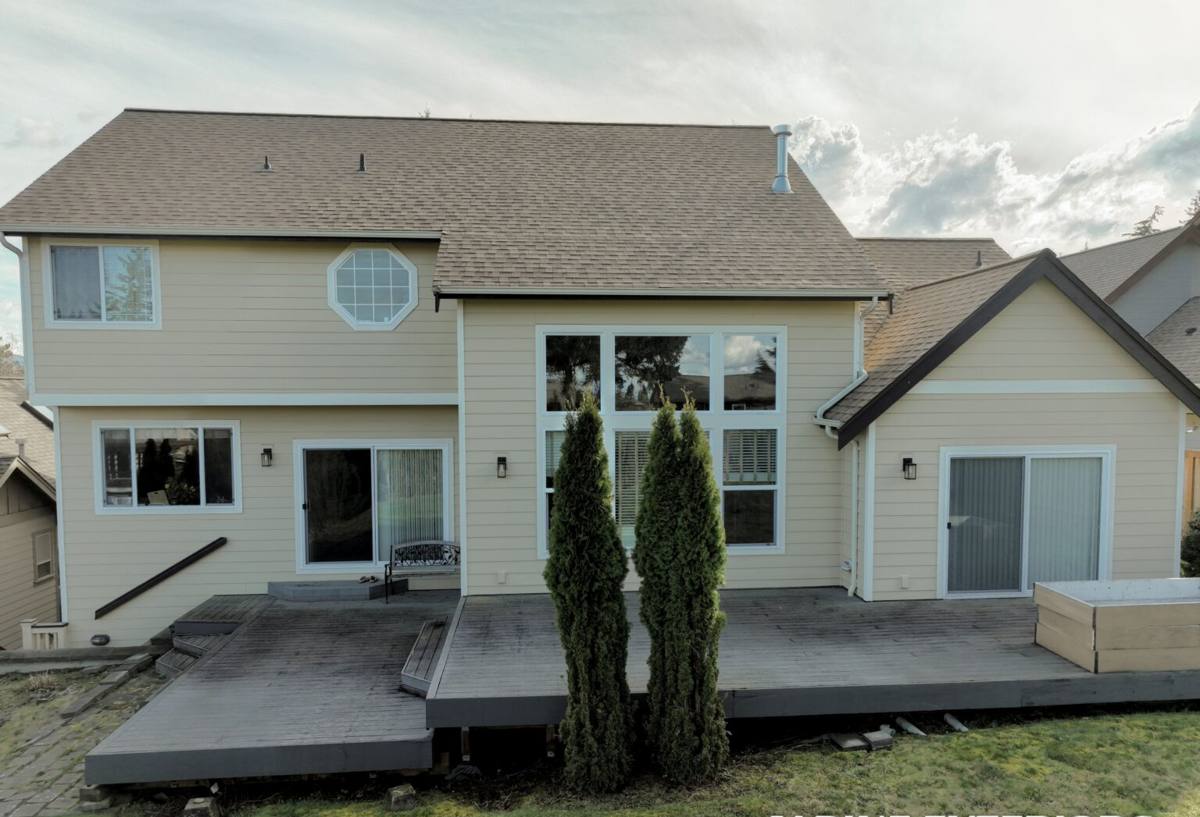
What Sunnyland Lots Tend to Demand From a Deck
No two lots are identical, but a few patterns show up often enough in this part of Fairhaven that we plan for them by default rather than treating them as surprises.
Tree Cover and Shade
Many Sunnyland properties have mature conifers or deciduous trees nearby. Shade keeps a deck cooler in summer, but it also means the surface dries slower after rain. Slower drying is the single biggest driver of moss, algae, and eventual rot, so a shaded deck needs a decking material and a drainage plan that account for extended dampness — not just a material that looks good on day one.
Slope and Drainage
A lot of homes in this area sit on lots with some grade to them. If a deck's footings and framing don't account for how water actually moves across that slope, water gets trapped under or behind the deck instead of running off, and that's where rot starts — quietly, underneath, where nobody looks until there's a soft spot.
Proximity to the Water
Salt-laden air corrodes untreated or poorly coated metal fasteners and hardware faster than most homeowners expect. It's not dramatic — it's a slow surface corrosion that weakens a joist hanger or a ledger bolt over several seasons, long after the deck still looks fine from the top.
Getting the Structure Right
The part of a deck that determines whether it lasts 10 years or 30 isn't the decking boards on top — it's everything underneath that you stop seeing once the job is done.
Footings
Footings need to sit below frost depth and bear on undisturbed, stable soil. On a sloped or previously landscaped lot, that sometimes means digging deeper or repositioning a footing than the original layout assumed. We check soil conditions on site rather than assuming a standard footing depth will work everywhere in Sunnyland — lots here vary more than people expect.
Ledger Board Flashing
If a deck attaches to the house, the ledger board connection is the single most common source of hidden water damage in this climate. Rain has to be directed away from the house framing behind the ledger, not just sealed with caulk, which degrades and fails silently. Proper flashing — installed in the correct layered order so water sheds outward and downward — is non-negotiable on any deck we attach to a structure, because a failed ledger connection can mean rot inside the wall, not just under the deck.
Framing and Fasteners
Given the salt exposure common in this area, we default to stainless steel or heavy-duty coated fasteners and connectors rated for coastal or treated-lumber contact, rather than the cheaper standard hardware that's fine further inland. It costs a bit more up front. It's a lot cheaper than replacing corroded hardware — or the framing it was holding together — in eight years.
Choosing a Decking Material
There's no single "best" decking material — there's the right material for how a specific deck will be used, how much sun or shade it gets, and how much upkeep the homeowner actually wants to do. Here's how the common options compare for a shaded, damp, salt-air environment like Sunnyland.
| Material | How It Handles This Climate | Maintenance | Typical Lifespan |
|---|---|---|---|
| Pressure-treated lumber | Good rot resistance when properly sealed; needs re-sealing to shed moisture and resist moss | Annual cleaning and re-staining/sealing | 15–20 years with upkeep |
| Cedar | Naturally moisture- and insect-resistant, but greys and can absorb moisture in shaded, damp spots without regular sealing | Periodic cleaning, re-oiling or sealing every 1–2 years | 15–25 years with upkeep |
| Capped composite | Handles moisture and shade very well; the cap resists staining and moss gets a much harder surface to grip | Occasional washing, no sealing or staining | 25–30+ years |
| Uncapped composite | More moisture-resistant than wood but the exposed surface can still stain and grow algae in constant shade | Regular cleaning to prevent surface buildup | 20–25 years |
For a fully shaded, damp Sunnyland lot, we lean toward recommending capped composite or a well-sealed cedar, depending on the homeowner's budget and how much maintenance they want to take on. For a sunnier, more open lot, pressure-treated or standard composite can perform just as well for less money. We'll walk through the honest trade-offs for your specific site rather than pushing one product line.
Our Deck-Building Process
- Site walk and design. We look at drainage, sun/shade exposure, tree cover, and how the deck ties into the house before recommending a layout or material.
- Permitting. We handle the permit application and coordinate any required inspections so the deck is built to current code, not just to what's convenient.
- Footings and framing. Footings are set to proper depth and bearing; framing uses hardware rated for this climate's moisture and salt exposure.
- Ledger and flashing (if attached to the house). This step gets done in the correct order, every time — it's the step that protects your home, not just the deck.
- Decking installation. Boards are laid with correct spacing for drainage and material expansion, and fastened per manufacturer specification when composite is used.
- Railing, stairs, and finish work. Guardrails and stair railings are built to current code height and baluster spacing requirements.
- Final walkthrough. We go over the finished deck with you, including what maintenance it needs and when.
Permits, Code, and Safety
Most decks attached to a house, and most decks built above a certain height off the ground, require a building permit and inspection in Whatcom County. Requirements can include guardrails at a minimum height once a deck is elevated past a certain point, baluster spacing that prevents a small child from passing through, and proper attachment of any stairs. These aren't paperwork formalities — they're the difference between a deck that's actually safe to stand on for decades and one that looks fine but wasn't built to hold up under real load, foot traffic, and time. We pull the required permits and build to code as a matter of course, not as an upsell.
Maintaining a Deck Through Whatcom County's Moss Season
Every deck in this climate needs some seasonal attention — the question is how much, and that depends heavily on the material and how shaded the site is. A simple annual routine keeps most problems from ever starting.
- Sweep leaves, needles, and debris off the deck regularly through fall — trapped organic matter holds moisture and feeds moss growth.
- Clean the deck surface at least once a year with a deck-safe cleaner to remove algae and moss before it gets established.
- Check and clear gaps between boards so water can drain through rather than pooling on the surface.
- Inspect the ledger board area and any flashing yearly for signs of water staining or gaps in sealant.
- Re-seal or re-stain wood decking on the manufacturer's or installer's recommended schedule — don't wait until it looks obviously weathered.
- Check fasteners and hardware periodically for corrosion, especially on decks closer to the water.
Why a Crew That Already Works This Neighborhood Matters
A lot of deck problems we get called to repair weren't built by lazy or dishonest contractors — they were built by capable crews who simply didn't build decks in this specific climate very often, so they used footing depths, fastener grades, or flashing details that are perfectly normal somewhere drier and got away with it for a few years before the moisture caught up. Working regularly in Fairhaven and neighborhoods like Sunnyland means we're not guessing at how this soil, this rainfall pattern, and this salt exposure behave over time — we've already seen how decks built different ways hold up here, and we build accordingly from the start.
If you're planning a new deck or replacing one that's showing its age, we're happy to take a look at your site, talk through material and layout options honestly, and give you a straightforward, no-pressure estimate using the form below.